
Aussiedoodles: Not From Australia
Aussiedoodles combine two intensely intelligent working breeds.


3 common Aussiedoodle behaviour problems (and how to fix them)
Remember: Your Aussiedoodle carries the genes of Australian Shepherds bred to control stubborn cattle through intense focus and nipping. A dog that stalks your children is running centuries-old herding genetics, not acting aggressively.
Where Aussiedoodles come from
Aussiedoodles were created in the 1990s-2000s attempting to combine Australian Shepherd working drive and trainability with Poodle intelligence and a theoretically low-shedding coat. F1 crosses are most common, meaning massive variation in temperament, coat, and size within single litters.
A first generation cross is a genetic lottery rather than a standardised breed, so a puppy can land anywhere between its Australian Shepherd parent and its Poodle parent, and the breeder genuinely cannot tell you where. Read both parents when you go and see a litter, and take the two dogs in front of you as your guide rather than the cross name.
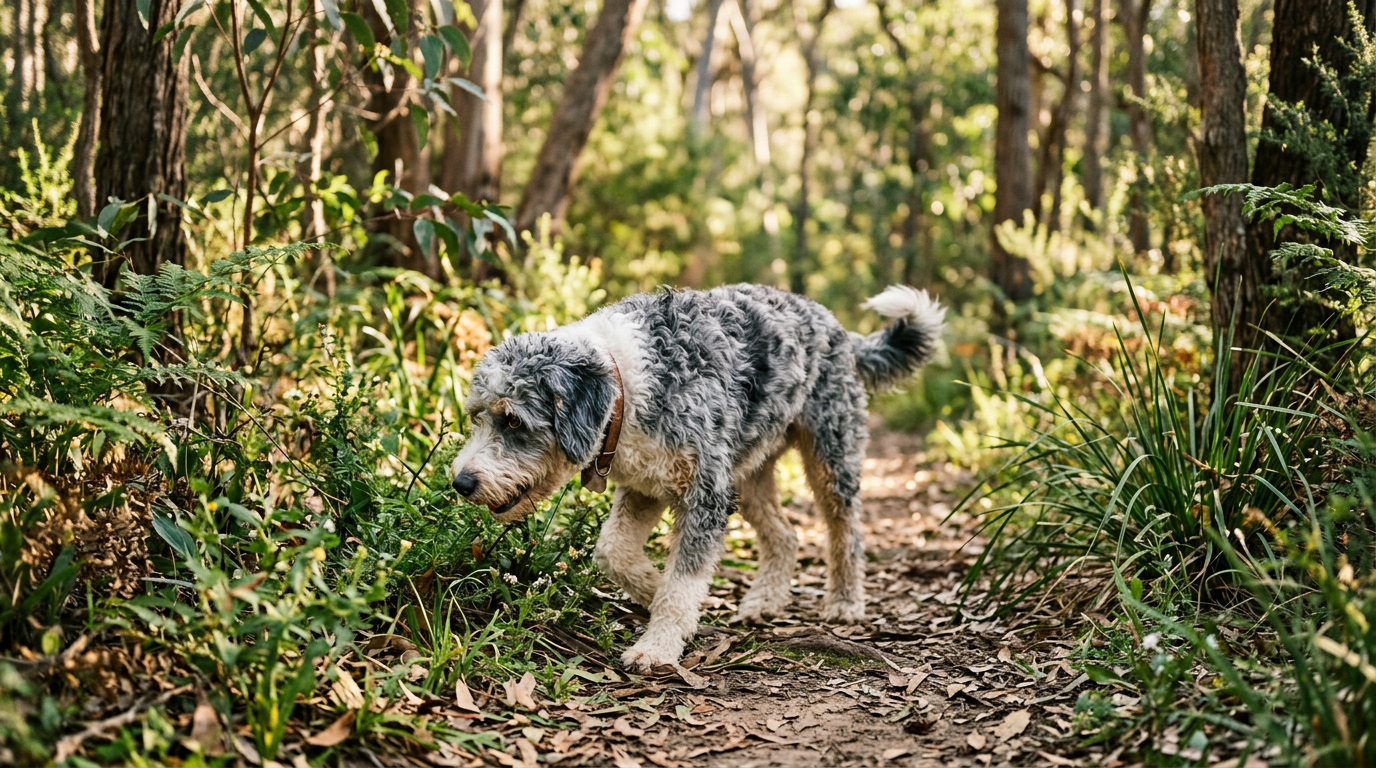
What were they bred to do?
- No working purpose, created purely for the pet market
- Australian Shepherds were bred for intense herding work, controlling livestock through nipping, stalking, and constant movement
- Poodles were bred as intelligent retrievers requiring handler focus
- Crossing these creates working breeds without work
Key breeding traits: Aussiedoodles carry high energy levels needing 2-3+ hours daily of structured exercise and mental work. They carry intense herding drive, including stalking, nipping, and reactivity to movement. When under-stimulated, they develop neurotic behaviours. Australian Shepherd aloofness with strangers combined with Poodle sensitivity creates potentially reactive dogs requiring extensive socialisation.
Why Aussiedoodles develop these behaviour problems
Your Aussiedoodle was bred from two high-drive working breeds. Crossing these creates dogs with potentially extreme working drive without appropriate outlets. The intelligence that's marketed as a benefit becomes a curse. These dogs need structured jobs daily or they create their own, usually through destructive and neurotic behaviours.
Problem 1: herding behaviours and nipping
What's happening
Your Aussiedoodle stalks children with intense staring, crouching, and following. They nip at heels, ankles, and hands. This is inherited herding behaviour, not aggression.
Why it happens
Australian Shepherds were bred for intense, close-contact herding requiring nipping at heels to move stubborn cattle. This is deeply genetic and emerges in crosses even in pet contexts.
The fix
- Accept you will likely never remove this behaviour, only manage it
- Make sure small children don't trigger your dog by running and screaming near them
- Use a long line to practise extensive recall training
- The moment nipping happens, whoever they nipped leaves immediately, every time
- Take them calmly by the collar and place them in a separate room for 5 to 10 minutes, every time
- Never chase them. Chasing turns it into a game
Struggling with herding and nipping? Our Skool community runs herding management protocols and video demonstrations of redirection techniques for working breeds.
Problem 2: reactivity and barrier frustration
What's happening
Your Aussiedoodle barks frantically at windows, fences, and doors, and lunges at other dogs on walks.
Why it happens
Australian Shepherds are naturally suspicious of strangers and new stimuli, and some become territorial. Barrier frustration adds to this: they see a trigger but can't reach it, and the frustration builds the longer it goes on.
The fix
- Focus on stacking as many calm wins in a row as you can
- If you need to stay 50m from another dog at first, that's fine
- If your dog tenses up, stop, kneel down, and take them by the collar
- Turn your back to the other dog if it's safe to do so, and wait for a shake-off or a big yawn, both signs they're settling
- If they lunge or react, turn and walk away calmly. No punishment
- Shorten the distance gradually, over weeks, not days
If the reactivity isn't shifting with distance work alone, a 1:1 adult dog training session gets a trainer working the exact trigger with you, in person.
Problem 3: separation anxiety
What's happening
Your Aussiedoodle panics when left alone. That can mean destruction, constant barking, or refusing to settle.
Why it happens
Australian Shepherds are bred to stay hyper-aware of their environment, and Poodles are similarly sensitive and prone to anxiety. Put the two together and you get double the anxiety genetics.
The fix
- Practise mini-departures through the day, starting at 20 seconds
- Come back without greeting, eye contact, or touch, and wait 5 full minutes until they're completely calm
- Never make departures dramatic. Do the leaving actions at random times through the day so the cues stop meaning anything
- Run 20 to 30 mini-departures over a weekend, each one short
- When you get home and they're excited, freeze completely until they settle
Exhausted by your Aussiedoodle's anxiety? Our Skool community runs step-by-step separation protocols built for anxious working breeds.
Get the full support system for your Aussiedoodle
That's why we built our free Skool community: ongoing support at every stage.
Inside the community, you'll get:
- Weekly live Q&A sessions where you can ask about YOUR specific Aussiedoodle
- Full breed-specific courses covering everything from puppy raising to advanced behaviour work
- A community of other Aussiedoodle owners going through the same thing
- Video demonstrations so you can see the techniques in action
- Troubleshooting help when something isn't working
Join The Toe Beans Co Skool community today, or book a free meet and greet if you'd rather start with a trainer in person.
