
Bernedoodle: Swiss Mountain Heritage Meets Poodle Intelligence
3 Common Bernedoodle Behaviour Problems (And How To Fix Them)

3 common Bernedoodle behaviour problems (and how to fix them)
Well-bred Bernedoodles from health-tested parents, placed with experienced large-breed owners, can be wonderful dogs. The challenge is most aren't well-bred, and most are placed with families who weren't ready for the reality of an active, complicated, 40kg+ dog.
Where do Bernedoodles come from?
Bernedoodles emerged in the early 2000s, when breeders started crossing Bernese Mountain Dogs with Poodles to try to build a healthier version of the Bernese. Bernese Mountain Dogs have short lifespans, often just 6 to 8 years, and the cross was meant to bring hybrid vigour and a longer life alongside the breed's steadiness.
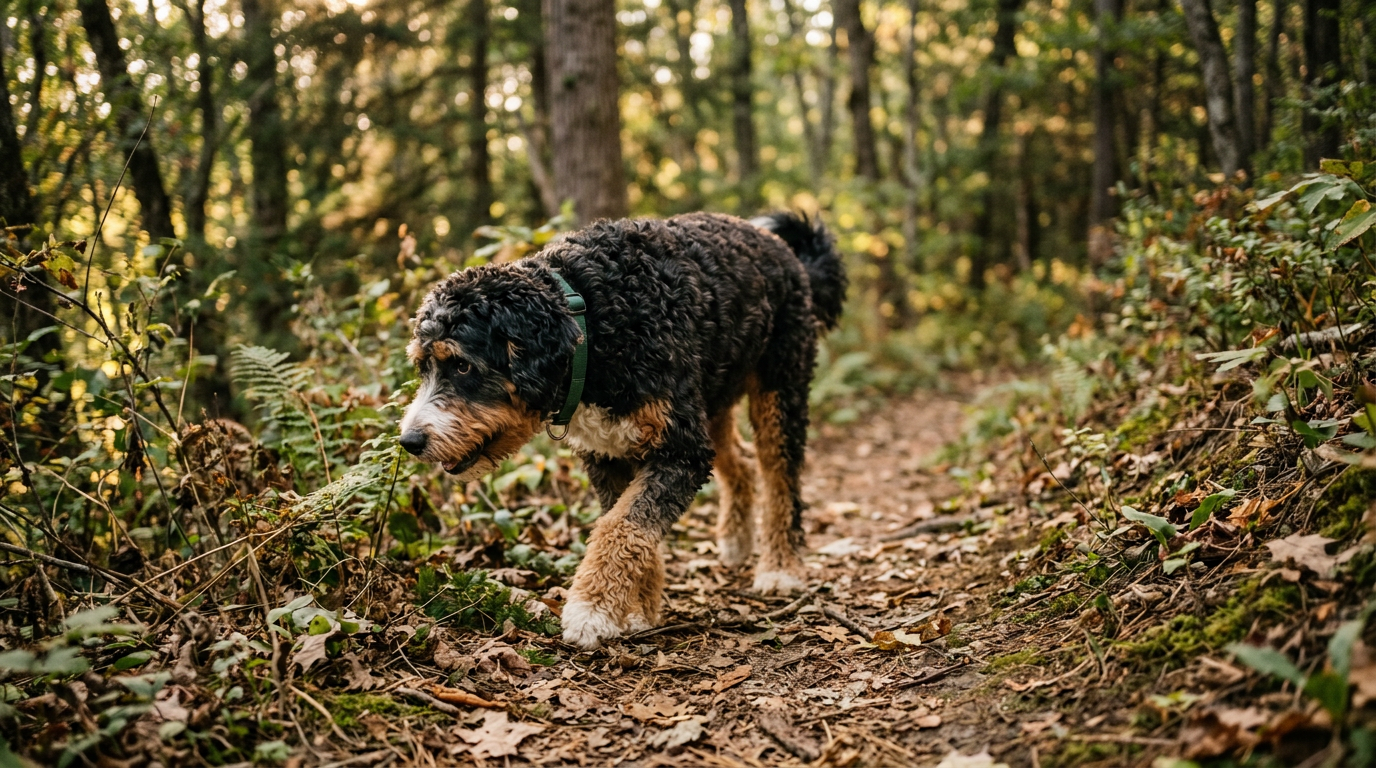
There was no working purpose behind the cross. It combines Bernese steadiness with Poodle intelligence, with the hope of a longer lifespan than a purebred Bernese. Large size is typical, even Minis often exceed 20kg, and the coat is more complex than the marketing suggests. Wavy to curly coats mat easily, and health concerns from both breeds carry through, including hip and elbow dysplasia, cancer risk, bloat, and degenerative myelopathy.
Worth being straight about what a first generation cross actually is. It's a genetic lottery rather than a standardised breed, so an F1 Bernedoodle can land anywhere between its Bernese parent and its Poodle parent on coat, size and temperament, and the breeder genuinely cannot tell you where. Meet both parents before you commit, and read those two dogs rather than the cross name or the way the litter is advertised.
Why do Bernedoodles have these behaviour problems?
Mixing Bernese and Poodle creates a real temperament gamble. Some Bernedoodles land calm and steady like a Bernese. Others come out high-energy like a Poodle. Plenty are an anxious mix of both. Whichever way it goes, you're raising a dog that can reach 50kg+, and that size alone demands more space, more exercise, more training, and more money than most owners plan for.
Problem 1: size-related behaviour management
Normal puppy behaviours like jumping, pulling on the leash, play biting, and counter surfing stop being cute and start being dangerous once your Bernedoodle is 40kg+. It usually happens because training gets put off. Owners think they have time, then find themselves with a six-month-old adolescent who's already 50 pounds and has been practising the same problem behaviours for months.
Train from 8 weeks, before size becomes the issue, because every behaviour you allow as a puppy becomes an adult habit. Make jumping a non-starter from day one: everyone turns away and ignores until four paws are back on the floor. Practise loose leash walking from the first walk, not once pulling has already become a habit. No furniture until invited, and that's about preventing a habit that's hard to reverse once a 40kg dog decides the couch is theirs, not about who's in charge. Get in as many positive experiences as you can before the socialisation window closes at 6 months, to head off territorial or fearful behaviour later. And go easy on the exercise: avoid running and jumping until growth plates close at 18 to 24 months in a giant breed like this.
Most of what goes wrong here is exactly what we cover in the puppy mistakes that turn into adult-size problems. It's rarely one big error. It's a handful of small ones left unaddressed for months.
Problem 2: separation anxiety
Your Bernedoodle follows you from room to room, panics the moment you leave, and gets destructive or vocal when they're on their own.
Bernese Mountain Dogs were bred to work alongside farmers all day, and Poodles are just as handler-focused, so you're combining two breeds that were never built to be left. Constant companionship through puppyhood, however well-meaning, often builds the anxiety in without anyone noticing.
Start with mini-departures throughout the day, as short as 20 seconds to begin with. When you come back, skip the greeting entirely, no eye contact, no touching, for a full 5 minutes until your dog is genuinely settled. Don't let departures become a big event: pick up your keys and put your shoes on at random points during the day that have nothing to do with leaving, so those cues stop meaning anything. On weekends, run 20 to 30 of these mini-departures, even if it's just to the car and back. If your dog is excited when you walk back in, freeze completely, no movement, no talking, until they settle on their own.
Problem 3: excessive greeting
Your Bernedoodle jumps up on people, tries to cuddle on their back legs, and knocks over children and guests in the process.
Like Boxers, Newfoundlands, and Golden Retrievers, greeting on the back legs is common in the breed. At this size, it's a genuinely dangerous habit rather than just an annoying one.
Set one rule from day one: affection only happens when your dog is lying down and calm. The moment they jump up, turn your back and fold your arms without a word. If jumping continues after a couple of attempts, a calm few minutes in another room resets things without any drama. When visitors arrive, take your dog to another room for at least 5 minutes and only bring them out once guests are seated and the initial excitement has died down. Teach your dog that the door opening is a non-event by training a sit before you open it.
Get the full support system for your Bernedoodle
We built a free Skool community for exactly this reason, so Bernedoodle owners get support that doesn't stop after one session.
Inside, you'll find weekly live Q&A sessions where you can ask about your specific dog, full breed-specific courses covering everything from puppy raising through to behaviour modification, a community of other Bernedoodle owners, video demonstrations of the techniques above, and troubleshooting help when something isn't going to plan.
If you'd rather start with a real conversation, book a meet and greet and we'll talk through what your Bernedoodle actually needs, or join the free Skool community and start there.
