King Charles Spaniel: it's not a Cavalier
Search "King Charles Spaniel training" and almost everything that comes back is about the Cavalier King Charles Spaniel, a different breed that didn't exist until the 1920s. If you've got a genuine King Charles Spaniel, also registered in the US as the English Toy Spaniel, the flat face, the breathing, and the need to stay near you come from an older, different set of genetics.
Where the King Charles Spaniel comes from
The King Charles Spaniel is the older of the two breeds. It dates back to 16th century England, and King Charles II was so attached to his that he reportedly issued a decree letting them into any public building, including Parliament. For centuries the breed stayed close to the royal court as a comforter spaniel, carried on laps and inside coats for warmth before anyone had central heating.
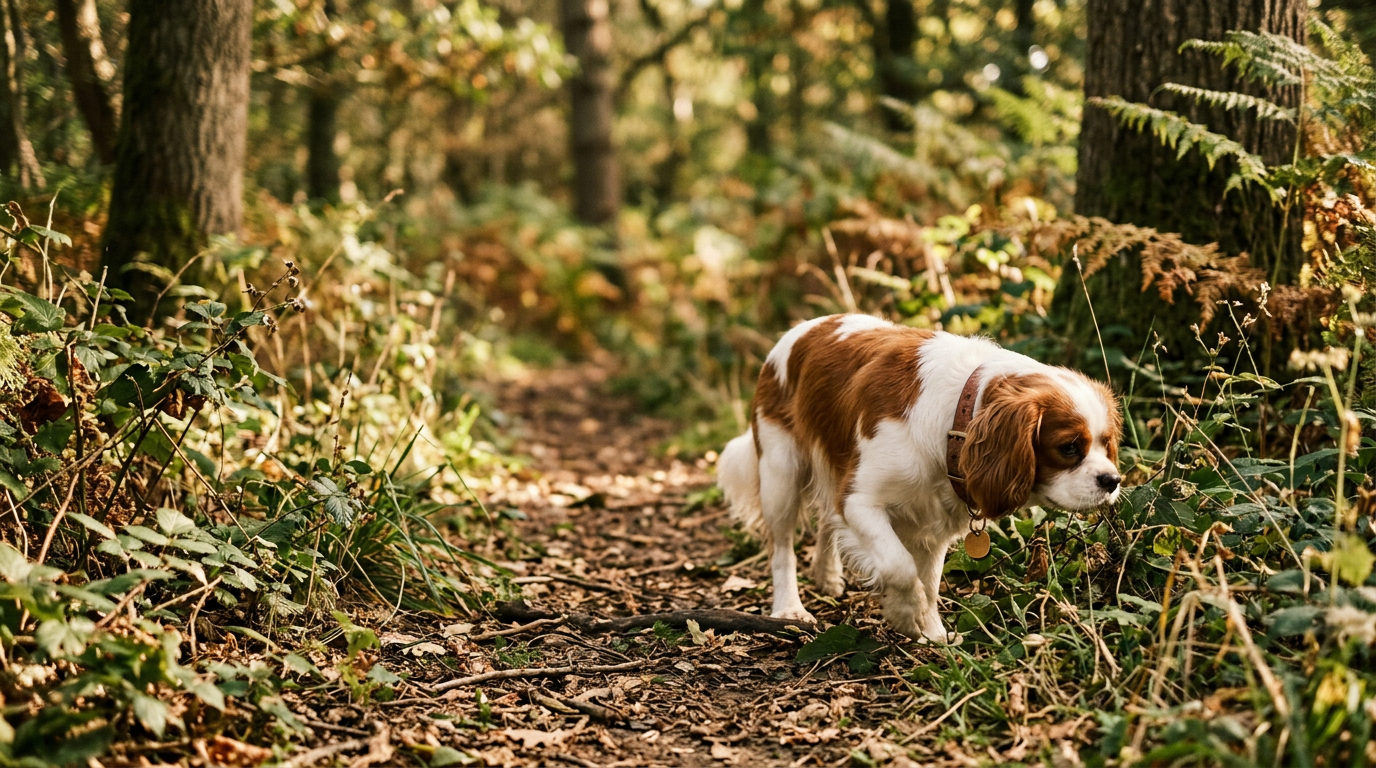
Victorian breeders then pushed the look further, favouring a shorter muzzle and a rounder, domed skull. That's the King Charles Spaniel you see today, small and flat-faced. The American Kennel Club recognised it, under the name English Toy Spaniel, in 1886.
The Cavalier came along much later. In the 1920s, a breeder named Roswell Eldridge offered a cash prize to anyone who could produce a spaniel matching the longer-nosed dogs painted alongside Charles II centuries earlier. That project became the Cavalier King Charles Spaniel, and it wasn't recognised by the UK Kennel Club until 1945 or the AKC until 1996. If that's the dog you're actually raising, our Cavalier King Charles Spaniel breakdown is the one you want.
What separates the two breeds
Side by side, the differences start with the skeleton, not the personality.
- Skull: domed and rounded on the King Charles Spaniel, flatter on the Cavalier
- Muzzle: noticeably shorter on the King Charles Spaniel
- Size: around 4 to 6kg on the King Charles Spaniel, closer to 6 to 8kg on the Cavalier
- Body: compact and almost square on the King Charles Spaniel, longer and more balanced on the Cavalier
Both were bred purely as companions. Neither has a working or guarding history. That's where the similarity ends.
Breathing is the daily issue
The King Charles Spaniel is more brachycephalic than the Cavalier, and that flatter face causes real breathing difficulty. Exercise tolerance is low. Some sleeping positions are uncomfortable. Regulating body temperature is harder still. A dog that can't breathe properly gets irritable and anxious, and that shows up as behaviour long before anyone connects it back to the face shape rather than neediness.
Watch for excessive panting, a tongue that turns purple or blue, or reluctance to keep moving on a walk. None of that is stubbornness.
Swap physical exercise for mental work: puzzle feeders, scent games hiding treats around a room, short sessions of trick training that don't demand much airflow. Walk in the cool part of the day only, ten to fifteen minutes at a time. Give your dog an elevated, orthopedic bed that keeps the airway open while resting. Talk to your vet about whether surgical options, like widening the nares or shortening the soft palate, make sense for your dog specifically. That's a conversation for whoever has actually examined your dog, not something to decide from an article.
Separation anxiety is built into the breeding
For four hundred years, this breed's entire job was staying within arm's reach of royalty who never left it alone. There's no independent working history to draw on. Being left alone contradicts what the breed was built for, so it shows up more often and more intensely here than in most breeds.
Start with departures so short they barely register: out the front door and back in twenty seconds. Come back in and give nothing, no greeting, no eye contact, no touching, until your dog has settled completely, even if that takes five minutes. Randomise the cues you normally give before leaving, keys and shoes, throughout the day so they stop predicting anything. On a weekend, run twenty or thirty of these mini-departures back to back, even if some are only to the letterbox and back. Build the gap in seconds, not in one long session.
You won't exercise this out of your dog. Mental and physical stimulation still matters, but the anxiety itself gets solved through repeated calm departures and calm returns. Getting ahead of it early is where our Complete Puppy Program puts most of its focus.
A naturally timid temperament
Centuries of breeding for a docile companion selected out anything bold or assertive. What's left is a soft, easily overwhelmed temperament. That's not a training failure. It's the genetics doing what they were bred to do.
Keep training gentle and simple: commands your dog can succeed at on the first try, heavy reward for calm engagement, no pressure. Introduce anything new, people, places, sounds, at a distance and at low intensity, and let your dog choose when to move closer. Forcing an interaction before your dog is ready builds more fear, not less. Some King Charles Spaniels never turn into outgoing dogs. That's fine. The goal is a dog that's comfortable, not a dog that's bold.
If you want support with a King Charles Spaniel specifically, our free Skool community runs weekly live Q&As where you can ask about your dog directly.