
Labradoodle: The First Gen Working Doodle
Remember: Labradoodles were created with genuine purpose, as service dogs for people with allergies.


3 common Labradoodle behaviour problems (and how to fix them)
Properly bred, properly trained Labradoodles can be excellent companions, therapy dogs, or service dogs. The problem is that most people don't have access to a properly bred one.
Your Labradoodle won't settle no matter how far you walk it. It launches at every visitor before they're through the door. And the coat that was supposed to be low-maintenance mats within days of a professional groom. None of that is bad luck, and it isn't a badly behaved dog. It's what happens when two working retriever lines end up in a pet home that expected something calmer, and it's the pattern we see most often with Labradoodles at our Sydney puppy school.
Where Labradoodles actually come from
The Labradoodle is the original doodle. It was created in Australia in 1989 by Wally Conron for the Royal Guide Dog Association of Australia, built to be a guide dog for a blind woman whose husband had allergies.
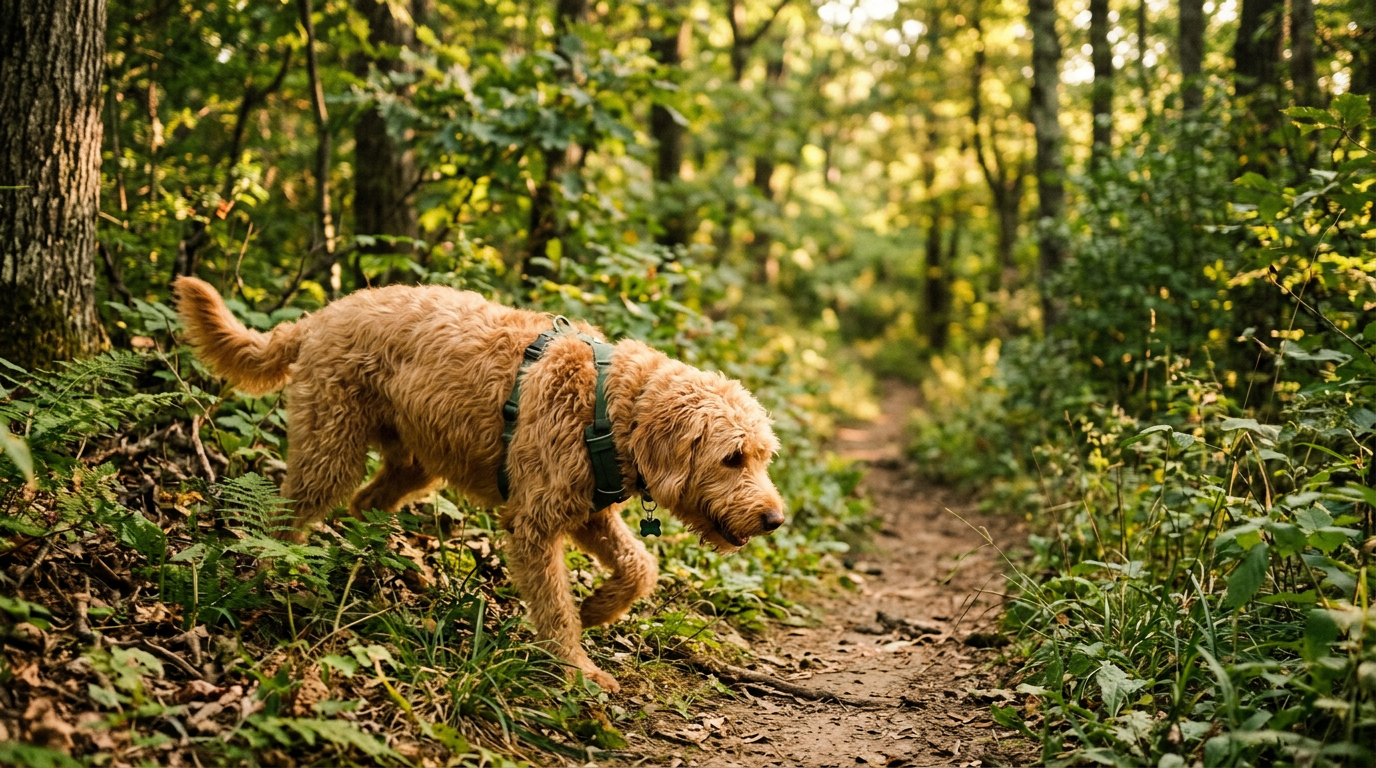
What was meant to be a tightly controlled breeding programme became something else entirely. Most Labradoodles sold today are F1 crosses from backyard breeders, with little to no health testing behind them. The dog you bring home has almost nothing to do with that original programme, and that gap is the root of most of what follows.
Combine a Labrador's biddability with a Poodle's intelligence, add a coat that's meant to shed less, and you get huge variation in the result. Bodyweight alone can range from about 14 to 36 kilograms. Coats run from straight and shedding to loose waves to tight curls. Some puppies get the Labrador's enthusiasm without the Poodle's self-control. Others get the opposite. Take that variation seriously, because an F1 cross is a genetic lottery rather than a standardised breed, and the breeder genuinely cannot tell you where a given puppy will land on coat, size or temperament. So read both parents when you visit a litter, and judge the two dogs in front of you rather than the word Labradoodle on the ad.
Why the same three problems keep showing up
Both parent breeds are working retrievers, bred to work all day in harsh conditions. Most families bring one home expecting moderate energy, because that's how the breed gets marketed. It's why so many Labradoodles we see in sessions were sold as easygoing family pets and turned out to be anything but.
Problem 1: energy that walks alone won't fix
What's happening: constant movement, can't settle, destructive habits despite regular exercise.
Why it happens: push the exercise up and you don't get a calmer dog, you get a fitter one that needs more tomorrow. Running a working retriever five kilometres builds the dog that needs seven next week.
The fix:
- Start training from 8 weeks old, before size becomes the problem. Whatever's allowed as a puppy becomes the adult habit.
- Manage jumping from day one. No attention while all four paws aren't on the floor, every time, from everyone in the house.
- Practise loose lead walking on the first walk, not the fiftieth.
- Get your puppy meeting people, dogs, and new environments before the socialisation window closes at 6 months. After that, you're managing fear responses instead of preventing them.
- Match exercise to a large-breed puppy's joints. Hold off on running and jumping until growth plates close, well into the second year.
Problem 2: jumping on greeting
What's happening: your Labradoodle knocks over children, older visitors, or whoever's nearest when it greets them.
Why it happens: Labradors are exuberant, highly social greeters. Poodles are handler-focused and can run hot on excitement too. Cross the two and you get a large dog with almost no impulse control, and the size is what makes it genuinely risky.
The fix:
- Affection only happens when your dog is lying down and calm. That's the rule, every time, from everyone.
- When it jumps, stop moving and stop talking. No eye contact. Let the excitement run out on its own.
- If it doesn't settle, walk it to another room for a few minutes, calmly and without a word.
- When visitors arrive, keep your dog in another room until everyone's seated and the initial noise has died down.
Problem 3: a coat that mats within days
What's happening: your Labradoodle's coat is matted again, and grooming sessions have turned into a battle.
Why it happens: "low-shedding, low-maintenance" is the most misleading line in doodle marketing. Labradoodle coats are genuinely high-maintenance, and most need a professional groom every 6 to 8 weeks to stay on top of it.
The fix:
- Book grooming in as a standing appointment. Skipping it is how matting gets ahead of you.
- Start handling and brushing at 8 weeks old. Short daily sessions with high-value treats, before matting is a problem to solve.
- Keep the coat in a shorter puppy clip rather than the longer teddy-bear look. Shorter mats less.
- Get a proper slicker brush, a metal comb, and a dematting tool, and use them daily, not weekly.
- If your dog struggles during a groom, stop and rebuild trust before you pick the brush back up. Push through it and grooming gets harder, not easier.
None of this comes down to a strict training method. It's early, consistent management before the size and the coat get harder to handle. If you're at the start of that with a Labradoodle puppy, our meet and greet is the place to start, and it feeds straight into the Complete Puppy Program if you want the full structure behind it.
