Labrador Retriever breed guide: what actually makes a Lab hard (and what makes them worth it)
Most of the Labrador calls I take come in at around seven months, and they all sound roughly the same. The dog was easy at twelve weeks. Then something shifted. He's mouthing harder than he ever did as a puppy, he's started clearing the kitchen bench, and he now weighs enough that one lunge on the lead takes someone off their feet.
Nothing has gone wrong here. What those owners are describing is a Labrador arriving at adolescence with the two things the breed was selected for, a persistent mouth and an appetite that never really switches off, plus about thirty kilos of body to carry them around in.
Luke Buchanan, Owner of The Toe Beans Co and Sydney's Puppy Trainer, is Red Cross Australia Pet First Aid certified and AFP background checked. Labs are the breed he works with most across Sydney. This guide covers what's breed-wired in a Lab, what's a training gap you can close, and where owners tend to confuse the two.
The Lab reputation vs the Lab reality
A Labrador is a large, food-driven retrieving dog with a long adolescence and an unusually high tolerance for household chaos.
The reputation says family dog, easy, good with kids. That's broadly true, and it's why the breed has sat at the top of Australian registration lists for years. A Lab will forgive a lot. He'll put up with a toddler climbing on him, and he'll keep offering you behaviour long after a more sensitive breed would have switched off entirely.
What the reputation leaves out is the middle. Between roughly four and ten months, a Lab is physically most of an adult dog and behaviourally nowhere close. The breed was built to work all day retrieving from cold water and then sit quietly in the boat between retrieves. Explosive on, then flat off. There isn't much of a middle gear in there, and a suburban lounge room asks for the middle gear about eighteen hours a day.
So the honest version reads like this. The temperament is as good as everyone tells you. The adolescence is harder than almost anyone warns you about. For a close cousin with a different tempo, the Golden Retriever guide covers the same trade-off in a softer package.
Adolescent mouthiness, the 4 to 10 month window
Mouthing in a Labrador rarely comes back at four months, because in most cases it never actually finished.
Early on, mouthing is developmental. You redirect it onto something the puppy is allowed to have and you move on. By around four months it's behavioural. The reason owners think it stopped is that adult teeth came in and replaced needle-sharp puppy teeth, so it stopped drawing blood. What changes at adolescence is arousal and jaw strength.
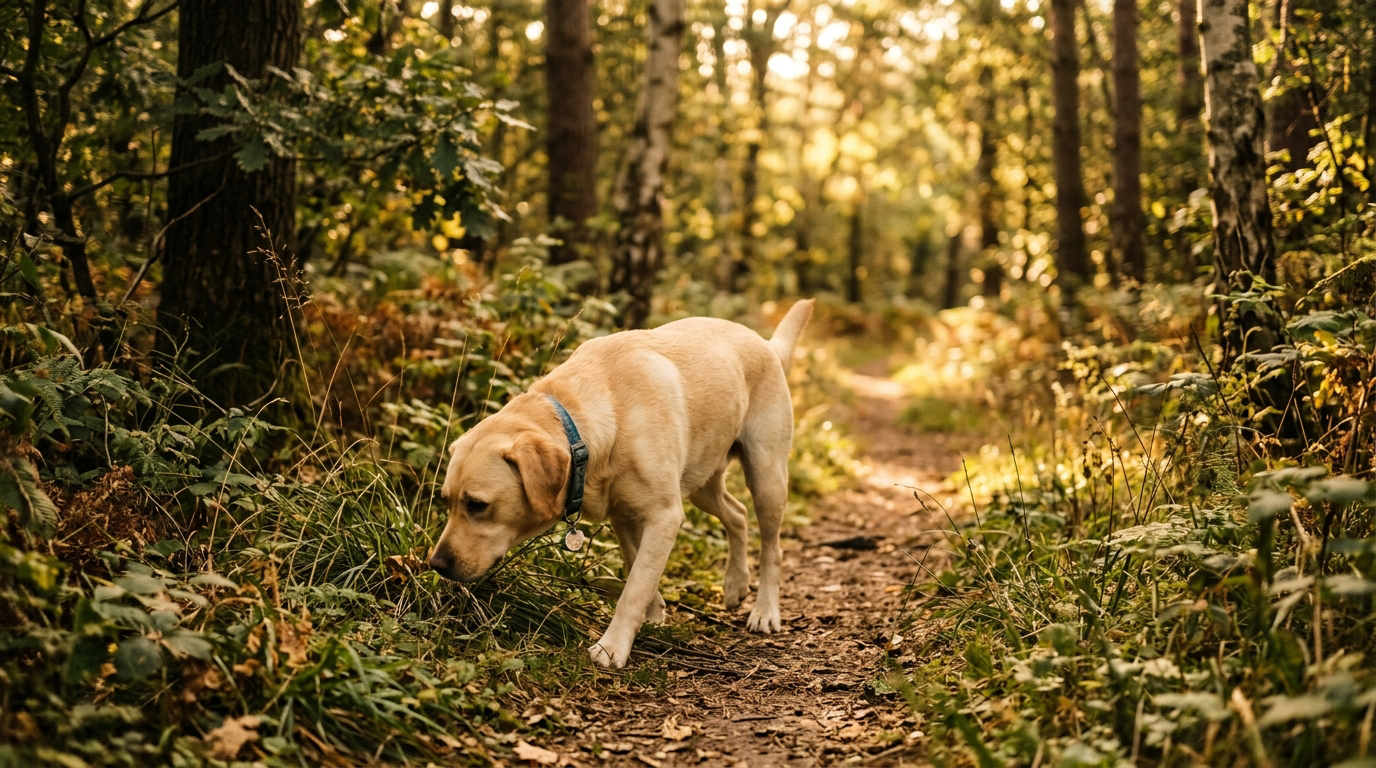
In a Lab it shows up as grabbing. Sleeves, the lead, a trouser leg, your forearm as you walk past. This is a breed that carries things for a living, so when arousal climbs, the mouth is where it goes.
At this age, skip the toy swap. That's an eight to fifteen week tool and it stops working once the behaviour is about arousal rather than teething. Use the calm freeze instead. Stop moving, no eye contact, no sound, nothing for him to pull against. If teeth land on skin or clothing, lead him out to a separate room or a gated area for a few minutes. That's Access Withdrawal, and it works because you've taken away the thing he wanted, which was you.
Silent the whole way through. No yelp, no telling off, no verbal marker of any kind. Any noise you make is still contact, and contact is what he was after.
One rule I won't bend on: the crate is never the timeout room. Use a laundry or a gated hallway instead. If you're already managing your own arms around the dog, the adolescent program for dogs 17 to 32 weeks exists for exactly this window.
Food motivation, where it works and where it becomes counter surfing
Food is the strongest lever you'll ever have with a Labrador, which is precisely why it needs structure around it rather than free access.
On the asset side, food motivation does most of the heavy lifting for everything you'll teach him. Recall, settle, place, loose lead work. He'll work for it in a way a Sighthound simply won't.
The cost is that the drive doesn't clock off when the session ends. Counter surfing usually turns up the week the dog is tall enough to reach the bench, which for most Labs falls in the five to six month range. Scavenging on walks follows within a month.
The approach is management plus structure around who controls the food:
- Nothing edible stays on a reachable surface, and that includes the back of the bench you think he can't get to. He can.
- Chews and bones get picked up once he's finished with them rather than left down as furniture.
- One food, consistently. Switching brands because he seemed bored teaches him that not eating produces something better.
- Meals arrive on your schedule and the timing varies. A dog who can predict dinner to the minute starts campaigning fifteen minutes out.
- Eat something yourself first. A cracker counts. Then ask for a sit, hold it, and release him to the bowl with "OK".
- If he wanders off from a full bowl, lift it within a second. It comes back at the next meal.
That last one is the whole approach in miniature. Nothing unpleasant happens to the dog, the thing he wanted just stops being available.
Size arrives before the brain, the 5 to 9 month landmine
Between five and nine months a Labrador reaches close to adult bodyweight while still behaving like an adolescent, and habits that were tolerable at fifteen kilos stop being tolerable at thirty.
This is the window I get called in for. Pulling was annoying in March, and by August the same pull takes a grandparent off the kerb. Jumping was a greeting habit, and now it puts a four-year-old on the floor. The behaviour hasn't moved an inch. The physics have.
For the lead, use SSCD. Stop, start, change direction, with no warning and no talking. Stop dead the moment the lead goes tight. Start again when it slackens. Change direction by turning across in front of him so he has to track where you're going instead of towing you where he's going. What makes this the right tool for a big adolescent Lab is that none of it rests on you being stronger than the dog, which by seven months you may well not be.
For jumping at the door, full ignore. No touch, no eye contact, no speech, and that applies to visitors too, which is the part you have to brief people on before they arrive. If he's still climbing, calm freeze and walk him away. If it escalates, timeout. Teach sit as the default arrival behaviour so he has somewhere to put the arousal. And when you know people are coming, run five minutes of SSCD through the house first, so the doorbell isn't what sets his threshold for the next hour.
Recall and the retrieve instinct, using what's already there
The retrieve drive a Lab is born with is the easiest recall reward you'll ever be handed, as long as coming back never ends the fun.
Wanting to come back and knowing when to come back are two separate skills. The first comes out of the leadership work above. The second has to be taught deliberately:
- Call once. A cue you repeat four times is a cue you've taught as optional.
- Rotate the reward between food, a thrown toy and real affection so he can't predict which is coming. With a Lab, weight the toy heavily, because you're paying him in the currency he was bred to want.
- Indoors, work off a short line. Step on it as he comes in, take the collar gently, reward, then release him back to whatever he was doing.
- Outside, move to a ten metre long line clipped across the body rather than at the neck, and only add distance once he's solid at the length you're already on.
- A whistle beats your voice. It's consistent, it carries, and it doesn't leak your mood into the cue.
Three things break recall in adolescence and I see all three most weeks. Calling him and then doing something he dislikes, so the bath, the nail clip, or the end of the walk. Calling him when he was never realistically going to come, which teaches him the cue is negotiable. And pushing distance up before the current level is reliable, which is the one keen owners fall into hardest.
Health considerations that change how you train
Two health factors change the training plan for a growing Lab: joint loading and weight.
On joints, large breeds carry the most risk of damage that won't show up for years. The working rule is five minutes of on-lead exercise per month of age, twice a day. So a four-month-old gets twenty minutes twice, and rough play in the backyard counts towards that total rather than sitting outside it. Watch for him sitting or lying down partway through a walk, which is the clearest signal you've gone past what he can carry. Favour grass and sand over concrete.
On weight, the feeding structure above does double duty. A Lab carrying extra weight also gets less out of food-based conditioning, because a dog who is never hungry works less hard for it.
Ears are worth a mention because Labs swim constantly and Sydney makes that easy. What that means for ear health is a vet or groomer question, and I'm not going to guess at it here. Same line applies to the rest. Diagnosing hip or elbow problems or clearing a specific dog for higher-impact work is a vet's call. I'll tell you how to load a growing dog sensibly. I won't tell you his joints are fine.
A Sydney family, a nine-week-old black Lab, and a very specific brief
Late July, in-home consult, booked before the puppy came home. The family were collecting a nine-week-old black Lab and the brief they handed me was unusually clear, which made it easy to plan against.
They had a toddler already and a newborn on the way, and they spend most weekends at rugby, which means crowds, noise, other dogs on leads, and a lot of dropped food at ground level. Three requirements came out of that: reliable around the toddler, safe around the newborn, and calm on lead in a crowd.
Two of those are timing problems as much as training problems. Collected at nine weeks in late July, his socialisation window closes at six months, so around the end of December. Everything that needs banking has to be banked before then. The newborn and the five to nine month size jump were always going to land close together, which is why the jumping work got front-loaded rather than left until it became a problem.
The rugby crowds turned out to be the best asset they had. A weekend fixture gives you noise, movement, strangers and other dogs in one place, on repeat, for free. The instruction was to sit fifty metres back for the first few visits and let him watch, then close the gap only while he stayed under threshold. Crowd exposure done badly at eleven weeks is worse than none at all. Lead work and a taught leave started in week one, because dropped food at a rugby field is the scavenging problem in its worst form.
Want help putting this into practice?
The Toe Beans Co runs a free SKOOL community where Sydney dog owners get access to training guides, Q&As, and direct support from Luke. It's free to join.
Upcoming puppy schools in Sydney
Luke runs regular puppy schools across Sydney, with venues in Paddington, Edgecliff, Zetland, Alexandria, Marrickville and Neutral Bay. Anyone in Sydney can attend any location. The Complete Puppy Program covers the four weeks of group work plus a one-to-one session in your own home, which is where most of the Labrador-specific work gets done.
Check upcoming dates and book your spot →
Frequently asked questions
Are Labradors good with young children?
Yes, Labradors are one of the better breeds around young children, with the caveat that the risk is size rather than temperament. What gets families into trouble is the five to nine month window, when a dog who has always greeted people by jumping is suddenly heavy enough to knock a small child over without meaning anything by it. Train the calm greeting well before he's big enough for it to matter.
When do Labrador puppies stop biting?
Developmental mouthing settles at around sixteen weeks, but in a Labrador the grabbing usually continues well past that as an arousal habit rather than a teething one. Owners often see it peak between four and ten months, once jaw strength has caught up. It stops when the household runs the same silent interrupt every single time.
Is puppy school in Sydney worth it for a Labrador?
For a Labrador it's worth more than for most breeds, because the socialisation window shuts at six months and a Lab's hardest period starts right after it. Group classes give you controlled exposure to other puppies and handlers during the window that counts. The Toe Beans Co runs puppy school at six Sydney venues, and anyone in Sydney can attend any of them.