3 common Pomeranian behaviour problems (and how to fix them)
Your Pomeranian jumps at visitors, barks at anything that moves past the window, and snaps if a stranger reaches in too fast. A Kelpie doing any of that gets called a training problem. A three-kilogram dog doing it gets called personality.
That's the pattern behind most Pomeranian behaviour issues. It's not the breed being difficult, it's the size making it easy to skip training a bigger dog would get by default.
Where do Pomeranians come from?
Pomeranians were bred down from German Spitz sled dogs weighing 30+ pounds, miniaturised in the Pomerania region on the Poland-Germany border through the 1800s.
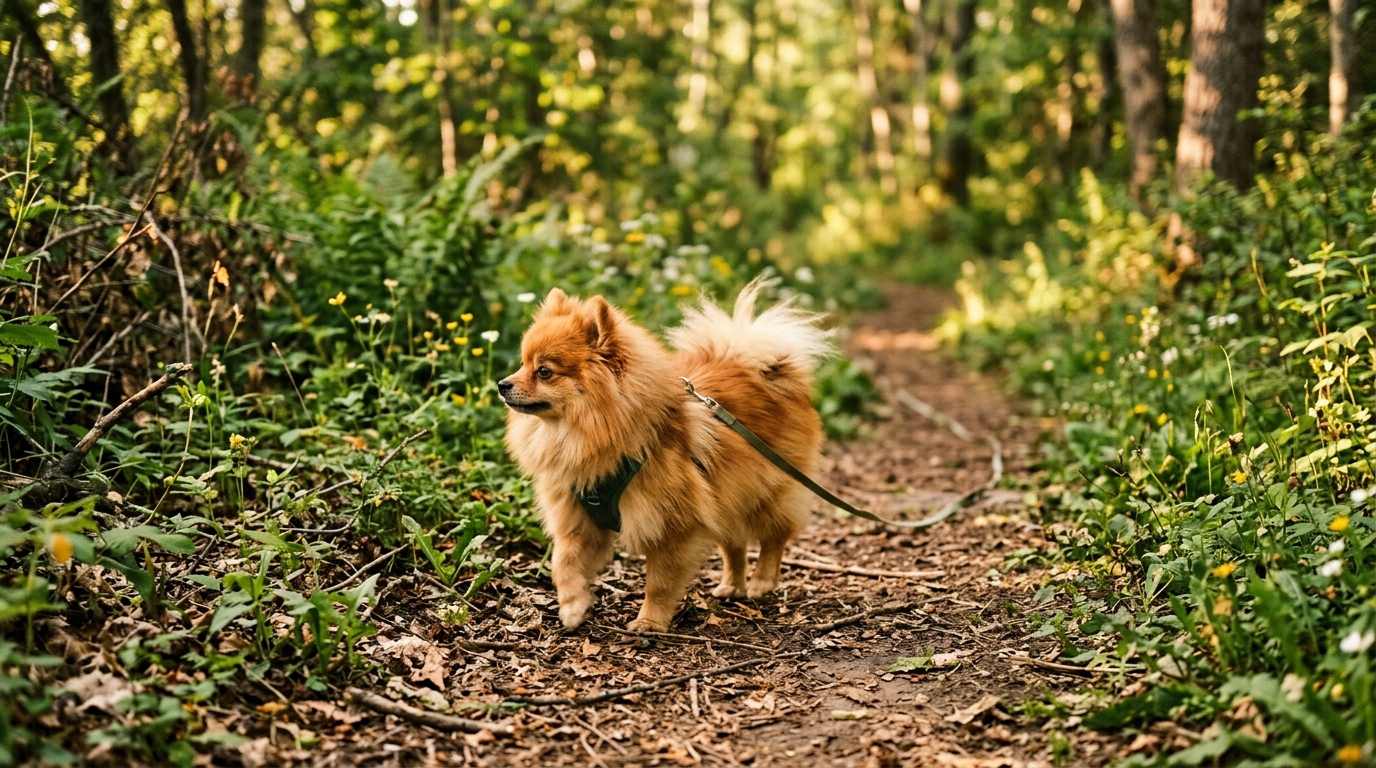
Queen Victoria fell for the breed on a visit to Italy in 1888, brought several home, and bred her own down further, to around 12 pounds. Her patronage made them fashionable, and breeders eventually settled the line at the 3 to 7 pound dogs we know today.
What were they bred to do?
- Working sled dogs and watchdogs in Arctic regions, before miniaturisation
- Companions for European women once bred down in size
- Kept the alertness and confidence of their working ancestors
- Portable enough to carry, sharp enough to alert to a threat
Working dog temperament in a toy-sized body, in other words.
Pomeranians kept the working Spitz temperament at a tenth of the size. They're vocal because barking was the job. They're confident because nobody bred that out of them, and most genuinely don't register how small they are. Add a strong attachment to one person, wariness of strangers, and a bark louder than the frame producing it, and you get a dog that was never bred to be delicate, whatever it looks like.
Why do Pomeranians have these behaviour problems?
Pomeranians are companion dogs now, full stop. But the temperament underneath is still the confident, alert Spitz dog it always was.
Treated like a toy rather than a dog, that temperament turns into small dog syndrome: the training a Labrador puppy gets automatically, a Pomeranian skips, because a three-kilogram dog jumping up doesn't knock anyone over. The same alertness that makes them sharp watchdogs is what tips into barking at everything, and their size can make them feel more vulnerable at ground level, which shows up as defensiveness when they feel cornered.
Problem 1: small dog syndrome
It's easy to excuse jumping, barking, snapping, or defensiveness when the dog doing it weighs three kilograms. But Pomeranians weren't bred to be submissive lap dogs. They kept the confidence of working Spitz dogs, and skipping training or socialisation because of their size just lets behaviour run that would be corrected immediately in a larger breed.
Train your Pomeranian exactly as you would a large breed. Set firm boundaries, and get structured training and socialisation in before the window closes at 6 months, not after. Stop picking them up to rescue them from situations, and stop picking them up mid-bark. If they're anxious or defensive around something specific, redirect calmly and physically, step between, lead them away on a loose lead, rather than talking them through it. A soothing voice in that moment reinforces the state they're in, not the calm you're after.
Problem 2: excessive barking
Your Pomeranian barks at everything, and it's a genuinely loud bark for the size producing it. That's the Spitz watchdog instinct still switched on. Alerting to change was the job, and miniaturising the dog never switched off the wiring.
Use a two-part acknowledgement instead of shouting over it. When your Pomeranian barks, walk calmly toward whatever they're alerting to for a couple of seconds, then turn around and walk away without saying anything. If the barking keeps going, take them to a quiet room and let them back out only once they've been silent for 30 seconds. For more on breaking the cycle, see our guide to reducing unnecessary barking.
Problem 3: separation anxiety
Your Pomeranian follows you room to room, panics the second you leave, and demands attention rather than asking for it. That traces back to what they were bred for: pure companionship for Victorian women who carried them everywhere. Portable and constantly held, plenty of Pomeranians never get the chance to learn how to be alone. Our guide to separation anxiety goes into more depth on building that up gradually.
Don't reward demand barking with attention. If your Pomeranian crowds you on the couch, use your hand to create a gap rather than letting them push into it. If they're straight back, calmly move them to a separate room for five minutes. No treats for attention-seeking, it just teaches them the behaviour works.
Get the full support system for your Pomeranian
That's why we built a free Skool community, so you've got support beyond a single blog post.
Inside, you'll get:
- Weekly live Q&A sessions to ask about your specific Pomeranian
- Full breed-specific courses from puppy raising through advanced behaviour work
- A community of other Pomeranian owners
- Video demonstrations of every technique
- Troubleshooting when something isn't going to plan