3 common Standard Poodle behaviour problems (and how to fix them)
The Standard Poodle was built to think. Bred as a water retriever that had to work at a distance from its handler and make its own decisions, it comes with a brain that stays switched on long after the hunting stopped. Most of what owners find difficult, the barking and the constant shadowing, traces straight back to that. Luke Buchanan, Owner of The Toe Beans Co and Sydney's Puppy Trainer, sees the same handful of patterns in nearly every Standard Poodle household he visits. None of them need force to fix. What they need is the dog's job description changed.
Where do Standard Poodles come from?
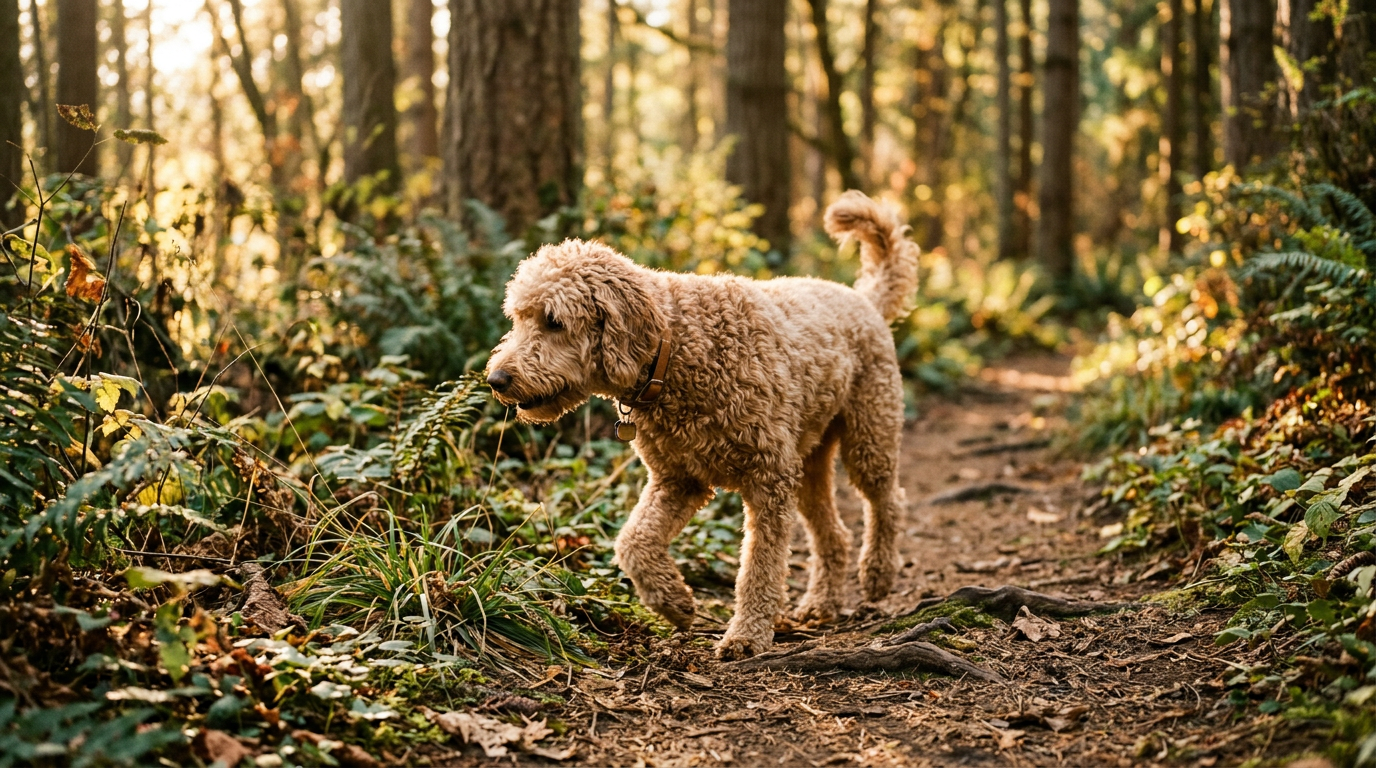
The Standard Poodle was originally bred in Germany as a water retriever. The name comes from "Pudel", meaning to splash in water. It was later refined and standardised in France, where it became the national breed, with written records going back to the 1400s. These were hunters' dogs. The show ring and the elaborate clip came centuries later, and even the clip started out functional, leaving hair over the joints and chest to keep them warm in cold water. Every doodle cross on the market today is borrowing from this dog.
And that's the difference worth knowing if you're weighing one against the other. A first generation doodle is a genetic lottery, so an F1 puppy can land anywhere between its two parents on coat, size and temperament, and the breeder cannot tell you where. Buy a pure bred Poodle and you know what you're getting, which is exactly why so many crosses reach for this breed in the first place.
What they were bred to do
- Retrieve waterfowl from cold water for hunters
- Work independently while still taking direction from a handler at distance
- Bark to communicate when they detected game
- Solve problems on the job without being told each step
- Swim strongly, with a mouth soft enough to carry a bird without damaging it
- Later, perform in circus acts, which is where the trainability got its reputation
Key breeding traits
Exceptional intelligence (Standards are consistently rated the second most intelligent breed), high trainability and problem-solving ability, an alert and watchful nature that requires them to announce changes, a low-shedding coat that needs a lot of grooming, versatile working ability across several jobs, and strong handler focus. They notice everything, and they were bred to tell you about it.
Why do Standard Poodles have these behaviour problems?
Most of what frustrates Standard Poodle owners is working dog genetics showing up in a family home. The breed now exists in three sizes, and Standards sit closest to the original working dog. They still do everything from service work to the show ring, but the majority live as companions, and the working intelligence hasn't gone anywhere. Without a job, that intelligence turns inward.
The grooming load in show lines has drifted well past the functional hunting clip. More to the point, the alert nature and the intelligence together produce a dog that scans constantly, and constant scanning with no outlet becomes anxiety. Bred as a close working partner to hunters, and later kept as a devoted companion by French aristocracy, the Standard Poodle carries an intense human-bonding drive on top of all that thinking. That combination is what produces the three patterns below.
Problem 1: excessive barking and alert behaviour
What's happening
Your Poodle barks at everything. Every sound and every small change in the environment gets announced.
Why it happens
Poodles were bred to alert hunters to downed waterfowl and to communicate across distance while working. The barking was the job. Their intelligence means they notice more than most breeds do, so they have more to report, and their history as watchdogs for French nobility layered vigilance on top of the retrieving work.
Underneath the barking is a dog that has appointed itself threat assessor for the household, and that distinction changes what the fix has to do. A Poodle barking at the third delivery van of the morning genuinely believes that ignoring it would be a dereliction of duty. Suppressing the noise leaves the job with the dog and adds pressure on top of it. Taking the job off the dog is what actually lowers the barking, and that means giving a verdict the dog can hear rather than going quiet and hoping they work it out. Silence gives them nothing to interpret, so they keep assessing. Our full guide on how to stop excessive dog barking covers the same escalation in more detail.
The fix
This is Golden Rule 2 in practice. Three steps, and the order matters.
- At the first bark, stay where you are and don't move toward the trigger. Acknowledge it with one calm, level "thank you". That tells your dog you heard it, you assessed it, and it's fine.
- If they bark again, walk over slowly to whatever they're alerting to, look at it, and give a second calm "thank you". Then turn and walk away without looking back at the dog. No other words.
- Any further noise after that goes straight to isolation, and this step is fully silent. Take them calmly by the collar to a quiet, boring room and close the door. Never use a crate for this, and never put them outside.
- Release only after at least 30 seconds of complete silence. Releasing during any noise teaches them that noise opens the door.
- Keep your voice and body flat the whole way through. A tense or urgent "thank you" reads as confirmation that there really was something to worry about, and it undoes the message.
- Everyone in the house responds the same way, every time. One person shouting from the couch cancels out a fortnight of consistent work from everyone else.
- Know what you're actually treating. Not all barking is excessive. What you're deescalating here is unnecessary alert and demand barking, not a single warning bark at a genuine stranger.
Problem 2: separation anxiety and velcro behaviour
What's happening
Your Poodle follows you from room to room, gets distressed when you leave, or can't settle when they're on their own.
Why it happens
Bred as a close working partner and later as a constant companion, the Standard Poodle has a human-bonding drive that runs deeper than most breeds. Add the intelligence on top and you get a dog that is hyper-aware of where you are and what you're about to do. They were bred to problem-solve alongside a person, which makes solo time genuinely difficult rather than merely boring.
There's a second layer that owners rarely spot. The dog believes it's responsible for keeping an eye on the household, and it can't do that job when it can't reach its people. That's why the response looks like panic rather than sulking, and it's why the two things owners instinctively do, comforting the dog before leaving and greeting it warmly on return, both confirm the exact belief driving it. Removing that confirmation, consistently, is most of the work. There's a fuller breakdown in our guide to solving separation anxiety.
The fix
Two things run in parallel: taking the meaning out of your departure cues, and changing what happens when you come home.
- Decouple your departure cues one at a time. Pick up your keys and sit back down. Put your shoes on and then go and make a cup of tea.
- Do the same with the door. Open it, close it, and go back to the couch. Repeat each cue until it produces no reaction at all.
- Run these at random points through the day, not just before you actually leave. A cue that reliably predicts nothing loses its power to trigger anything.
- Start mini-departures at under 30 seconds and come back before any distress builds. Volume beats duration early on, so aim for 20 to 30 of them across a free weekend day.
- Vary the lengths unpredictably. Twenty seconds, then two minutes, then 45 seconds, then five. The only pattern you want them to learn is that you always come back.
- When you return, ignore them completely. No touch and no eye contact. Don't speak to them at all. Wait until they're genuinely settled rather than just quiet, then wait five more minutes before you call them over.
- Everyone follows the same return ritual, including visitors, walkers and family. One excited hello at the door undoes a week of work.
- Extend the duration only once returns are consistently calm, and by no more than half at a time. If a longer absence fails, drop back to the last length that worked and hold there for a few days.
- Watch the quiet signals as well as the noise. Pacing and fixating on the door both count as over-threshold even without a sound.
- You can't exercise separation anxiety away, though a dog with enough mental work behind it starts from a lower baseline.
Give an established adult case four to eight weeks, and run the first fortnight strictly before you judge whether it's working. One thing to avoid: don't use food to reward settling. With a dog this clever and this food-driven, you teach the sequence rather than the state, and they learn to get up so they can lie back down and get paid. If you're doing this with a young dog, our guide on leaving a puppy home alone covers the same groundwork.
Problem 3: obsessive behaviours and fixations
What's happening
Your Poodle locks onto an object, an activity or a routine and can't seem to switch off.
Why it happens
A brain bred to notice subtle changes and anticipate a handler's next move doesn't stop doing that when the hunting stops. With no job to point it at, that awareness turns into anxious scanning, and scanning turns into fixation.
The part most owners get wrong is the arousal level. A dog locked onto something through the window is usually running at a six or seven out of ten, well above the threshold where it can process anything you say. Most owners read the same dog as a three. That's why repeating a command at a fixated Poodle does nothing. Above roughly a five, language stops landing at all, and the more you talk the more you confirm that whatever they're staring at is worth this much attention.
The fix
- Read the state before you do anything. If they're already wound up, break the fixation first with stop-start-change-direction on lead, done in silence, until the arousal drops a level.
- Once they're low enough to reach, use a calm hold. Take a relaxed underhand grip under the collar, palm up, under the chin. Say nothing at all.
- Hold until the whole body relaxes. You're waiting for a yawn or a shake, and it can take two to five minutes the first few times.
- Release without speaking. Early on, a couple of seconds of genuine settling is a result. Duration builds with repetition.
- Stay neutral toward whatever they fixated on. If you stop near it, squat with your back to it. Don't soothe the dog while they're locked on, because comforting a fixated dog confirms there was something worth reacting to. Affection comes once the trigger is gone and they're properly calm.
- Rotate the toys and objects they have access to, so nothing becomes the one thing.
- If the pattern keeps recurring, or you can't bring them down at all, move to isolation. Walk them calmly by the collar to a quiet room without speaking. Five to twenty minutes for an adult dog. Never a crate, never outside.
- Give them room to run somewhere safe and enclosed. Physical work won't fix fixation on its own, but a Standard Poodle with no outlet at all has nowhere else to put it.
- A dog that genuinely cannot settle at any point in the day has a wider problem than fixation. That's a stressful way to live, and it's worth getting hands-on help rather than working through it from an article.
In Luke's experience, the Standard Poodle fixation cases that take longest to shift are the ones where the household has spent months trying to talk the dog down. Once the talking stops, the hold starts to land.
Is a Standard Poodle right for a new owner?
A Standard Poodle suits some households very well and makes others miserable. Here's what you're signing up for.
An exceptionally intelligent dog
Poodles are consistently rated among the most intelligent breeds. They learn fast, and they solve problems you'd rather they left alone. If you want a dog you can teach almost anything to, this is the breed. The flip side is that a bored Poodle will find its own project, and you won't like it.
A low-shedding companion
Poodle coats shed very little, which is why they're so often described as hypoallergenic. No dog genuinely is. Allergic reactions come from dander and saliva rather than hair, so a Poodle can be much easier to live with than most breeds without being risk-free. If someone in the house has allergies, spend real time around an adult Poodle before you commit.
A highly trainable dog
The intelligence combined with a strong pull toward working alongside a handler makes them very trainable. They do well in obedience work and in service roles, and they hold what they learn.
A versatile, athletic dog
If you're active, they'll keep up. They swim well and they pick up complex physical tasks quickly. Plan on real exercise every day plus something that makes them think, because the second one matters more with this breed than the first.
An elegant dog with a grooming bill
The coat allows for everything from a functional clip to something far more elaborate, and it needs professional grooming every six to eight weeks whether you want that or not. Budget for it before you buy.
Owning a Standard Poodle is a commitment to serious grooming and to keeping an intelligent dog mentally occupied. They do best with handlers who enjoy that side of it. If you're out of the house ten hours a day and nobody has the time to give the dog a job, this is a breed that will let you know about it.
Want help putting this into practice?
The Toe Beans Co runs a free SKOOL community where Sydney dog owners get access to training guides, Q&As, and direct support from Luke. It's free to join.
Upcoming puppy schools in Sydney
Luke runs regular puppy schools across Sydney, with venues in Paddington, Edgecliff, Zetland, Alexandria, Marrickville and Neutral Bay. Anyone in Sydney can attend any location.