Your dog spots another dog forty metres up the road and the walk is finished. Barking and lunging, and a lead you're now holding with both hands while you apologise to someone who's already crossed the street.
That's reactivity, and it grinds owners down faster than almost any other behaviour I deal with. Most of the people who call me about it have quietly stopped walking in daylight.
Reactivity is an emotional response to something your dog has decided it needs to manage on your behalf. Luke Buchanan, Owner of The Toe Beans Co and Sydney's Puppy Trainer, works reactivity cases across Sydney every week, and the pattern holds up: the dog has appointed itself to a job nobody gave it, and it's doing that job under pressure. Take the job back and the reaction has nothing left to run on.
What reactivity actually is
Reactivity is a behaviour problem, which means it answers to leadership rather than to commands. Barking, lunging, snapping and freezing at a trigger on lead, over the fence, through the front window, or from the back of the car are all the same underlying thing: a dog running a risk assessment it isn't equipped to run.
That reframing matters because it changes what you actually work on. Treat the barking as the problem and you'll spend months suppressing a symptom. Change what your dog believes its job is, and the barking fades because your dog no longer needs it.
The two reactive dogs I see most
Reactivity has two common presentations. They look like opposites from the outside and they need different handling day to day, though the underlying fix is the same for both.
The self-appointed threat-manager. Weight forward, chest up, body moving towards the trigger rather than away from it. This dog has taken on the job of spotting and dealing with danger because, as far as it can tell, nobody else in the household is doing it. There's no rank or status in this. It's a dog carrying a workload it was never meant to have, running it under stress, and running it badly, because no dog is built to do risk assessment for a family. What this dog needs is a decisive, unhurried change of direction the instant it starts to lean in.
The avoidant one. Tail low, body tucked in close to you, reacting only once it feels cornered and can't create space. This dog is reacting from stress and needs distance, plus the option to approach in its own time.
Owners often read the first type as confidence and the second as fear. Both are stress. In my sessions the thing that gives it away is where the weight sits the moment the trigger appears, before any noise starts.
Finding your dog's threshold
Threshold is the distance at which your dog can see a trigger and still think. Under threshold, the body stays loose, your dog can turn back to look at you, and it can take food. Over threshold, you get the locked stare, the stiff spine, the noise, and a dog that has stopped hearing you.
To find it, start further out than you think you need. Watch your dog, not the trigger. Soft body and a head that comes back to you means you're in the right place. A fixed stare before any barking means you're already at the edge of it.
Closing that gap happens across short sessions over weeks. A week of calm at twenty metres beats three days of guessing at ten. Shrink the distance only once your dog is reliably settled where it currently is.
Going over threshold isn't a neutral event. A dog in full reaction is rehearsing the exact pattern you're trying to undo, and it's flooded with stress hormones that take hours to clear. If you can't tell whether you're under or over, you're too close. Add distance before you do anything else.
Stop, start, change direction
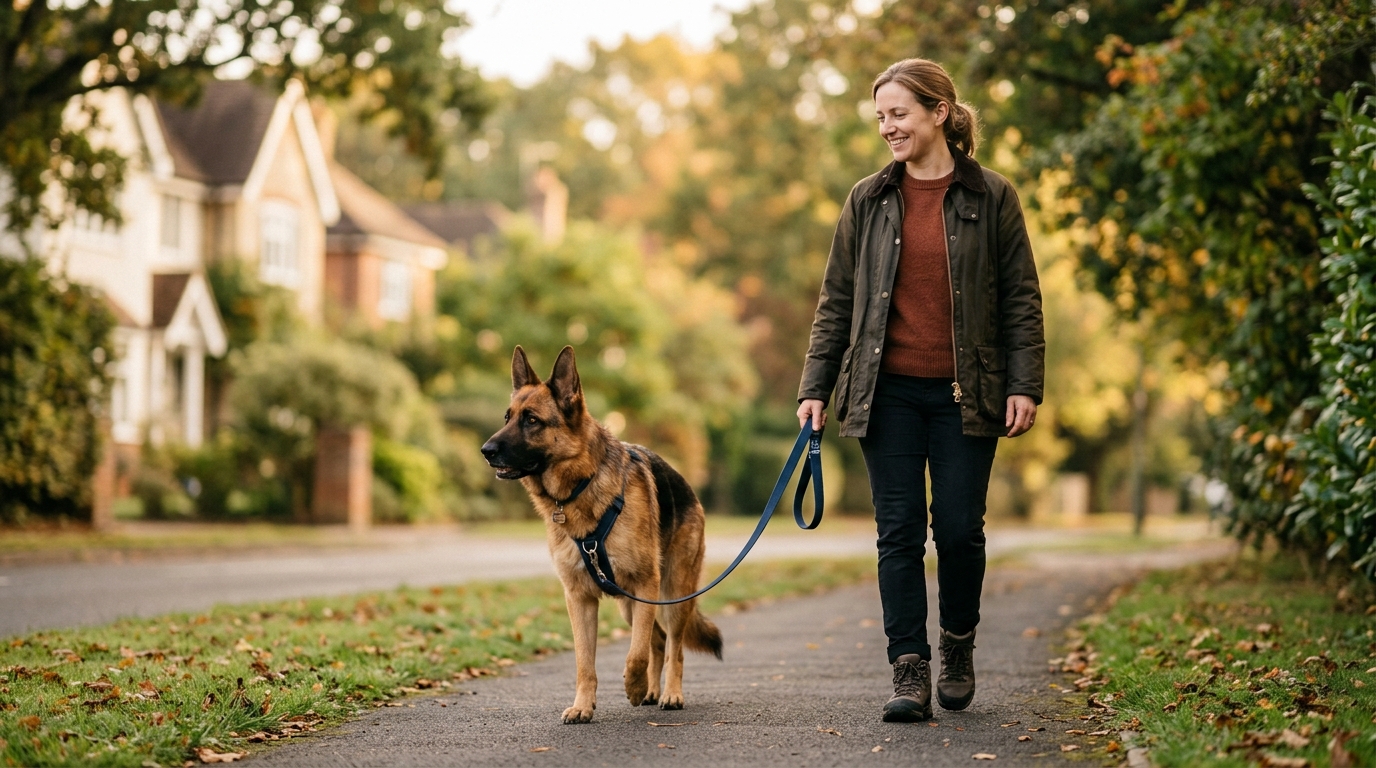
SSCD is the main walk tool, and it's the one I hand to nearly every reactivity client on day one. Walk your dog on lead. Stop with no warning. Start again. Change direction, turning in front of your dog so it physically registers that you picked the direction.
Do it in silence. Talking through SSCD measurably reduces how well it lands, because your dog should be reading your body rather than waiting for a word. You can run it indoors on a short line or out on a quiet street. Food helps draw attention in the first few sessions.
For reactivity, use it as a warm-up before you go anywhere near a known trigger distance, and again as the working tool during the threshold session itself. It also brings energy down before something new happens, like a car ride or a visitor at the door.
What it teaches is a useful kind of unpredictability. Your dog can't guess what you'll do next, so it stays tuned to you instead of scanning the street on its own initiative. That's the direct mechanism that undercuts the threat-manager pattern. If your dog also pulls hard on lead, the same tool does that job, and there's more detail in our guide to stopping lead pulling.
Figure 8s in a small space
Figure 8s are SSCD concentrated. You walk a figure-of-eight pattern in the garden or any small patch of ground, and the shape forces constant direction changes without needing a route.
I use them before leaving the house with a dog that's already fizzing, and as a low-stimulus rep before a threshold session so the dog is watching the handler before a trigger ever appears. Two minutes of figure 8s before you open the front door does more for the first hundred metres of the walk than anything else you can do in that time.
The calm freeze
The calm freeze is a silent physical hold that interrupts a moment before it escalates. Take a calm underhand grip under the collar, palm up, under the chin. Say nothing at all. Hold until the body settles, then let go.
Your lead hand stays loose. The collar grip does the holding, so there's no pulling and no tension travelling down your arm. Keep your eyes neutral rather than locked on your dog, because a stare turns the whole thing into a contest.
The first few attempts, two seconds of genuine calm is a win. Duration builds with repetition. Sequencing matters as well: if your dog is already wound up, run SSCD first and then freeze. If your dog is genuinely flooded and past the point of hearing you, a calm timeout in a separate room is the better call, because the freeze was never designed for a dog that's already over threshold.
Practising with a dog you know
If you've got a friend with a settled dog who's willing to help, that's the best practice environment you'll find, because you control every variable in it.
- Walk past each other at a distance both dogs are comfortable with, then progress to walking in the same direction
- Keep both dogs on the outside of the handlers first. Then one on the inside. Then both.
- Give each stage a full week of calm before you move on. Three days of it going fine isn't the same thing.
- Walk with purpose when you pass. Slowing down and reeling the lead in announces to your dog that something is about to happen.
Reacting at home and at the fence
Home reactivity is where the leadership piece shows up most plainly, and it's governed by the danger rule. When your dog barks at something outside, acknowledge that first bark with a single calm, level "thank you". That tells your dog you heard it, you've assessed it, and there's nothing further to do.
On a second bark, walk over slowly, look at whatever it's barking at, acknowledge it again with the same calm "thank you", then turn and walk away without looking back. If it continues past that point, take your dog quietly by the collar to a separate room, in complete silence, with no eye contact and no talking. That third step is the only silent one.
Your tone does most of the work here. A tense or urgent "thank you" tells your dog it was right to worry, and you've just confirmed the threat for it. Level and unbothered is the entire point. Most owners lose the ground they've built by letting a grumble slide after the second acknowledgement, so hold the line there. There's a fuller breakdown in our guide to stopping excessive barking.
If your dog barks at dogs behind fences on the walk, don't let it rehearse. Stop, turn your back to the barking while you hold the collar calmly, wait around thirty seconds, then move on with purpose.
Why a "look at me" cue won't fix this
A "look at me" command is a taught behaviour, and taught behaviours come from positive reinforcement. Building something new is what positive reinforcement is genuinely good at. Removing an established pattern is a different job, and reactivity is an established pattern.
If your dog still believes it's responsible for managing danger, a cue becomes a trick performed under pressure. It can hold a reaction down while you're actively cueing it, and it comes apart the second your timing slips or the context shifts. I've watched dogs with a flawless attention cue in the back garden lose it completely on a narrow footpath in Newtown.
Do the leadership work first. Once your dog stops needing to fixate outward, attention comes back to you on its own. Treat-based attention work is a decent addition after that, sitting on top of the groundwork rather than standing in for it.
Socialisation, and what it does and doesn't explain
The socialisation window closes at six months. That's the figure that matters, and it's later than most owners get told. The target before that window shuts is a hundred experiences: people of every age and appearance, children, traffic, unfamiliar surfaces underfoot, loud noises, and calm early visits to the vet and the groomer before there's ever a medical reason to go.
Match dogs by size and weight rather than by age, and only let your puppy meet dogs you know and know are vaccinated. A twelve-week German Shepherd is already bigger than a six-month dachshund.
There's advice going around that puppies should be left to get growled at and chased so they learn where they stand. I'd be careful with that one. Letting a pushy dog crash into a puppy builds a fear association, and that association is exactly what produces the avoidant profile described above. Good socialisation is neutral exposure that a puppy gets to observe and process at its own pace.
When something worries a puppy, the technique is making nothing of it. Stay neutral, keep walking or stay busy with something else, don't soothe with words or affection, and don't drag the puppy closer either. If you've stopped near something worrying, turning your back to it says more than any reassurance could. Affection comes afterwards, once the thing is out of sight and your dog has genuinely settled.
Poor socialisation explains a great deal about how a dog became reactive. It doesn't cap what you can do about it now, though it does mean progress gets measured in months.
Your tension travels down the lead
Tightening your arm as you spot a trigger tells your dog something's coming before your dog has seen anything at all. Shortened lead, held breath, quickened pace, and your eyes locked on the other dog. For a self-appointed threat-manager, all of that reads as confirmation that you agree there's a problem.
Some dogs are noticeably worse with their own owner than with anyone else for exactly this reason, which catches people off guard, because they assume their presence should be the settling factor.
The mechanics that matter:
- Loose arm, loose lead, soft shoulders, and breathing you've checked before the trigger appears rather than after
- You go through doorways first, every time. This gets set before the walk starts, as part of the lead pickup and doorway sequence at home.
- If your dog pulls, stop and turn rather than leaning into it
- Keep your dog on one consistent side and don't switch mid-walk
- Build a positive association at distance using food or a toy. Affection reads differently and can reinforce the fixation.
- Cancelling the walk is a legitimate option on a day when your dog can't settle at all. Nothing useful gets learned in that state anyway.
Managing the environment while the training catches up
Management buys you the room to train. Quieter routes at quieter times, and wide open spaces where you can see a trigger coming from far enough out to make a decision about it.
Avoid narrow alleyways, off-lead dog parks, blind corners and the school-run window until you've got something to work with. A long line in the park gives you range without giving up control. With fence-line reactivity, the priority is never letting the rehearsal happen, so acknowledge it, then take your dog on a structured walk rather than letting it patrol.
Management is the scaffolding that lets the training work, and there's no stage of this where using it counts against you.
When reactivity needs a trainer in the room
Threshold work, SSCD, figure 8s and the calm freeze are all things you can start this week without help. There are cases where a blog post is the wrong format, though.
Get someone in person if there's already been a bite, a redirected bite, a near-miss that felt out of your control, or an incident you're still turning over weeks later. Same if a muzzle is genuinely needed for safety during a controlled introduction. A muzzle is a legitimate safety tool and never a fix on its own, and needing one is a signal the case wants hands-on guidance. Our guide on when mild aggression needs help covers where that line sits.
Also worth booking a session: progress that's stalled despite consistent threshold work over a real stretch of time, or any uncertainty about which of the two profiles you're dealing with, because getting that wrong sends the handling in the wrong direction from day one. We run one-to-one in-home work across Sydney for adult dogs, which is the format reactivity actually needs. You can read how that plays out in practice in our force-free recovery method, and in a four-month case study of one Sydney dog.
Want help putting this into practice?
The Toe Beans Co runs a free SKOOL community where Sydney dog owners get access to training guides, Q&As, and direct support from Luke. It's free to join.
Upcoming puppy schools in Sydney
Luke runs regular puppy schools across Sydney, with venues in Paddington, Edgecliff, Zetland, Alexandria, Marrickville and Neutral Bay. Anyone in Sydney can attend any location.
Check upcoming dates and book your spot →
About The Toe Beans Co
We're a dog training company based in Sydney, Australia, with clients worldwide. We use force-free methods, which means no pain and no fear in anything we do.
Our mission:
- Give every owner someone they trust to call when their dog needs help
- Raise as much money for Teenage Cancer Research as we can