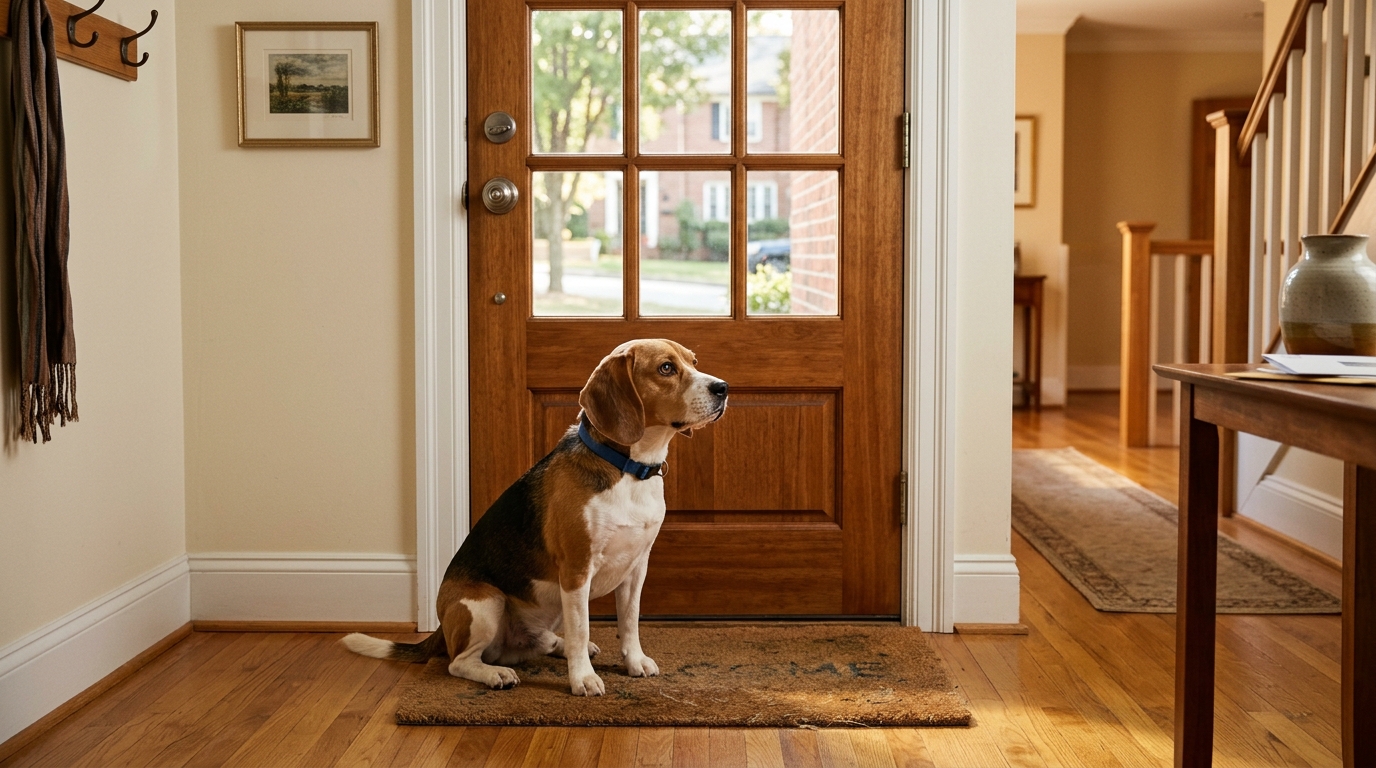
You pick up your keys and your dog is already at the door, pacing. You get back three hours later to a chewed skirting board, a message from the neighbour about the barking, and a dog who can't settle for another twenty minutes. Most owners I meet have already tried the obvious things. A longer walk before leaving. A stuffed Kong. The radio left on. None of it held.
Separation anxiety is one of the harder behaviour problems to shift, and most of the advice online tackles the wrong end of it. It focuses on the moment you leave. The work that actually moves the needle happens hours earlier, at your dog's food bowl, and in the two minutes after you walk back in.
This guide sets out the order Luke Buchanan, Owner of The Toe Beans Co and Sydney's Puppy Trainer, works in on separation anxiety cases, and why that order matters more than any single technique.
What separation anxiety actually is
Separation anxiety is distress caused by a dog believing they're responsible for the household, then losing access to the people they think they're responsible for. It's a belief problem before it's a behaviour problem. The barking and the chewing sit downstream of it.
That distinction changes what you treat. A bored dog settles once they give up waiting. A dog with genuine separation anxiety can't disengage from you even when you're home. The clearest tell I use in a first consultation has nothing to do with being left alone: can you go to the bathroom on your own? Can you walk out to the garage without company? If the answer is no, you're looking at anxiety rather than boredom, and the plan is different.
For the service side of this, our page on dealing with separation anxiety in Sydney dogs covers how we run it in sessions. What follows is the protocol itself.
Start at the food bowl, not the front door
Gesture eating comes first. Before your dog's bowl touches the ground, you visibly eat something yourself in front of them. A cracker is enough. This is the prerequisite for everything else on this page, and skipping it is the most common reason people stall out around week three.
The sequence looks like this:
- Eat something yourself, in view of your dog, before the bowl goes down
- Ask for a sit, then a wait, then release with a calm "OK" before they eat
- If your dog walks away from a bowl with food still in it, lift the bowl straight away. Food doesn't sit and wait for them
- Nothing edible is left lying around the house between meals. No chews or bones on the floor all day
- Vary your feeding times, so meals arrive on your schedule rather than a clock your dog has learned to read
Where the food relationship is more loaded, split the meal into three bowls in three rooms and run the sequence three times over. Smaller reps, lower stakes.
The reason this comes before any leaving work is mechanical. Every technique further down this page is trying to hand a responsibility back to you. If your dog still controls when and whether they eat, that responsibility hasn't moved anywhere, and the departure drills have nothing underneath them. I've watched owners run textbook micro-separations for three weeks and go nowhere, purely because the food side was never touched.
Expect resistance at first. One dog I worked with held out for three days before he accepted the new arrangement. He ate on the fourth day, and the 4am demand barking stopped inside that week.
The other house rules still apply
Separation work sits on top of all five Golden Rules rather than beside them. Two of them do most of the lifting here.
Golden Rule 2 covers danger, and it's the closest relative to separation anxiety. A dog who barks at every sound outside believes threat assessment is their job. A dog with separation anxiety believes holding the household together is their job. Same underlying belief, two different symptoms.
Handling it has a precise shape, and that shape isn't silence:
- First bark: a calm, level "thank you". You heard it, you've got it, no need to keep going
- Second bark: walk slowly over to wherever the trigger is, acknowledge it with the same calm "thank you", then turn and walk away without looking back at your dog
- Anything after that: quiet isolation, no eye contact and no talking, until they settle
Tone is what makes or breaks it. A raised or urgent "thank you" tells your dog they were right to be worried. A level one tells them there was nothing in it. If barking is the loudest part of your problem, our guide on how to stop excessive dog barking works through the escalation in more detail.
Golden Rule 3 covers what happens after any separation, and it's the rule this whole problem lives or dies on. That one gets its own section below.
Building micro-separations
Once the house rules are holding, you start on absence itself. The work runs in stages, and the temptation is always to skip to the last one.
Stage one: take the meaning out of your departure cues
Pick up your keys and sit back down. Put your shoes on and make a cup of tea. Open the front door, close it, go back to the sofa. Repeat each one until your dog stops reacting. A cue that predicts nothing loses its power to worry them. Watch the quiet signals as well as the loud ones, because pacing, fixating on the door, and refusing to lie down all count as being over threshold even with no noise at all.
Stage two: build independence while you're still home
Use baby gates and closed doors to give your dog time in a different room from you, every single day. This matters most for the dogs who shadow you room to room. Don't comfort a dog who looks worried before you leave, because comfort confirms that something big is about to happen. Neutral is the target.
Stage three: short absences, lots of them
Start under thirty seconds. Leave, come back before distress starts, and re-enter completely calmly. Volume beats duration here, so on a day off aim for twenty to thirty of these. Vary the length unpredictably. Twenty seconds, then two minutes, then forty-five seconds, then five minutes. Your dog can't rehearse a pattern out of that, so they learn the only rule that matters, which is that you always come back.
Extend only once the calm is consistent, and extend by no more than half at a time. Five minutes to eight, eight to twelve, twelve to twenty. If a longer absence goes badly, drop back to the last length that worked and consolidate there for a few days before trying again.
Stage four: the real working day
A dog who copes with two hours on a Saturday hasn't automatically built the threshold for eight hours on a Tuesday. Extend duration on the days that actually resemble your working days, with shorter absences either side of work until the longer stretch holds. Let your dog's response set the pace rather than the calendar.
How you walk back in
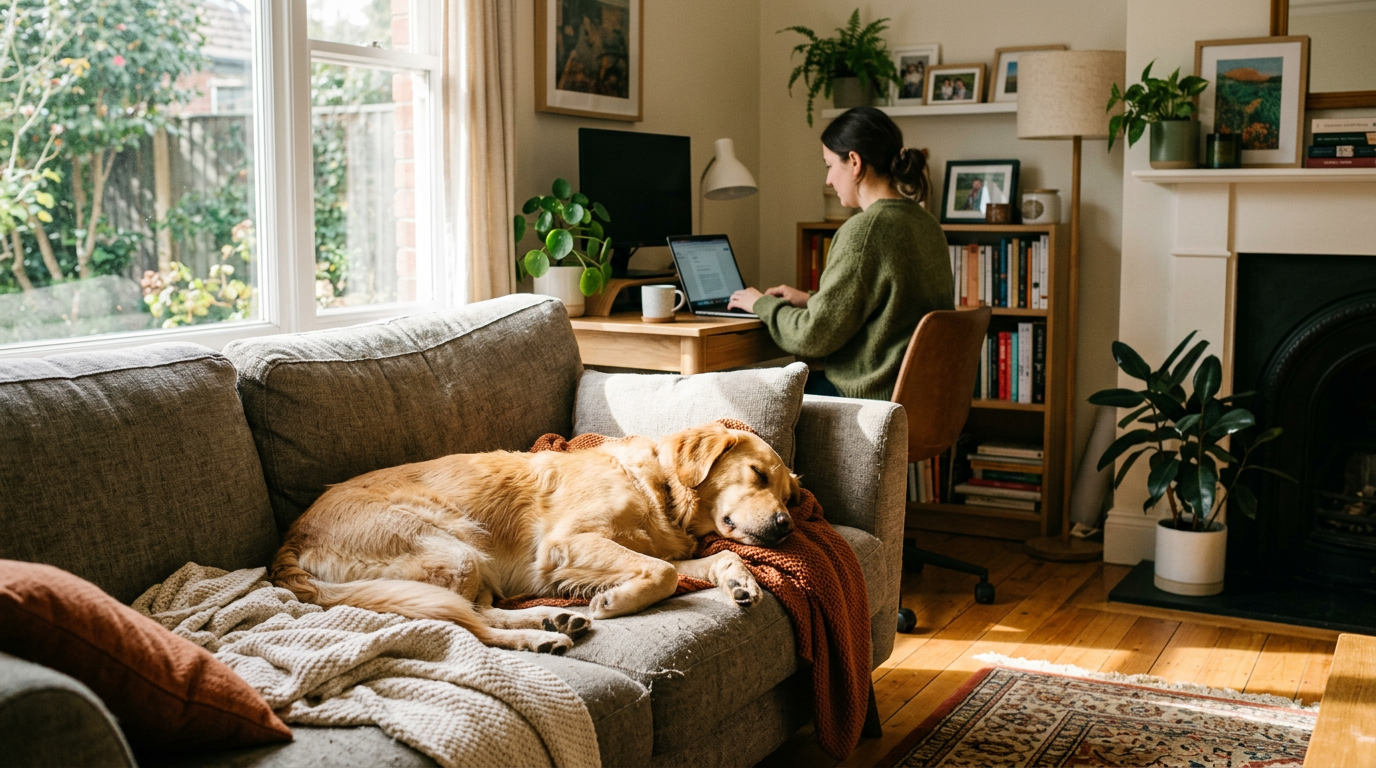
The return is the most load-bearing part of the whole method, and it's the part most owners get wrong, because getting it right feels unkind.
Walk in and ignore your dog completely. No touch, no eye contact, no talking. Wait until they're genuinely settled, not merely quiet. Then wait another five minutes. Then call them over on your terms and give them all the affection you want.
An excited greeting confirms to your dog that your absence was a real event, and that their worry about it was justified. A boring return tells them nothing happened. That's the whole message.
Watch for the games dogs run to pull you into an early greeting. Coming ninety per cent of the way across the room and stopping, so that you close the gap. Lying across your feet. Bringing a toy over. Move off without a word and carry on with whatever you were doing.
This applies to visitors too. One guest making a fuss on arrival can undo a week of consistent work in a single evening.
What makes it worse
Some of the most commonly given advice actively works against you here.
- Long, reassuring goodbyes. They mark your departure as an event, which is precisely what you're trying to undo
- Feeding treats for settling. With a clever dog, or one who isn't especially food-driven, this backfires. They learn the sequence of getting up and lying back down to get paid, and the worry underneath never resolves. Separation anxiety is a behaviour problem rather than a command problem
- Shutting the dog in the crate to contain the damage. The crate stays a positive space at all times, and it's never where a dog gets sent when things go wrong. A dog who associates the crate with being shut away loses the one safe space this work depends on
- Switching foods to chase a fussy dog's mood, which teaches them they control what happens next
- Staying home to avoid the problem. Every avoided absence is a rep you didn't do
Does living in an apartment change anything
Not the method. It does change the pressure you're under, because a barking dog behind a shared wall earns you a complaint in days rather than months, and that urgency is what pushes people into shortcuts. The stages above run identically in a two-bedroom flat in Zetland and a terrace in Randwick. What you may need on top is a neighbour who knows what you're doing and will give you a fortnight of goodwill.
How long this takes
Most established adult cases take four to eight weeks of consistent work. Puppies often improve inside one to two weeks. Be strict for the first fortnight before you judge whether it's working, because most of the owners who tell me the method failed were running it loosely rather than running it properly.
Be honest with yourself about severity. Long-established anxiety in an older dog can take considerably longer, and it's one of the few behaviour problems where I won't promise an outcome. If your dog injures themselves trying to escape, or shows aggression when you try to leave, stop the self-directed plan and get someone in. Our in-home behaviour and training sessions across Sydney exist for exactly that.
Regression is built into the model rather than being a sign it's broken. A few slipped returns won't undo weeks of good work. A pattern of them will.
Puppies and adult dogs
With a puppy, start leaving them alone in short stretches from the first week they're home, and build up gradually. Night crying is the version most people meet first. The volume often spikes right before a puppy settles by themselves, so responding at that exact moment locks the pattern in. Before you write it off as anxiety, check the room isn't too large, that they've had a toilet break, and that they were calm when you put them down. There's a fuller breakdown in our guide to puppy separation anxiety.
An adult dog is working against a belief that's been reinforced for years rather than weeks, which is why the timelines run longer and why the feeding work carries more weight. The protocol doesn't change. The patience does.
Calming sprays and supplements
Several calming sprays have arrived on the market over the last few years, and owners ask about them constantly. Some trainers rate them. The evidence is thin in both directions.
What is clear is that they're used alongside behavioural work rather than in place of it. Protein shakes without the gym don't build muscle, and the same logic applies here. If you want to try one while you run the protocol above, it's unlikely to hurt.
Want help putting this into practice?
The Toe Beans Co runs a free SKOOL community where Sydney dog owners get access to training guides, Q&As, and direct support from Luke. It's free to join.
Upcoming puppy schools in Sydney
Luke runs regular puppy schools across Sydney, with venues in Paddington, Edgecliff, Zetland, Alexandria, Marrickville and Neutral Bay. Anyone in Sydney can attend any location.
Check upcoming dates and book your spot →
Common questions about dog separation anxiety
Can separation anxiety be cured
Most cases improve substantially and many resolve completely. Established adult cases typically take four to eight weeks of consistent work, and puppies usually improve faster than that. Long-standing anxiety in an older dog is the situation where a full resolution can't be promised.
Should I get a second dog to keep my dog company
It rarely fixes it, and it often doubles the problem. The distress comes from losing access to you rather than from being alone in general, so a second dog doesn't answer the question your dog is actually asking. You also risk the new dog learning the same pattern by watching.
How long can I leave my dog alone while we're working on this
Only as long as they can currently manage calmly, which early on may be under a minute. Arrange a walker, a sitter or family cover for the gap between what your dog can handle and what your day requires. Repeatedly pushing past their threshold reinforces the anxiety rather than building tolerance.
Does a crate help with separation anxiety
It can, provided the crate is already somewhere your dog chooses to go. Never introduce a crate as a response to the anxiety, and never use it as the place your dog gets sent when things go wrong. Once the crate is associated with being shut away, you've lost the safe space this work relies on.
My dog is fine overnight but panics when I leave in the morning
That's common, and it points at the belief rather than at loneliness. Overnight you're present and your dog can account for you. In the morning you disappear and they can't. Work the stage one cue drills hardest on your morning routine, since that's usually the most heavily rehearsed set of departure cues in the house.