You grab the lead. Your dog goes from asleep on the couch to launching at the front door in about two seconds, and the next twenty minutes are you being towed down the street with your arm nearly out of its socket, praying no other dog shows up.
Leash pulling is one of the most common problems Sydney dog owners bring us, and it rarely means what people think. It comes down to what happens before you even reach the door, and what you do the moment the lead goes tight.
Here's what actually works.
Why loose-lead walking is hard to teach
A few reasons this trips up almost every owner:
- The walk is often lost before you leave the house. If your dog is already bouncing off the walls when you pick up the lead, calm walking outside was never going to happen.
- Your dog has taken the lead role, literally. Pulling usually means your dog has decided it's their job to choose the pace and the direction, not yours.
- Dogs vary in how much they tolerate a lead at all. Some settle onto it quickly. Others find it restrictive in a way that takes longer to work through.
- A four-month-old puppy and an eleven-month-old puppy aren't the same dog. Both get called "puppies", but their attention spans and impulse control are worlds apart.
- Most owners are comparing themselves to working dogs. A security dog walking to heel all day is handled by someone who works with dogs professionally, every day. Your dog is a family member, not on the clock.
Why it's worth fixing
A walk should be the easiest part of your day with your dog. For a lot of owners it's the part they dread, or quietly avoid.
Left alone, pulling means sore shoulders, awkward run-ins with other dogs, and walks that get shorter and less frequent because they're unpleasant. Fixed, you get a dog that's properly exercised, and a walk you can actually enjoy.
Some dogs will always prefer to be off lead given the choice. You're not training a robotic heel for the entire walk. You're building a dog that holds a loose lead when you need it, and settles into it rather than fighting it.
It's about progress, not perfection
For puppies: don't expect minutes of perfect heel-position walking. What you're doing now is laying the groundwork. Short, consistent sessions beat one long walk where everyone gets frustrated.
For adult dogs: look for small wins day by day rather than a fast fix. Pulling is often a sign of a wider pattern in how decisions get made in your house, not just a leash problem.
Win the walk before you leave the house
Most people lose the walk in the hallway, not on the street. Break it into stages, and keep your dog calm at each one before moving to the next:
- Put on your shoes and coat
- Pick up the lead and harness
- Call your dog over
- Clip on the lead
- Walk to the front door
- Step outside
- Walk to the edge of your property
- Step past your boundary
If energy climbs too high at any stage, go back one. If your dog can't settle, the walk waits.
This adds a few minutes at first. Within a week or two it takes less than five minutes start to finish.
Getting out of the car? Hold the collar until your dog is calm, then let them out and go straight into stop, start, change direction (more on that below).
Worth knowing: a full-body shake once your dog's out of the car, not a fearful shiver, usually means they're releasing tension. It's a good sign, not a bad one.
Setting up for success
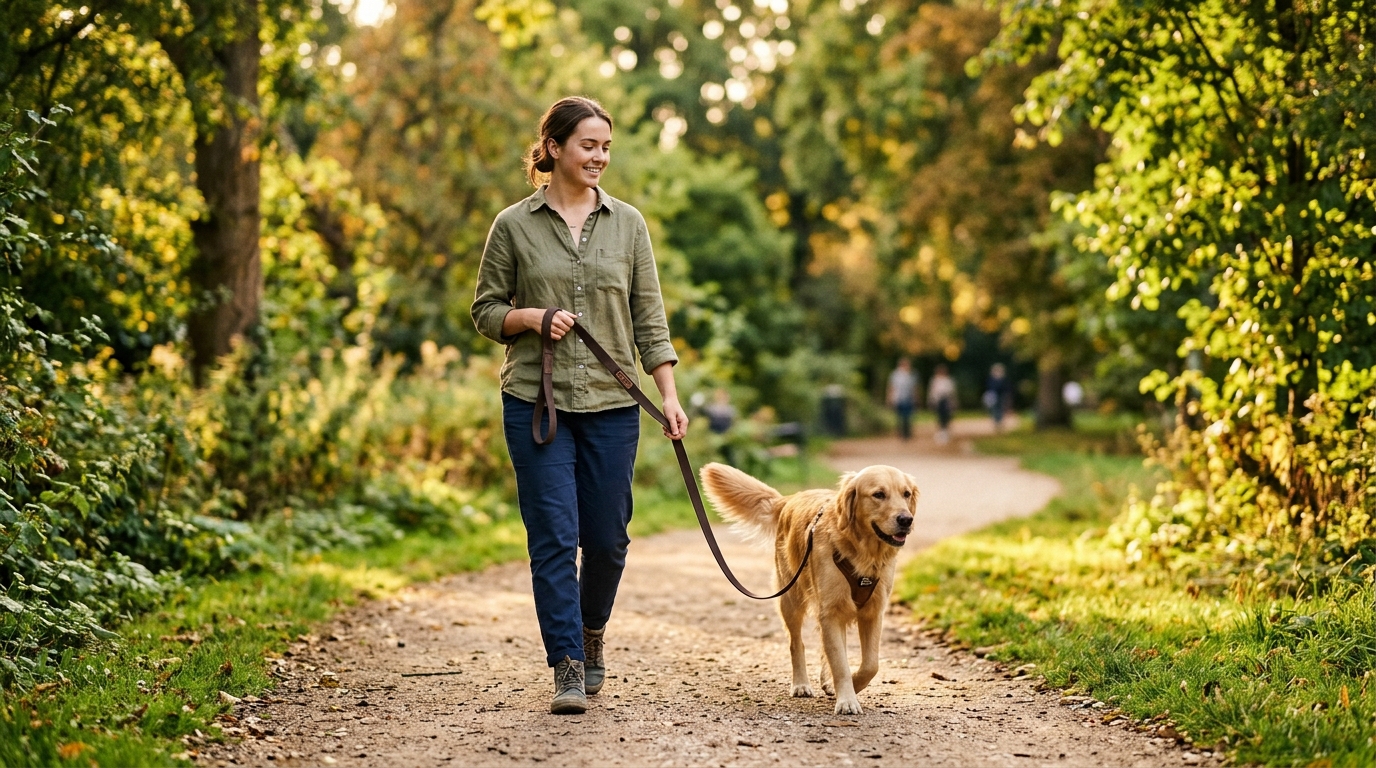
Once you're through the door, the job is still yours. Your dog needs to see, calmly, that you're the one making decisions on this walk, not tolerating whatever they decide to do with the lead.
Dogs get excited about walks. That's normal. Problems start when the excitement doesn't come back down, so calm energy matters on your end of the lead as much as theirs.
The structured walk and the free walk
Teach two cues:
- "Walk", paired with a pat on your thigh, starts a structured stretch where your dog stays close beside you.
- "Go free" or "okay" releases them to sniff and explore.
Move between the two often. Start with structured stretches of around twenty seconds, and build up over weeks until your dog can hold ten to twenty minutes of structured walking when you need it.
When pulling starts
The technique we use with almost every dog is stop, start, change direction. Stop without warning. Start again. Change direction, always turning in front of your dog rather than being pulled around behind them. Do this in silence, no words, no "no", no correction of any kind. Your dog can't predict what's coming next, so it has to start watching you instead of pulling ahead.
In a small space, like a hallway or a garden, compress the same technique into a tight figure-eight pattern. The constant direction changes do the same job in less room.
If your dog can't cope with what's around it, a strong smell, another dog nearby, walk away and reset rather than pushing through. That's not giving in. They're not ready for that distraction yet.
Whichever version you're using, keep your arm and the lead loose. Tension in your hand travels straight down the lead into your dog.
Using the right gear
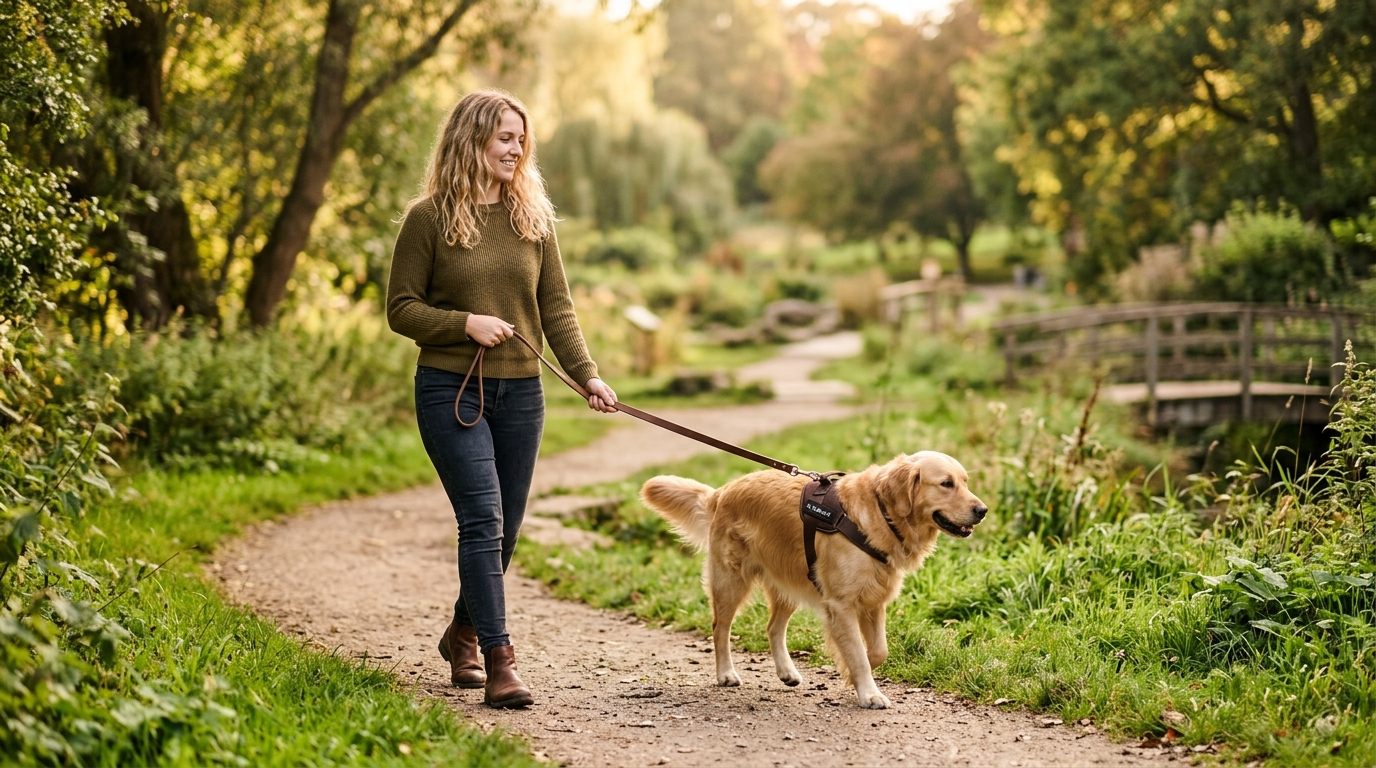
No harness or collar fixes pulling on its own. Your dog still has to choose to walk beside you because it's calm and paying attention. The gear just makes that easier to teach.
Front-clip harness: our first recommendation for dogs that pull. It gives you gentle steering without pressure on the throat.
Flat collar: fine once your dog already walks well, and for holding ID tags. Constant pulling against a flat collar puts pressure on the throat, so it's not where we start with a puller.
Long line: clip it to a harness, never a collar, for recall and off-lead-adjacent work. A hard jerk on a collar at speed can injure your dog's neck.
What we don't use: prong collars, e-collars, or choke chains used as corrections. They work through discomfort rather than trust, and they're not part of how we train.
Common mistakes that keep pulling going
- Yanking the lead when your dog gets ahead of you
- Expecting the finished result in the first week
- Pushing through situations your dog isn't ready for yet
- Holding the lead tight for the whole walk
- Losing your own calm, which travels straight to your dog
If a walk isn't going well, postponing it beats forcing it. Pulling doesn't fix itself through repetition alone. It fixes when the same structure gets applied consistently.
Recall and reactivity on the lead
Loose-lead walking is the foundation both of these sit on top of. If your dog can't hold a calm walk beside you, recall and reactivity work will be harder to build.
For the full process on getting a reliable recall, see our guide on recall training that actually works.
If your dog is barking, lunging, or freezing at other dogs or strangers on the lead, that's a different problem with its own process, covered in our force-free recovery method for reactive dogs.
Common questions about lead pulling
Q: Is it normal for a puppy to pull on the lead?
A: Common, and not a sign anything's gone wrong. Most puppies pull the first few times a lead's attached because they've had no practice with one yet. Short, structured sessions from eight weeks build the habit early, before pulling becomes the default.
Q: How long does loose-lead training take?
A: Depends on the dog and how long pulling has been the pattern. Some owners see a real difference within a couple of weeks of consistent stop, start, change direction. A dog with months or years of practice pulling usually takes longer to unlearn it.
Q: Will a front-clip harness stop the pulling on its own?
A: No. It makes pulling less rewarding and easier to manage while you teach the actual skill, but the harness alone won't teach your dog to walk calmly beside you.
Get ongoing support with lead walking
Loose-lead walking rarely gets solved in one session. Our free Skool community gives you somewhere to go when a technique isn't landing for your specific dog.
Inside, you'll get weekly live Q&A sessions, video walkthroughs of the walk checklist and stop, start, change direction, and a community of owners working through the same thing.
Sydney-based and want hands-on help? Luke runs 1:1 in-home sessions across the Eastern Suburbs and beyond, and the Complete Puppy Program builds loose-lead walking in from week one.