Most owners introduce the crate the same way: puppy in, door closed, then guilt when the crying starts. What follows is either a retreat, the door opens and the lesson is learned, or an exhausting standoff that confirms to the puppy that the crate is something to fight. Neither works, and neither is necessary. The crying itself isn't the problem to solve. It's information, and once you can read it correctly, crate training gets a lot easier.
Luke Buchanan, Owner of The Toe Beans Co and Sydney's Puppy Trainer, has worked through this with hundreds of puppies across Sydney. Nearly every "my puppy won't stop crying in the crate" call comes down to the same gap: nobody explained how to tell distress crying from protest crying, so every cry gets treated the same way. They're not the same, and responding to them the same way is what keeps owners stuck.
Why your puppy cries in the crate in the first place
A puppy at 8 to 16 weeks has almost no ability to self-regulate. The nervous system is firing constantly, new smells, new sounds, new surfaces, and there's no internal off switch yet. Crying is often that system overflowing. On top of that, a puppy that's recently left its litter has lost its main source of physical warmth and reassurance. The first few nights, some crying is a normal, honest response to that loss. It isn't a sign you're doing it wrong.
Where owners get stuck is treating every cry the same way. Some assume all crying means distress and abandon the plan the moment it starts. Others assume all crying is attention-seeking and ignore everything, including a genuine need. Both mistakes come from skipping the same step: working out which one you're actually dealing with.
Distress crying vs protest crying: how to tell the difference
These are two different signals and they call for two different responses. Confusing them is the single biggest reason crate training stalls.
Distress crying means a genuine need hasn't been met. If any of the following is true, that's your answer, meet the need calmly, then return your puppy to the crate rather than abandoning it for the session.
- Your puppy needs the toilet
- Your puppy has just eaten or had a drink and needs a few minutes before settling
- Your puppy hasn't had a toilet break or a run-around before going in, and has excess energy
- The crate is in a room that's too isolated for where your puppy is at in the process
- Your puppy wasn't calm before being placed down, the crying started before the door even closed
- It's one of the first few nights away from the litter, and this is honest first-night grief rather than a training problem
Protest crying starts after every one of those boxes is already ticked. Your puppy has toileted, isn't hungry, has had a run, the crate is set up right, and it was calm when placed down, and the crying is still happening or picks up once the door closes. That's not an unmet need. That's your puppy testing whether the noise changes what you do. It often spikes hard right before it drops off and your puppy self-settles, which is exactly the moment owners give in, because it sounds most urgent right then.
The test is simple: has everything on the distress list genuinely been ruled out? If no, it's distress, go and fix the actual problem. If yes, it's protest, and the way through is holding calm and quiet until there's a break in the noise, even two seconds, then opening the door. Opening it mid-cry teaches your puppy that crying works, and that lesson is quick to learn and slow to undo.
Set the crate up right before any of this matters
A few basics need to be right before the crying diagnosis is even useful. Size the crate so your puppy can stand, turn, and lie flat, and no larger. Go bigger and one end turns into a bathroom. Never crate a puppy under 8 weeks old. Cap daytime crating at 5 hours for a young puppy. That's a ceiling to build towards, not a starting point. Don't crate straight after a meal or a drink, and don't crate before a toilet break or a proper run-around.
Where you put the crate matters more than most owners expect, and it's a judgement call. My preference is the living room, with someone sleeping on the couch nearby for the first couple of nights. Nobody's woken across the house for toilet trips, and you get a clear, close read on whether a cry is distress or protest, rather than trying to interpret it through a closed bedroom door. The alternative is the crate in your bedroom. That works too. The trade-off is you'll eventually need to move it out, and that transition is its own small crying phase to work through later. Either is fine. Pick the one you can actually follow through on.
The crate training steps, briefly
The full day-by-day breakdown, treats at the entrance, feeding inside, extending the door closed second by second, is covered in detail in our companion guide on making the crate a safe space. The short version, mapped to what kind of crying to expect at each stage:
- Days 1 to 2, door open. Almost no crying at this stage. If there is any, it's distress, check the list above, most likely your puppy wasn't calm before being placed near the crate.
- Days 2 to 5, door closed for seconds then minutes. This is where protest crying usually shows up for the first time. Hold for a break in the noise before opening. Don't extend the duration until a session has gone quietly from start to end.
- Week 2, out of sight. Crying that returns here is often distress again, specifically the room feeling too isolated too soon. Go back a step rather than pushing through.
- Week 2 onward, overnight. This is where the two types of crying matter most, covered in detail below.
Overnight crying: distress or protest, decided in real time
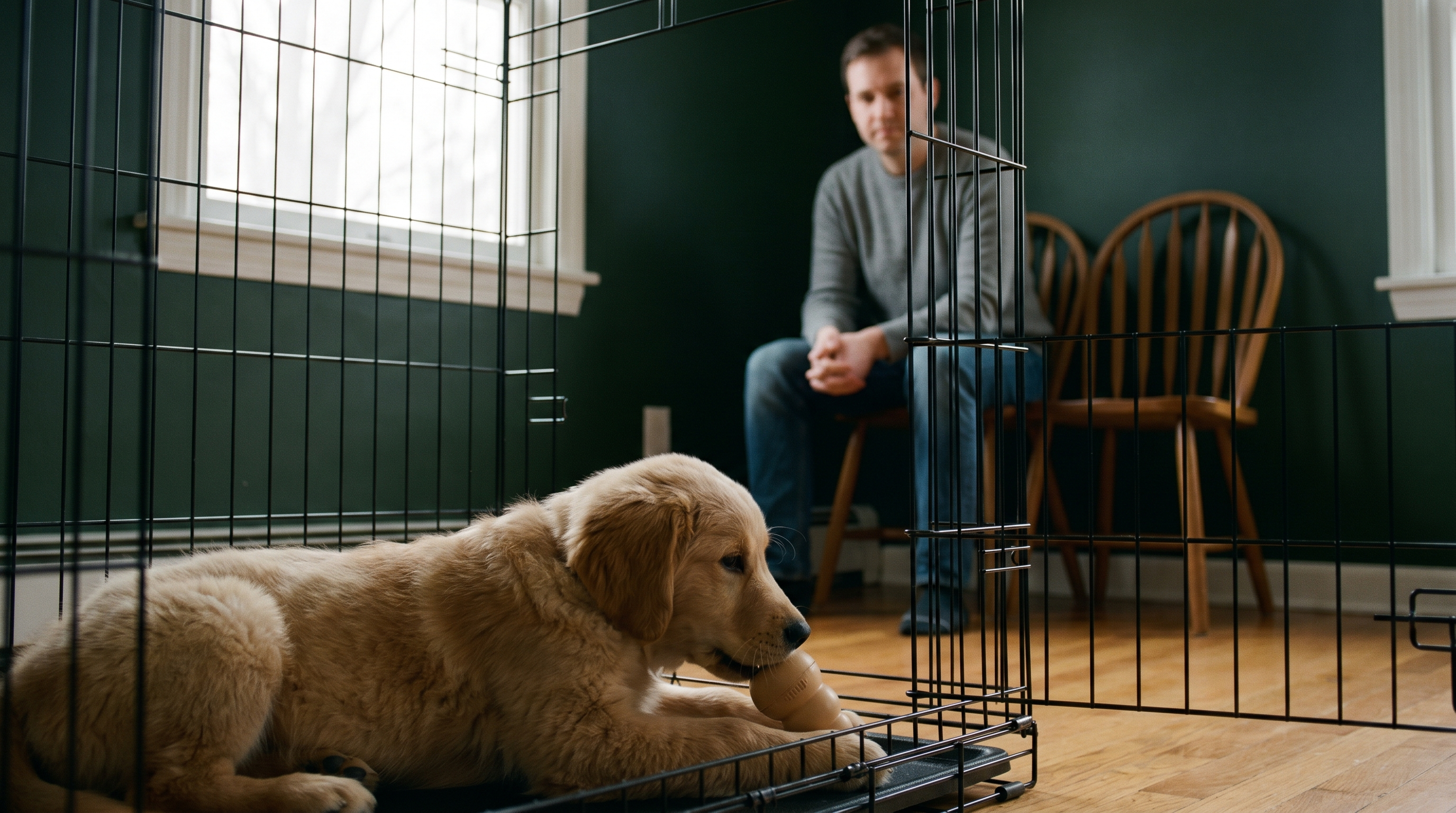
This is where the distinction earns its keep. Set an alarm for around 1am for the first week, and get up before your puppy is fully awake and crying if you can. Carry your puppy outside without any talking, fuss, or eye contact. Wait for the toilet, offer a small, quiet reward, and go straight back to the crate. No games, no extended cuddles. Keep the whole thing boring on purpose. Boring is what tells your puppy the night is for sleeping.
If crying starts outside that window, ask one question: has it actually been long enough since the last toilet break for this to be a genuine need? If yes, that's distress, take your puppy out the same calm way. If the alarm went off twenty minutes ago and the crying has started again, that's very likely protest. Hold off. Wait for quiet, then let your puppy out as a non-event, not a celebration. However your puppy comes out of the crate, day or night, keep it calm rather than excited. An excited greeting after a cry is one of the fastest ways to make the crying worse the next night, because it just got rewarded.
Troubleshooting crying that doesn't fit the pattern
Most cases resolve with the distress and protest framework above. A handful don't, and they're worth naming so you're not left guessing.
Crying spikes hard, then stops abruptly. That sharp peak right before silence is almost always protest crying about to resolve on its own. Go in at the peak and you'll interrupt your puppy right as it was about to succeed. Hold off, even though it's the hardest moment to wait through.
Crying starts again every time you leave the room, even after weeks of progress. Check whether this is really about the crate, or about being left alone generally. If your puppy is settled in the crate while you're home but unravels the moment you're out of sight anywhere in the house, not just the crate, that's a separation issue rather than a crate one. This guide on separation crying covers it specifically.
Crying doesn't stop after 10 to 15 minutes, even with the checklist ticked. Don't wait it out on principle. Take your puppy out calmly, reset, and go back a stage in the sequence. Something was pushed faster than your puppy was ready for, and the fix is backing up, not holding firm.
Crying that had stopped comes back after a break, illness, or a change in routine. This is common and it isn't a failure. Go back to the last stage that was actually quiet and rebuild from there rather than starting completely from scratch.
Toilet training regressed and the crying is tangled up with accidents. Crate training and toilet training run on the same clock in the early weeks. If accidents have crept back in, the crate schedule usually needs tightening before the crying will settle. Our toilet training guide has the schedule that fixes this fastest.
Quiet doesn't always mean settled
One distinction worth having, because it changes what you're aiming for. A puppy that's stopped crying because it's worn out looks the same at a glance as a puppy that's actually settled, but they're not the same thing, and only one of them is the goal. Watch the body, not just the noise. A settled puppy lies with its weight properly down, breathing slows, eyes are soft or closed. A puppy that's shut down from exhaustion tends to hold itself stiffer, curled tight, barely moving, more frozen than relaxed. If you're consistently seeing the second pattern, that's a sign the steps were moved through too fast, not that the method doesn't work. Go back a stage and slow down.
How to know it's working
By the end of the first week, protest crying should be shorter and less frequent, not gone entirely, shorter. By week two, the overnight wake-up should be down to one clean toilet trip with a quick return to sleep. By week three or four, a cry on entry, if there's one at all, should be brief and self-resolving within a minute or two, without any need for you to do anything.
Want help putting this into practice?
The Toe Beans Co runs a free SKOOL community where Sydney dog owners get access to training guides, Q&As, and direct support from Luke. It's free to join.
Upcoming Puppy Schools in Sydney
If you want structured, in-person guidance, Luke runs regular puppy schools at venues in Paddington, Edgecliff, Zetland, Alexandria, Marrickville and Neutral Bay. The Paddington venue at 308 Oxford Street is the flagship, and anyone in Sydney can attend any location.
Check upcoming dates and book your spot
Frequently asked questions
Q: Is it normal for a puppy to cry in the crate?
A: Some crying in the first few nights is normal and honest, your puppy has recently lost its main source of warmth and company. What matters is telling that apart from protest crying once the basics are in place, and responding to each correctly rather than treating every cry the same way.
Q: How do I tell distress crying from protest crying?
A: Run through the distress checklist first: toilet, food, exercise, calm before placement, room not too isolated, early first nights. If any of that's true, it's distress, go and fix it. If everything's ticked and the crying continues or picks up after the door closes, that's protest. Wait for quiet, then open the door.
Q: My puppy stopped crying. How do I know if that means settled or just worn out?
A: Watch the body rather than the silence. Slow breathing, soft eyes, and weight properly down mean settled. A stiff, curled, barely-moving puppy is more likely shut down from exhaustion than relaxed. If you're seeing the second one, slow the process down and rebuild from the last stage that was genuinely calm.
Q: How long does crate training a puppy take?
A: Most puppies who follow a staged introduction and the distress and protest framework reach reliable, voluntary crate use within 2 to 4 weeks. Skipping the diagnosis step, and responding to every cry the same way, is what stretches that timeline out.
Q: Is there a crate training specialist near me in Sydney?
A: The Toe Beans Co offers in-home puppy training across Sydney, plus group puppy school at venues in Paddington, Edgecliff, Zetland, Alexandria, Marrickville and Neutral Bay. Crate training is covered in the Complete Puppy Program, which includes an at-home 1:1 session, a 4-week group puppy school, and a week-by-week online course from eight weeks to twenty-four weeks. Luke works through crying and settling issues in 1:1 sessions regularly.