
What Puppy School Actually Does for Your Dog

"What does puppy school actually give my dog?" is a fair question, because most owners can't name the outcomes past "he'll be trained." Puppy school isn't one event that produces a trained dog. It's the delivery mechanism for four concrete outcomes: bite inhibition, a settled dog in public, solid recall foundations, and an owner who actually knows what to do at each stage. None of those land properly in a single four-week course. They need scaffolding across the whole window from 8 weeks to 6 months and well beyond it.
Luke Buchanan, Owner of The Toe Beans Co and Sydney's Puppy Trainer, built the Complete Puppy Program around exactly that gap, because puppy behaviour isn't fixed in one lesson. It develops on its own biological timeline.
Bite inhibition
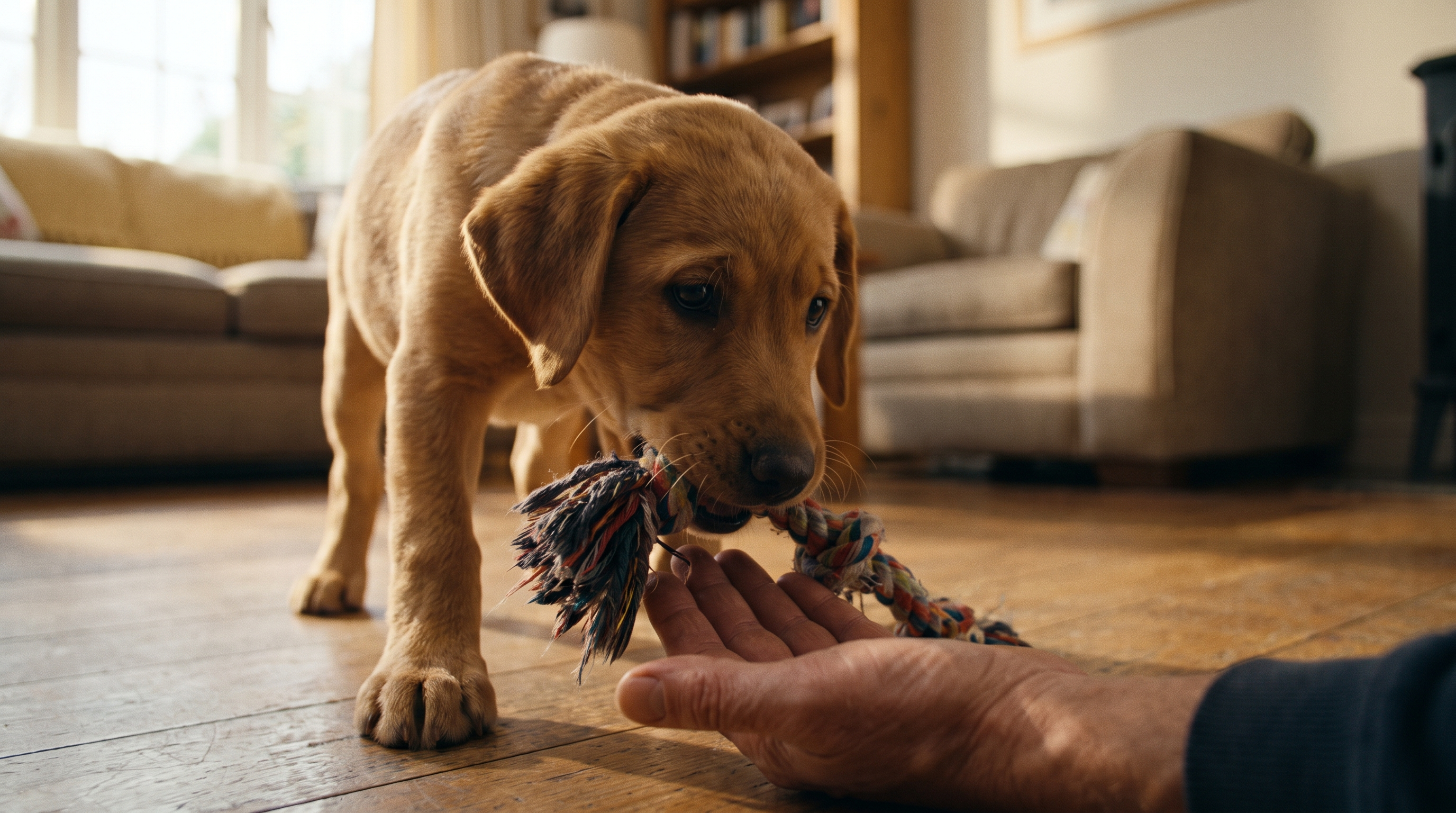
Mouthing at eight to twelve weeks is normal. Puppies learn bite pressure from littermates yelping and pulling away, and puppy school's job is managing that correctly through the window, then tightening the response as the puppy gets older. What's appropriate at nine weeks becomes a genuine problem at sixteen.
At eight to ten weeks, redirect only, hand never in the mouth, swap in a soft toy. At twelve to fifteen weeks, go quiet, take a calm underhand grip of the collar under the chin until the puppy settles, then release, gently push off, and redirect. No words at any point, because any verbal response is still engagement and engagement is what the puppy is after. By sixteen weeks, mouthing should be dropping off, and if it isn't, that's an immediate calm timeout, because it's stopped being developmental.
A nine-week-old puppy mouthing hard during a cuddle gets a calm redirect to a toy. A seventeen-week-old doing the same thing goes straight to a quiet room for a minute or two, not because the behaviour changed but because the correct response moved. Owners who only attend a class at nine weeks and never get guidance again are usually still redirecting with a toy at five months, when the right response has already shifted three times.
A settled dog in public
Public settling comes down to two things: keeping a dog's arousal below the level where it can actually learn, and getting real socialisation done before the window closes at 6 months.
Stop-Start-Change Direction is the core tool for teaching a dog to track you rather than the environment. "Making nothing of it" is the one most owners get backwards. If a puppy freezes at a skateboard rolling past on a Newtown footpath, the instinct is to crouch down and soothe it. That confirms there was something worth worrying about. The trained response: turn your back to it, ignore the puppy entirely, only give affection once the skateboard's gone and the puppy's settled on its own.
Eight to twelve weeks is "making nothing of it" and handling. Sixteen weeks to 6 months is where structured socialisation has to lock in, because that is the end of the window. A dog that misses that structured public exposure is significantly more likely to develop fear-based reactivity later, and that's a much harder thing to undo.
Recall foundations
Recall is unusual because it starts as a relationship outcome long before it's a formal command. Every time your dog comes when called and gets something good for it, recall is already being built, whether you've started "training" it yet or not.
At ten weeks, recall starts on a short line indoors: call once, step on the line if needed, reward, release with "OK" so coming back never feels like the fun is over. By five or six months, the same dog is off-lead in a park being called past the distraction of another dog. That's not the same skill louder. It's a new skill layered on the first one. And never call a dog to do something it dislikes, a bath, a nail clip, the crate. Go and get it instead, or recall stops being reliable for good.
A puppy with a single four-week class at ten weeks has zero scaffolding for the distance-and-distraction phase that shows up months later. That gap is exactly what ongoing support is built to fill.
An owner who knows what to do at each stage
This is the outcome that actually matters most, and it's the hardest one to deliver in a single class. A four-week course can teach you what to do in week one. It can't teach you to recognise that your five-month-old's new pushiness is puberty, not a training failure, or that twelve to twenty-four months is the peak adolescent stretch where every earlier piece of work gets tested hardest.
An owner whose only contact with a trainer was a class at ten weeks has no way of understanding why their previously easy seven-month-old is suddenly ignoring recall around other dogs. Panic and inconsistency creep in right when consistency matters most. An owner still connected to support at that stage gets told plainly: this is normal, here's what to reinforce, hold the line and it passes.
Why this needs more than four weeks
The developmental stages this covers span close to a year, from eight weeks to twenty-four months in larger breeds, and the correct action changes at nearly every stage. That's the actual reason the Complete Puppy Program is built as an at-home 1:1 session, four weeks of group school, an online course that runs week by week from eight weeks to twenty-four weeks, and ongoing support, rather than a single class. It's designed to cover the whole window, not just the slice that happens to fall inside class dates.
The most common mistake I see is treating puppy training as something that happens in class and finishes when the class ends. The patterns set in the first six months are the hardest to undo, and several of these outcomes have hard deadlines that sit well outside a four-week format.
Want help putting this into practice?
The Toe Beans Co runs a free SKOOL community where Sydney dog owners get access to training guides, Q&As, and direct support from Luke. It's free to join.
Upcoming Puppy Schools in Sydney
If you want structured, in-person guidance for your puppy, Luke runs regular puppy schools at venues in Paddington, Edgecliff, Zetland, Alexandria, Marrickville and Neutral Bay. The Paddington venue at 308 Oxford Street is the flagship, and anyone in Sydney can attend any location.
Check upcoming dates and book your spot
Frequently asked questions
Q: How long does it take for puppy school benefits to actually show up?
A: Bite inhibition and basic settling usually show progress within two to three weeks of consistent handling. Recall and public settling take longer, often three to six months, because they're built in layers as your puppy grows.
Q: Will a four-week puppy school class be enough on its own?
A: For the socialisation piece, largely yes if the class is well run. For recall, bite inhibition timing, and reading adolescent changes, you'll need guidance that continues past week four.
Q: Does The Toe Beans Co support continue after puppy school finishes?
A: Yes. The Complete Puppy Program includes an at-home 1:1 session on every tier, plus an online course that runs week by week from eight weeks to twenty-four weeks and ongoing support, so you're not left without guidance once group classes end.
