
Velcro Puppy: When Following You Everywhere Becomes a Problem

Your puppy follows you to the kitchen when you make coffee. Follows you to the bathroom. Follows you back to your desk, circles twice, and settles with its chin on your foot. You tell yourself it's sweet. It probably is, at this stage. But if you're in Sydney's Eastern Suburbs, working from home, and your puppy is eight weeks old, there's something worth knowing: the velcro stage is the easiest behaviour to enjoy and the easiest to accidentally turn into a real problem.
Luke Buchanan, Owner of The Toe Beans Co and Sydney's Puppy Trainer, sees it regularly. The puppy that followed everywhere at ten weeks becomes the dog that destroys the door frame at six months, the first time the owner goes back to the office. The owners are always shocked. The pattern was always predictable. Here's what's actually happening, and what you can do about it now, while it still takes days to fix rather than months.
What a velcro puppy actually is
A velcro puppy isn't an especially loving dog. It's a dog that hasn't learned to expect you'll come back, so following you is its safety strategy.
The Toe Beans Co works from Relational Leadership, and under that framework following behaviour comes down to responsibility. A puppy that believes it's holding the leadership role in the household has no off-switch for that responsibility. The leader's safety is the leader's job. A puppy that's been positioned, accidentally, as the one in charge can't afford to let you out of sight. It follows because switching off feels dangerous.
The observable distinction matters here. Healthy following: your puppy comes to you when you move, checks in briefly, then settles. It can turn its attention to a toy, a smell, or the room when you're stationary. When you disappear briefly into the next room, it might look towards the door but settles within thirty to sixty seconds. Velcro behaviour looks different: your puppy gets up every single time you move, regardless of direction. It can't settle in a room unless you're physically there. Physical contact-seeking is close to constant. When separated by a door, it vocalises without pause or self-regulation.
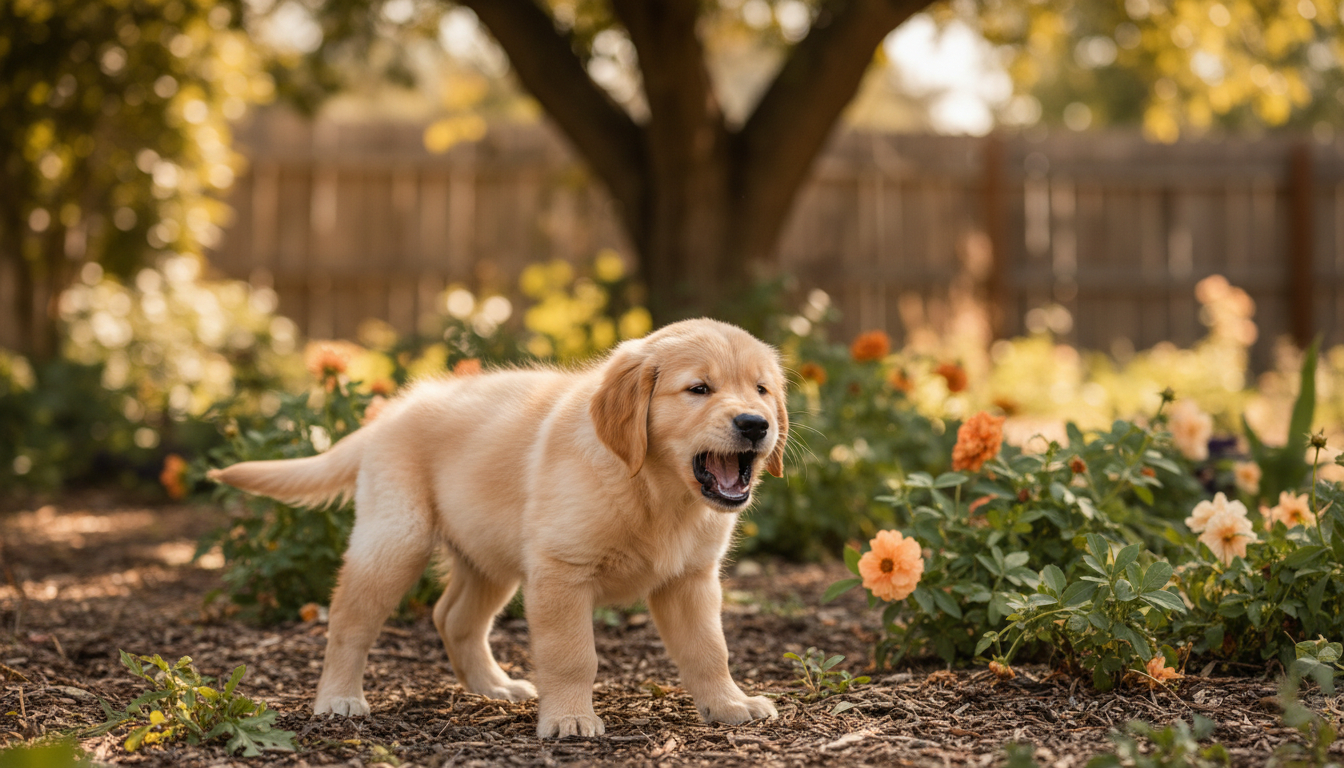
Why some puppies are velcro and others aren't
Two factors overlap: genetic predisposition and owner-created reinforcement. Both are real. Only one is within your control.
Certain breeds were selectively bred for constant handler attention. Border Collies, Kelpies, and Australian Shepherds were bred to check in with their handler constantly and read micro-signals. Vizslas and Weimaraners were historically bred as close-contact companions. Toy breeds like Cavalier King Charles Spaniels were bred specifically to be human companions.
But genetics only set the odds. What locks the pattern in is reinforcement. The most common pattern: you enjoy the velcro stage. Your puppy following you everywhere feels like love, so you respond with contact and attention every time it does.
Working from home makes it worse. When you're home all day, there are more chances to reinforce the pattern. Your puppy follows you to the kitchen and gets a pat at the kettle. By week four, it's learned you're always within range, so any experience of you being gone feels bigger than it should.
How velcro behaviour becomes separation anxiety
Velcro behaviour and separation anxiety sit on the same spectrum, just at different points. When the velcro dynamic is in place and you actually leave, your puppy's arousal system switches on with nothing there to hold it in check.
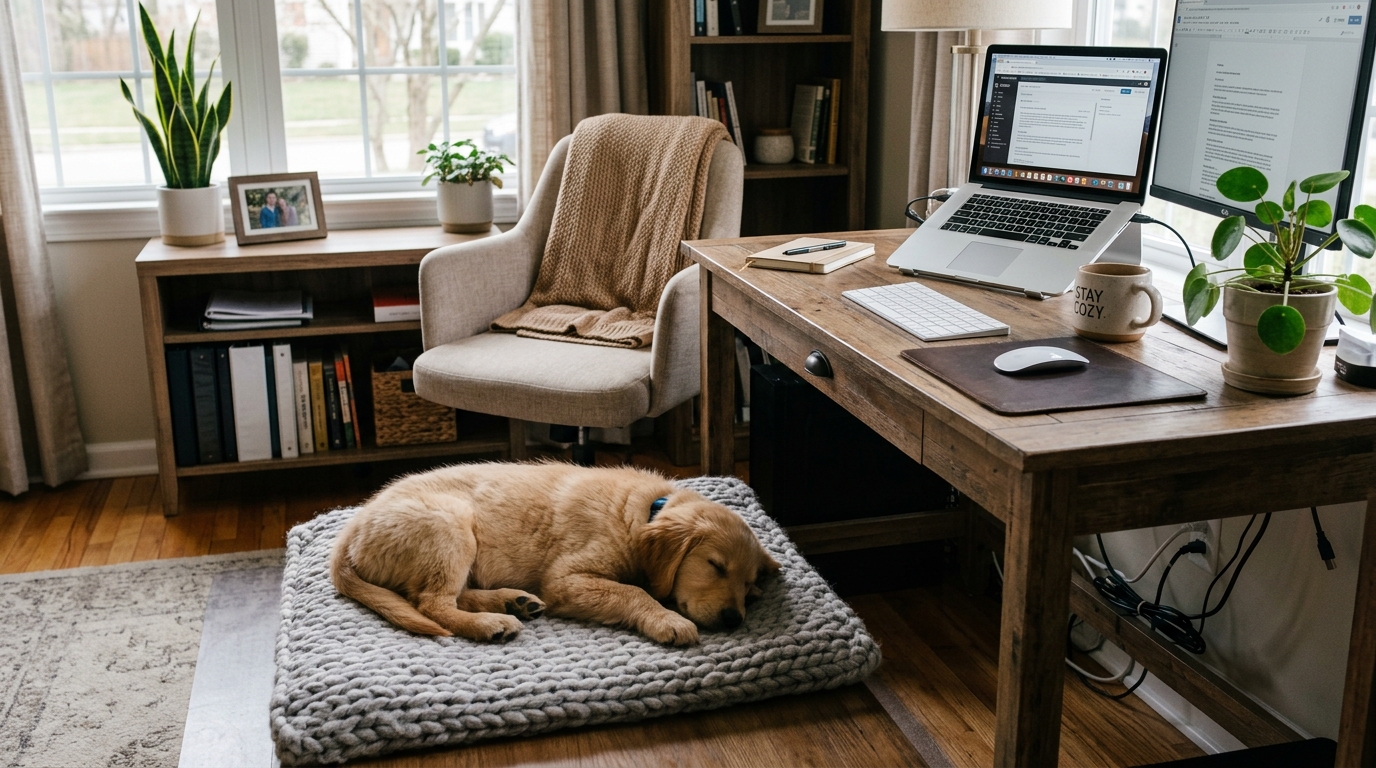
The WFH case is the sharpest version of this. A puppy raised in a full-time WFH household has often never experienced an absence longer than five minutes in its first twelve weeks. When you go back to the office, the gap between what your puppy's nervous system expects and what it actually gets is enormous. It's the pattern Luke sees most often in Eastern Suburbs separation anxiety cases: not a dog with a temperament problem, a dog that's never had the practice.
For a full breakdown of what separation anxiety looks like and how to work through it, see the puppy separation anxiety guide.
Building independence without breaking trust
Independence isn't taught by leaving your puppy alone and hoping it copes. It's built through repeated, reliable proof that absence is safe, exercising the self-regulation muscle until your puppy can find its own baseline without you there.
The exercises that actually work at eight to sixteen weeks, covering both directions: the constant shadowing during the day, and the leaving and returning.
Who initiates contact. This is the piece most velcro advice skips: the following that happens all day, not just at the door. When your puppy noses in, leans against you, or pushes into a room ahead of you, it's initiating the interaction, and that's the leader's job, not the follower's. The fix is calm and silent: create a small gap. Step back half a step. Close a door partway. Redirect to the mat. No pushing your puppy away, no talking, no using its name, just a quiet gap that makes clear you decide when contact happens. Call your puppy to you instead, on your terms, several times a day.
The mat and settle protocol. Teach your puppy to go to a mat and stay there while you move around the house. Start at a metre. Work up to the other side of the room, then a different room. Build duration: thirty seconds, then five minutes, then fifteen. The rule holds both ways: your puppy doesn't leave the mat to follow, and you don't go to your puppy while it's on the mat, except to reward the settle.
A smaller world to manage. Use a baby gate to create different levels of proximity through the day, in the same room for some activities, separated (visible, audible, not accessible) for others. A smaller space is also easier for a puppy to feel settled in than the run of the whole house, so this does double duty. It builds structured separation multiple times a day without you leaving the house at all.
Mini departures. Leave the room. Walk back in. Leave for ten seconds. Walk back in. Do this twenty to thirty times in a session, with no emotional content on departure or return, then ignore your puppy completely until it's genuinely settled, wait five more minutes, and only then call it to you. Build duration unpredictably. By the end of the first week, your puppy has had absence resolve itself dozens of times.
The morning routine sequence. Puppy on the mat while you shower. Getting dressed in a different room. Making coffee without your puppy underfoot. None of this needs extra time. Independence gets built into normal domestic life.
Crate time during the day, not just at night. Three to four times a day while you're home. If your puppy cries, don't open the door until you get thirty to sixty seconds of quiet, then let it out calmly, no fuss. Opening the door on crying teaches your puppy that crying works. The crate becomes associated with routine, not loss. If you haven't set the crate up as a safe space yet, TBC's crate training guide covers how to do that from day one.
The Complete Puppy Program builds independence from week one, because the puppies that don't have it by twelve weeks are the ones showing the sharpest separation problems when the household routine changes.
The bathroom test (and other small daily practices)
Going to the bathroom is one of the most unavoidable short separations in daily life, which makes it a useful daily gauge. Pass: your puppy watches the door close, maybe sniffs around it once, then wanders off. When the door opens, it might look up but doesn't mob you. Fail: your puppy sits at the door and vocalises the whole time. When the door opens, it jumps up, seeks contact, or follows tightly back.
If it's a fail, use it deliberately. Close the bathroom door ten times a day as training reps. Wait thirty seconds. Open only when your puppy isn't actively vocalising.
Every time you come back, give your puppy nothing until it's settled, no eye contact, no voice, no touch, then wait a bit longer before you initiate. That's how arrivals become non-events. Once arrivals are non-events, departures are too.
When to call a trainer
Getting a trainer involved early is prevention, not damage control. Reach out now if your puppy can't be left alone in a room for five minutes without sustained vocalising, and that's still true after seven days of consistent handling. Reach out if you're full-time WFH with no structured alone-time built into the first four weeks. Reach out if there's a return-to-office date in the next four to eight weeks and your puppy hasn't been prepared for it. The eight-to-sixteen-week window is when this work responds fastest. You can book a meet and greet and Luke will walk through where you're at.
Want help putting this into practice?
The Toe Beans Co runs a free SKOOL community where Sydney dog owners get access to training guides, Q&As, and direct support from Luke. It's free to join.
Upcoming Puppy Schools in Sydney
If you're based in Sydney's Eastern Suburbs and want structured, in-person guidance for your puppy, Luke runs regular puppy schools at Paddington and Neutral Bay. The Paddington venue at 308 Oxford Street is the flagship, and anyone in Sydney can attend either location.
Check upcoming dates and book your spot →
Frequently asked questions
My puppy was fine, then suddenly got clingy. Why?
In the first seven to ten days after arrival, most puppies are in an observation phase. Around weeks two or three, the attachment system activates on schedule. Whether it develops into velcro behaviour depends on how you respond between weeks three and eight. A second common cause is the fear imprint window at approximately eight to eleven weeks.
Should I let my puppy sleep on the bed?
TBC's position: a puppy that handles separation well during the day, settles independently, and whose owner manages contact on their own terms can share a bed without it being the driver of any problems. The practical test: if your puppy can be put off the bed and settle on the floor without vocalising or persisting, the sleeping arrangement isn't the primary problem.
Is it bad that I work from home?
Working from home isn't bad for your puppy. It's a training challenge that requires active management. WFH is actually an advantage used correctly: no environment gives you more opportunity for mini departure training reps than being home all day. The fix isn't working from the office. It's introducing structured separation into the WFH day deliberately.
