
Puppy Barking at Night: How to Get Your Puppy Settled

Night one with a new puppy, you probably expected some crying. Night five, you may be questioning every decision you made this year. What most owners don't know, and what most training advice glosses over, is that the first few nights of barking and the barking that develops four weeks in are two completely different problems, driven by different states in the puppy's nervous system. Applying the wrong fix to either one makes both worse.
Luke Buchanan, Owner of The Toe Beans Co and Sydney's Puppy Trainer, works with new puppy owners across Sydney's Eastern Suburbs regularly, and night barking comes up in almost every intake. Here's the honest version: what's actually happening, the rule most owners don't hear, and how to get through it.
Why your puppy barks at night
What's happening biologically: cortisol spikes sharply the moment a puppy is separated from the litter, triggering a genuine stress response, not manipulation. The nervous system doesn't yet have the capacity for independent regulation, so vocalising is the only tool it has.
A puppy pulled from its litter at seven to eight weeks has spent its entire existence in a warm, physically dense group. Warmth regulation in early puppyhood is partly collective: the litter sleeps in a heap and body heat is shared. A puppy sleeping alone for the first time drops its core temperature faster than its thermoregulatory system can compensate, and that physical discomfort is real.
Cortisol levels spike sharply at litter separation. This isn't excitement arousal or alert arousal. It's the biological stress response to perceived pack loss. In the wild, a puppy separated from the pack vocally signals its location. The vocalisation is survival behaviour, not manipulation. The puppy's nervous system has no concept of "this is my new home." It knows its pack is gone and it's signalling to be found.
In my sessions, this is the thing new owners get wrong most often: they hear the crying as defiance or manipulation, when the puppy doesn't have the developmental capacity to fake it. The signalling is involuntary.
Pack instinct in this developmental window means the puppy's primary regulation mechanism is proximity to the group. In a litter, the puppy co-regulates with its siblings and mother. The first few nights alone are the first time it has ever had to attempt independent regulation. It doesn't yet have that capacity. It hasn't been built. This matters because it means the puppy can't "calm itself down" through effort. The biology won't allow it at this age.
In weeks one to three, night barking is a biological response to a genuine loss. The environment needs to address the underlying state: warmth, proximity, familiar smell. Training logic doesn't apply yet.
The first week is the hardest (and what to expect)
Nights one to three are typically the worst. The puppy is in a completely new sensory environment: new smells, new sounds, new floor surfaces, no litter smell, no heartbeats nearby. Every input it uses to evaluate safety is absent.
Nights four to seven begin to shift if the environment is set up correctly. The puppy starts to register the owner's smell, breathing, and presence as a substitute regulation input. Improvement is non-linear: a good night four followed by a difficult night five is completely normal and reflects how stress recovery works in a young nervous system, not failure.
What I see almost every time is exactly that pattern: a good night four, then a rough night five, with the owner assuming they've done something wrong. They haven't.
By week two to three, a puppy that has been placed with the proximity principle in place (more on this below) will show longer quiet windows. One overnight toilet run is normal at this age. The bladder can't physically hold through the night until approximately twelve to fourteen weeks.
The rule most trainers don't tell you
Standard advice splits into two camps: "let them cry it out" or "take them to bed with you." TBC's position is that both are wrong, and the answer sits between them.
I've had this conversation with a lot of Sydney parents who tried the full cry-it-out approach for one night and gave up by 2am. Neither extreme works for a puppy this young.
In the Relational Leadership framework, a puppy that is genuinely afraid and isolated isn't learning anything except that the world is unsafe and that the pack doesn't respond. The complete-ignore approach applied to a newly separated eight-week-old is the wrong tool for that developmental moment. That said, bringing the puppy into the bed immediately creates a physical precedent that becomes very difficult to walk back as the dog grows.
The practical principle is that your puppy needs to be aware that you are there, but does not think that crying gets them attention. There are 2 methods:
- Crate in living room (preferred)
- Crate in bedroom
Crate in the living room
If you place the crate in the living room, then someone sleeps on the couch for the first few nights. You can follow the routine and make sure you are helping them toilet and this doesn't disturb anyone else. You can also move about to help your puppy understand you are there without needing to give them direct attention.
In the event that your puppy has a meltdown and you know it is not distress over toileting you simply stand up turn on the lights and move around for a few minutes. You do not need to acknowledge your puppy, then go back to bed. You are telling them I am here, there is nothing to worry about.
Once you have moved back to your bedroom and left the puppy in the living room you would follow this same advice. Your puppy cries and you know it is not distress then you walk into the room and move about for few minutes.
Crate in the bedroom
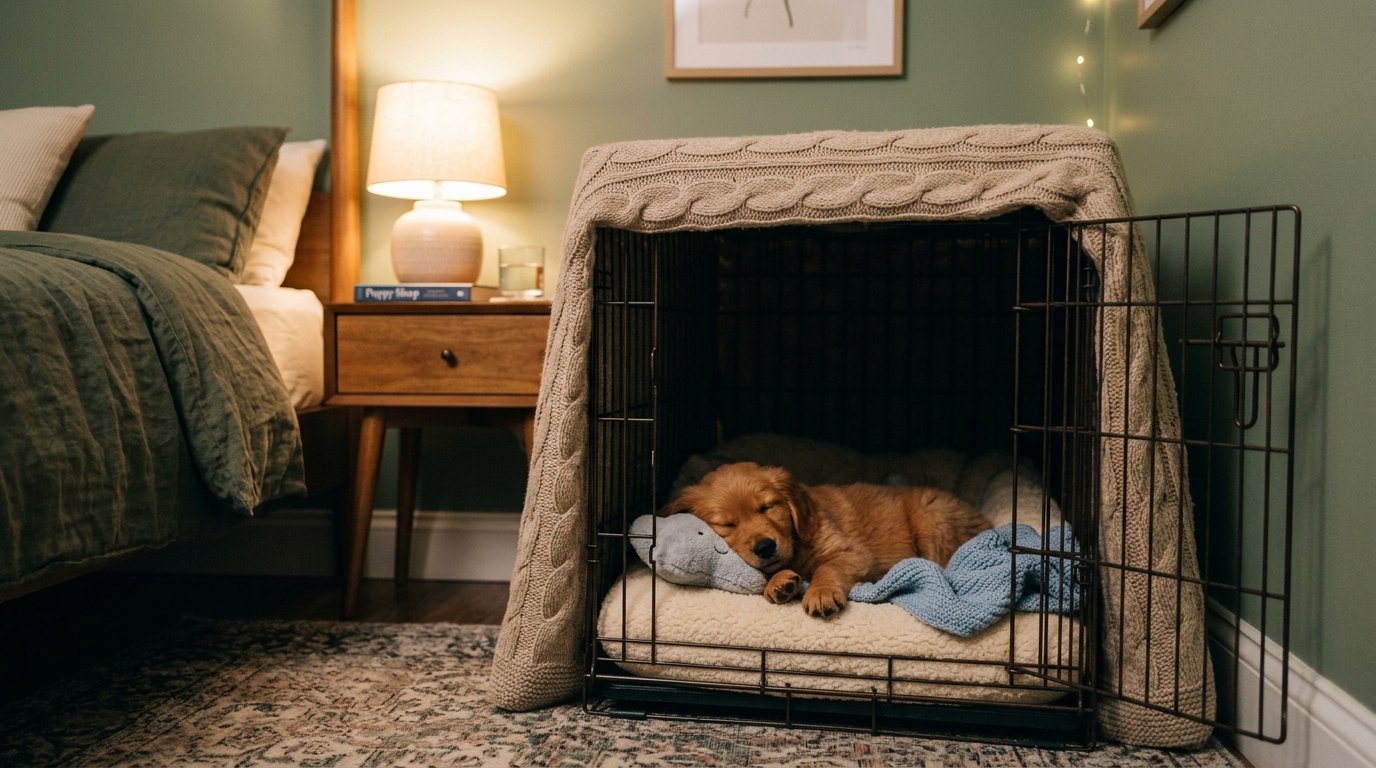
If you want to have the crate in the bedroom this is for you: The crate or sleeping area sits beside the owner's bed, on the floor next to it, close enough that the puppy is within approximately one to two metres. At that distance, the puppy's nervous system receives a proximity signal that partially substitutes for litter co-regulation. The vocalising reduces dramatically.
The graduated withdrawal is the part most trainers skip. Once the puppy is settled overnight at that close distance (typically by the end of weeks two to three), the sleep area moves incrementally. Not from beside the bed to the hallway overnight. A foot at a time. Then a metre. Then to the doorway. Then outside the room. This takes three to six weeks, and the pace is dictated by the puppy's actual response, not your timeline. A few nights of regression means you moved too fast, not that the method has failed.
Setting up the sleep area
A crate is the preferred setup because it creates a defined den space, makes overnight toileting clear (the puppy signals at the door), and establishes the positive crate association that carries into daytime settling and travel. The crate training guide covers the full introduction sequence.
The sleeping area must feel enclosed, not open. Puppies in the wild sleep in dens. An open bed on an open floor has none of the sensory enclosure a puppy's nervous system is calibrated for. Cover three sides of the crate with a blanket. Leave the front open so you are visible from inside it.
What goes inside: a blanket or toy from the breeder if you can get one (litter smell is the single most impactful variable in the first nights), soft bedding that holds warmth, and a warm water bottle wrapped in fleece positioned to one side. What does not go inside: food, excessive toys, or anything that overstimulates. Not hot enough to burn. Warm enough to register.
Where to place it: beside your bed in weeks one to three. Not in the laundry. Not in a spare room. The placement is doing active work. It provides the proximity stimulus that reduces the biological fear response. Putting the crate in the laundry is convenient. It is also how you get four nights of flooding and a puppy that has learned the crate predicts abandonment.
What to do in the moment
If the puppy vocalises mid-night after a toilet run: wait two to three minutes before responding. If it escalates to genuine distress, reach down and place a hand flat against the outside of the crate briefly. The proximity is the signal, not the touch. Remove the hand before the crying stops so it is not functioning as a reward for vocalising.
If the puppy wakes and seems to signal a toilet need: quietly get up, low lighting, no talking, no play, take the puppy outside, toilet, crate, back to quiet. The entire interaction is boring. No comfort talk. No celebration. This is a functional activity. A short, predictable toilet sequence repeated consistently teaches the puppy that night waking resolves quickly and normally.
One thing to never do: bring the puppy into the bed in the middle of the night because the crying is wearing you down. The puppy has just been taught that sustained crying at 2am produces the exact outcome it was seeking. Night two it will know precisely what to do.
And a note on arousal at bedtime: a puppy that has been over-stimulated in the evening (visitors, rough play, excited handling in the final ninety minutes) won't settle quickly regardless of setup. The calm lead-up to the sleep area isn't optional. Low lighting. Quiet activity. No high-energy play in the hour before crating. A puppy at a low arousal level at bedtime settles in fifteen to twenty minutes. A puppy at a high arousal level is going to take an hour regardless of how well the crate is set up.
If you have already developed some demand patterns through inconsistent handling overnight, the demand barking guide covers the transition from fear-based night vocalising to learned demand behaviour and how to address it. The puppy training schedule guide covers how the overnight routine fits into the full daily structure across the first sixteen weeks.
When night barking is something more
Normal adjustment night barking in weeks one to three diminishes over time, is most intense in the first one to two hours after the household goes quiet, and shows clear improvement across the first two weeks when proximity and warmth needs are addressed.
These are the signs to take more seriously. No improvement after three weeks with the correct setup in place: if the proximity principle has been properly applied and the vocalising is as intense at week three as week one, something else is happening. In my experience, when this pattern holds past three weeks despite a properly set up environment, it's physical almost every time, not behavioural. Physical discomfort is common (gastrointestinal distress during food transitions, pain that isn't visible during the day). Rule out a physical cause before applying a training approach.
Vocalising accompanied by unusual posture, restlessness that doesn't resolve, bloating, or straining to toilet is a veterinary matter, not a training one. There is also a qualitative difference between a puppy vocalising for comfort and a puppy in genuine pain. Pain vocalisations are higher-pitched, more continuous, and don't have the small quiet windows that protest vocalising shows. If the sound doesn't pause for even twenty seconds across ten minutes, that isn't protest behaviour.
A puppy that is vocal overnight and also showing anxiety signals during the day (constant following, whining when you move to another room, unable to settle independently) may be showing early separation anxiety that needs proactive attention. The five causes of puppy barking guide covers the full spectrum if you're trying to identify what type of barking you're dealing with.
Want help putting this into practice?
The Toe Beans Co runs a free SKOOL community where Sydney dog owners get access to training guides, Q&As, and direct support from Luke. It's free to join.
Upcoming Puppy Schools in Sydney
If you're in Sydney and want structured, in-person guidance for your puppy, Luke runs puppy school at six venues across Sydney, and all six are taking bookings.
Check upcoming dates and book your spot →
Frequently asked questions
Should I let my puppy sleep on the bed?
Not as the default in the first weeks. Starting in the bed resolves the proximity issue too completely, so the puppy never builds independent settling skills, and it creates a precedent that's hard to undo as the dog grows. Use the proximity principle instead: crate beside the bed, close enough to hear you breathe. It gives almost the same co-regulation benefit without the dependency, and you can graduate the distance outward as the puppy develops.
My puppy was fine, now they're barking again. Why?
Puppies don't develop in a straight line. Fear-sensitivity windows around eight to eleven weeks, and again at six to fourteen months, mean previously neutral things can suddenly trigger a strong response. Environmental changes do the same: a new house, a routine shift, a new person in the home. Go back to the proximity setup for a few nights rather than treating it as demand barking. Regression usually resolves within a week.
How long does this last?
With the setup right from the start, nights one to three are hardest, week two shows clear improvement, and by week three most puppies settle through the night with one toilet break. That break disappears as bladder capacity develops, usually around twelve to fourteen weeks. From there, the sleep area moves outward gradually, and by fourteen to sixteen weeks most puppies are settled wherever their permanent sleep area ends up.
Is there local support if my puppy still isn't settling after a few weeks?
Yes. If proximity and warmth are set up correctly and the vocalising hasn't eased by week three, it's worth a session rather than pushing through alone. Luke runs puppy school at six venues across Sydney, all of them taking bookings, and the free Toe Beans Co SKOOL community is there for quick questions in between sessions.
