Your puppy is barking at you because every time you have responded, you have taught them barking works. That is not a criticism. It is how the behaviour gets built. Every single demand bark you hear at home started with a response that confirmed the bark produced a result. Once the pattern is established, it tends to get worse before it gets better. Here is what is happening and how to break the loop.
This piece is the deep dive on demand barking. If you want the broader picture across all five types of puppy barking, the puppy barking piece covers the diagnosis. This one is for when you have identified the type and you need the protocol.
What demand barking actually sounds like
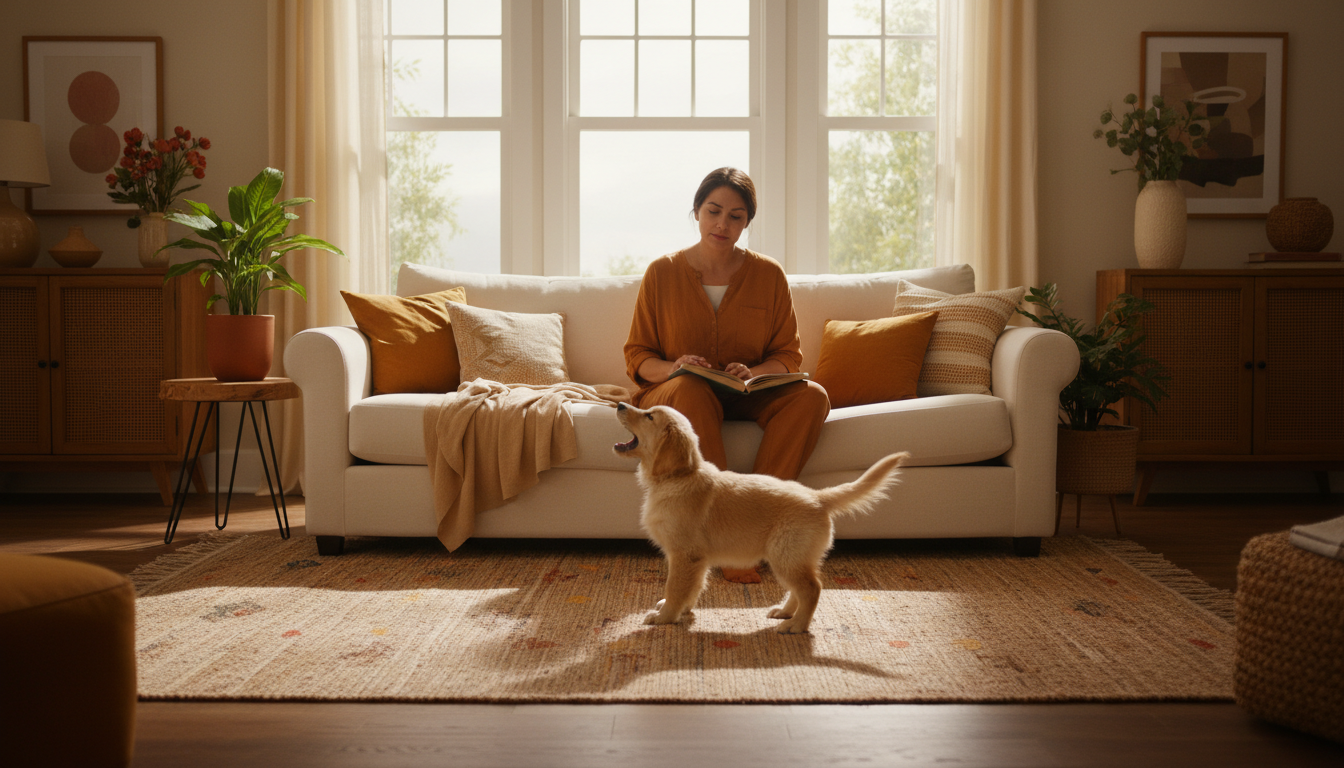
Demand barking has a distinctive sound that sets it apart from every other type of bark.
Sharp and repetitive, with a steady, almost mechanical rhythm. Bark, pause, bark, pause, as if your puppy is pressing a button and waiting for the result. It is not building in intensity (that is frustration or anxiety) and it is not sporadic (that is alert barking). Some puppies do a short burst of two or three barks, then pause and stare. Then another burst. Then stare again. The stare is the tell. Your puppy is watching you for a response.
Body language is forward but calm. Your puppy is facing you, or facing the thing they want. Head up. Ears forward or soft. Tail may wag slightly. This is not a stressed dog and not a fearful dog. It is a confident dog who has learned a strategy.
Context triggers are specific. Food preparation. You sitting down to eat your meal. You sitting on the sofa. A lead becoming visible. Your puppy's dinner time. Attention being withdrawn. You on the phone or in conversation. The demand bark is always tied to a specific want.
The reinforcement loop you are running by accident
The loop has four steps. Most owners are running all four without realising.
Step 1. Your puppy barks. They want something. Attention, food, a walk, to get on the sofa, to be let outside.
Step 2. You respond. Any response at all. This is the trap. The response does not have to be positive. You looking up from your phone, that is a response. You saying "stop it" or "shhh," that is a response. You getting up and walking toward your puppy, that is a response. You making eye contact and saying "no," that is a response. A frustrated sigh is a response. To your puppy, any reaction from you is proof that barking produced a result. The bark worked.
Step 3. Your puppy learns that barking gets a response. This is conditioning in its purest form. Your puppy is not calculating, planning, or being manipulative. They are simply learning what produces outcomes. Bark equals response. This is taught the same way every other learned behaviour is taught. Through repetition and consequence.
Step 4. You eventually cave and give the thing being demanded. This is the step that locks the bark in permanently. It typically happens after you have been ignoring for thirty seconds, or a minute, or five minutes, and cannot take the noise any longer. The moment you give your puppy what they want, the lead, the treat, the attention, access to the sofa, your puppy does not learn "eventually I stopped and it worked." Your puppy learns "I need to bark louder and longer before the signal comes through." Every time you cave after a longer duration of barking, you train your puppy to bark for longer next time.
The reinforcement is not just "I gave you the thing." The reinforcement is the entire sequence. Your puppy barking, you reacting, you eventually caving. This is the loop. Your puppy runs it again because it worked last time.
Why "just ignore it and it will stop" fails the first time
Most owners try ignoring. Most owners give up within a few days, often within the first session. The reason is the extinction burst, and most owners have never heard of it.
When a strategy that has always worked suddenly stops working, behaviour does not immediately fade. It escalates first. Your puppy does not conclude "barking is no longer effective." They conclude "I need to try harder." This is called the extinction burst, the temporary spike in intensity, frequency, or duration before the behaviour fades. It is a predictable part of the process. It is not your puppy getting worse. It is your puppy testing whether the old strategy still works if they increase the effort.
In practical terms. If your puppy has been barking five times in a row before getting a response, and you suddenly stop responding, they bark ten times. Then fifteen. Then louder. Then longer. The bark may hit a level of noise and persistence you have never experienced before. This is the burst.
The problem is that the burst is exactly the point where most owners cave. You have made it further than you ever have, three minutes of ignoring, and then your puppy ramps up to a level you cannot tolerate and you give in. What you have just done is train a louder bark. You have accidentally taught your puppy that the key to getting a response is to escalate further than before. The next cycle will start at that higher baseline.
The 4-step protocol that actually breaks the loop
This is Relational Leadership applied to attention-seeking behaviour. The protocol is built on one non-negotiable. The behaviour must produce nothing. Every time. Without exception.
Step 1. Total ignore. No touch, no eye contact, no speech. Not a dramatic turn-away. Not a loud "no." Not a glare. Genuinely nothing. You continue exactly what you were doing as if your puppy made no sound at all. No sighing, no stiffening, no shifting in the seat. Your puppy is sophisticated enough to read micro-responses. The standard is zero reaction. If you cannot hold this with your puppy in the room, physically get up and leave the room. Remove the audience. Your puppy cannot bark for a response if there is no one to respond.
Step 2. Calm timeout at the point of escalation. If the bark escalates, and it will, especially in the early days, you do not reward the escalation by engaging with it. You also do not simply sit and absorb it. That normalises the noise. Instead, calmly, without speaking, without eye contact, take your puppy by the collar with an underhand grip and walk them to a quiet room. Shut the door. Duration: one to two minutes for puppies, five minutes for adult dogs. The timeout is not a punishment. It is the removal of the thing your puppy is trying to get, which is contact with you. The walk to the timeout room must be completely calm. No angry energy. No dramatic frog-march. Calm and neutral. The energy you bring to the isolation is the message you send.
Step 3. Release with zero acknowledgement. Walk back in. Do not greet your puppy. Do not look at them. Apply Rule 3. This is a mini separation. Wait for your puppy to fully settle. Not just to stop barking momentarily, but to genuinely be in a calm, disengaged state.
Step 4. Reward the calm on your terms. Here is where timing is critical. Do not reward your puppy the moment the barking stops, because that teaches them stopping the bark is the strategy. The reward for calm comes after a period of settled, quiet behaviour they have sustained without prompting. Once they are genuinely calm and have been for thirty seconds to a minute, call them over, not the other way around, and give them the attention or access they were looking for.
How long it takes to extinguish a learned demand bark
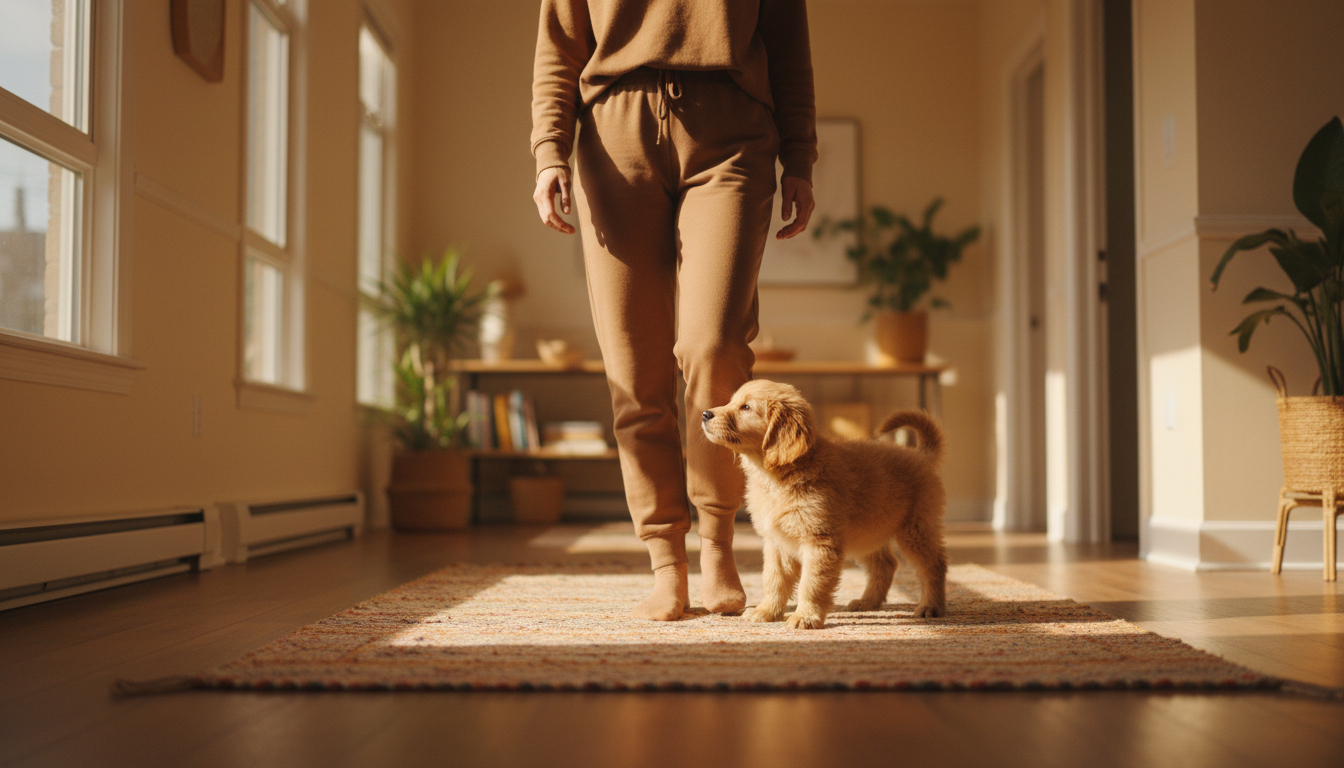
Three to fourteen days with genuine consistency is the realistic range.
Day 1 to 3. Usually gets worse before it gets better. This is the extinction burst period. Hold the protocol.
Day 3 to 7. For most dogs, the frequency and duration of demand barking starts to drop. Your puppy has begun to update its model of what works.
Day 7 to 14. The bark is significantly reduced or fully extinguished in straightforward cases. Your puppy has learned that calm is the only behaviour that produces results.
Variables that slow progress. Inconsistency in the household. One person who still responds to the bark, even occasionally, even to say "stop," resets the cycle. Every person, every time. Inadvertent response. The owner who does not make eye contact but tenses visibly, sighs loudly, or shifts in their seat. A bark that has been running for years. An adult dog who has been demand barking since puppyhood has a deeply conditioned behaviour. Expect the upper end of the range. Three weeks. This is still fast. The behaviour was years in the making.
When demand barking is masking something else
Not every bark is a demand bark, and applying the ignore protocol to a dog who is barking from anxiety, pain, or unmet need is the wrong call.
Anxiety. An anxious dog's barking is driven by stress, not strategy. It is typically continuous rather than rhythmic. Paired with panting, pacing, yawning, lip-licking, an inability to settle between barks. If your dog is barking when left alone, even briefly, and shows signs of distress, that is separation anxiety, not demand barking. Ignoring a dog in genuine distress does not extinguish the bark. It extends the distress. The cause must be addressed first. The puppy separation anxiety piece covers the diagnosis.
Pain or physical discomfort. A dog who suddenly begins barking at night, or has shifted from quiet to persistent vocalisation with no clear trigger, may be in pain. Particularly relevant in older dogs. Vet check first, behaviour protocol after.
Frustration with a genuine unmet need. A dog barking to go outside to toilet is not demand barking in the same way as a dog barking to get on the sofa. Before writing off any barking as attention-seeking, check that exercise needs are being met, your puppy has toilet access at appropriate intervals, and you are not asking them to hold it longer than is reasonable.
If you have applied the protocol consistently for two weeks and the bark is still going, a session with a trainer almost always finds the gap. The Complete Puppy Program covers the whole behaviour curriculum for the first six months. A free meet and greet is the easiest way to talk it through.