D
H
M
S
Offer
Provide additional details about the offer you're running
FLASHSALE


Your puppy barks at the door. Barks at the window. Barks at the postman, the neighbour's cat, a plastic bag blowing across the yard, and sometimes at absolutely nothing you can identify. You've tried telling it to be quiet. You've tried ignoring it. You've tried shouting over the top of it, which you know isn't ideal but you were at the end of your rope and the neighbours were giving you looks.
Here's what most owners miss about puppy barking: not all barking means the same thing, and the fix depends entirely on why the puppy is doing it. There's no single "stop barking" technique because there's no single reason puppies bark. Treating alert barking the same way you treat demand barking is why most people can't get it under control.
Luke Buchanan, Owner of The Toe Beans Co and Sydney's Puppy Trainer, breaks barking into two categories and applies a different response to each. Once you understand the distinction, the whole problem becomes manageable.
Alert barking is the puppy telling you something is happening. A knock at the door, a noise outside, a person walking past the window. The puppy has detected something and is reporting it. This is normal, natural behaviour. Dogs are supposed to alert. The issue isn't that it starts. The issue is that it doesn't stop.
Demand barking is the puppy telling you to do something. Feed me. Play with me. Let me out. Pick me up. Look at me. This barking isn't a report. It's a command directed at you. The puppy has learned that barking produces results, and it's using that tool to control interactions.
The reason the distinction matters is that the correct response to each type is completely different. Responding to alert barking the way you'd handle demand barking makes alert barking worse. And responding to demand barking the way you'd handle alert barking teaches the puppy that demands work.
"Just ignore it" is the most common recommendation online. For demand barking, this is directionally correct but usually applied without enough structure to actually work. For alert barking, ignoring it is the wrong move entirely. The puppy is trying to tell you something. Ignoring an alert makes the puppy bark louder and longer because, from its perspective, you haven't received the message.
Shouting "quiet" or "no" is a reaction. The puppy barks, you make noise back. In the puppy's mind, you've joined in. You're barking too. This increases arousal rather than reducing it. Verbal corrections delivered at volume are the fastest way to escalate barking behaviour.
Distraction with treats teaches the puppy that barking is the first step in a sequence that ends with food. Bark, get treat, stop barking. Next time: bark, expect treat. The barking becomes the opener to a transaction the puppy has learned to initiate.
Bark collars and citronella sprays suppress the behaviour without addressing the cause. The puppy still feels the need to alert or demand. It just can't express it. That stress goes somewhere else, often into destructive behaviour, anxiety, or redirected aggression. Suppression without resolution creates new problems.
Alert barking requires acknowledgement, not correction. The puppy is doing its job. Your response needs to communicate: "I've received the message. I'm handling it. You can stand down."
This is Rule 2 from the 5 Golden Rules in practice. When the puppy alerts, you calmly go to the puppy (or the source of the alert), look at what the puppy is barking at, and say "thank you" in a calm, flat tone. Then you step between the puppy and the stimulus, positioning yourself between the threat and the dog. You've taken over. The puppy's job is done.
What happens next is critical. After the acknowledgement, you walk away from the stimulus calmly. Not toward the door to investigate further. Away. The message is: I checked, it's nothing, we're moving on. Most puppies will follow you. If the puppy returns to barking at the same stimulus, repeat once. Calm approach, "thank you," position yourself in front, walk away.
What I see in my sessions is that most owners either ignore the alert (making the puppy bark harder) or rush to the door themselves (confirming that there is indeed something to worry about). Both responses tell the puppy it needs to keep alerting. The "thank you" protocol tells the puppy the exact opposite: message received, threat assessed, all clear.
Demand barking is the puppy trying to control you. The fix is the complete opposite of acknowledgement. You give the puppy absolutely nothing.
This connects to Rule 4 (everything on your terms) and Rule 5 (only give attention on your terms). When the puppy barks to demand food, play, attention, or access to something, you withdraw all engagement. Turn your back. Leave the room if needed. No eye contact. No verbal response. Nothing.
The moment the puppy is quiet, even for three seconds, you can calmly re-engage. The timing matters. You're reinforcing silence, not the bark that preceded it. If you wait too long after the quiet starts, the puppy doesn't connect the silence to the reward.
This is where most people break. Demand barking gets louder before it gets better. The puppy has learned that barking works, and when it suddenly stops working, the first response is to try harder. Louder barking, longer barking, more frantic barking. This is called an extinction burst, and it's the sign that the approach is working. The puppy is testing whether the old rules still apply. If you hold your ground through the burst, the behaviour drops off. If you give in during the burst, you've taught the puppy that louder barking is what's needed.
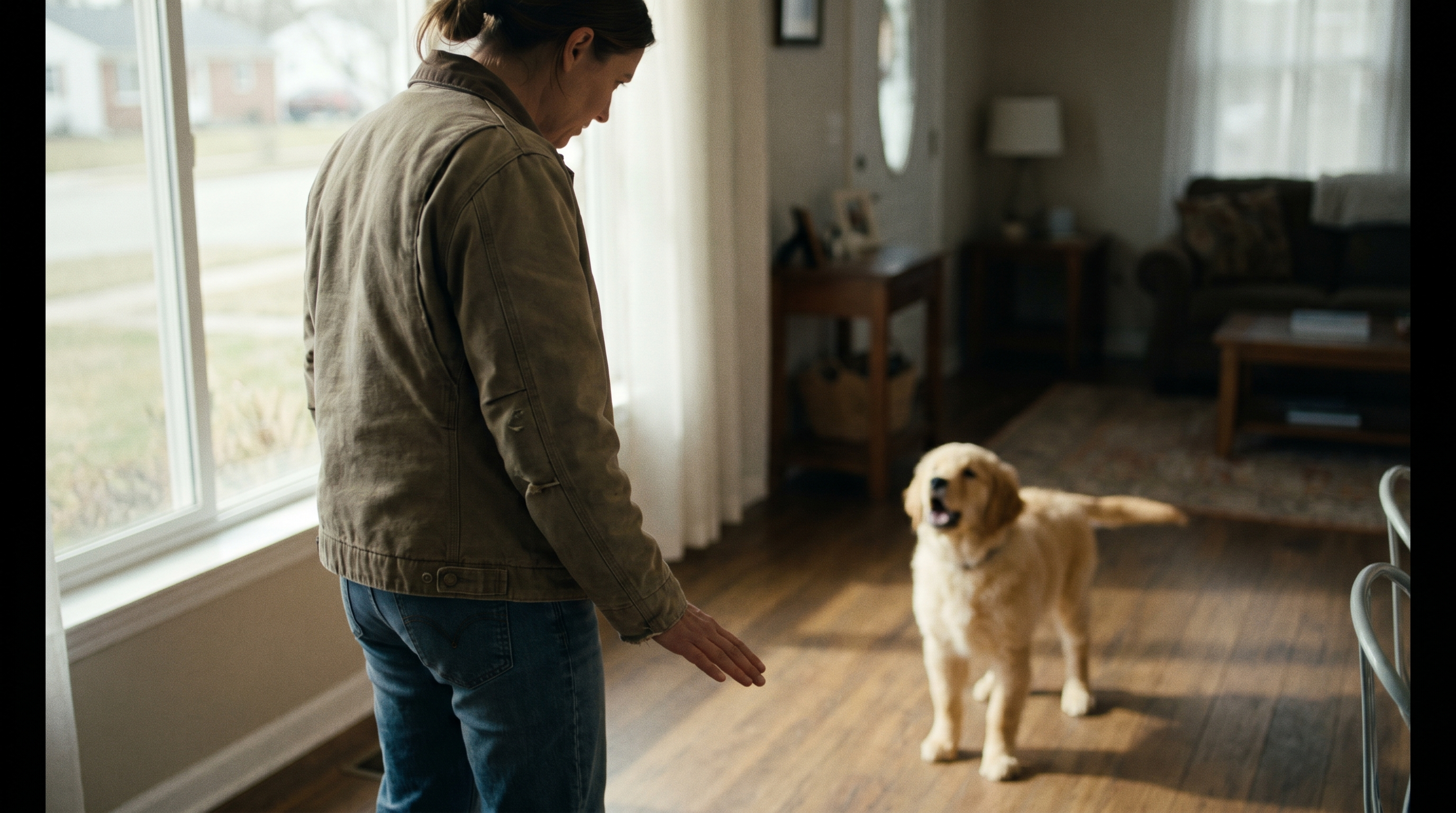
Shouting at a barking puppy is the most common accelerator. You're adding energy and noise to a situation that needs less of both. The puppy reads your raised voice as confirmation that there's something to be excited about. Calm and quiet are the only tools that deescalate barking.
Inconsistency between alert and demand responses confuses the puppy. If you sometimes acknowledge alert barking and sometimes ignore it, the puppy doesn't know which rule applies. If you sometimes withdraw from demand barking and sometimes give in, the puppy learns to keep trying. Pick the correct response for each type and apply it every time.
Giving in during the extinction burst is the single fastest way to create a persistent barker. If the puppy barks for ten minutes and you crack at minute eleven, you've just taught it that eleven minutes of barking is what's required. The next session will start at eleven minutes and go up from there.
Using punishment-based tools (bark collars, spray collars, shake cans) suppresses the symptom without addressing the cause. The puppy still has the urge to alert or demand. Blocking the expression of that urge creates pressure that surfaces elsewhere. I've seen puppies moved from bark collars develop anxiety-based destructive behaviour within weeks.
If the barking is accompanied by aggression (lunging, snapping, stiff body posture), that's beyond standard barking management and needs professional assessment. Reactive barking with aggressive intent is a different behavioural category.
If the barking is constant and doesn't respond to either protocol after three weeks of consistent application by everyone in the household, something else is driving it. Pain, anxiety disorders, or early developmental issues can produce barking that doesn't follow the normal alert/demand pattern. A trainer who can observe the behaviour in context will pick up what's being missed.
If you're facing complaints from neighbours or strata management, get professional support sooner. The pressure to stop the barking quickly leads to suppression methods that create bigger problems. A structured plan with realistic timelines protects both the puppy and your living situation.
Want help putting this into practice?
The Toe Beans Co runs a free SKOOL community where Sydney dog owners get access to training guides, Q&As, and direct support from Luke. It's free to join.
Upcoming Puppy Schools in Sydney
If you're based in Sydney's Eastern Suburbs and want structured, in-person guidance for your puppy, Luke runs regular puppy schools across Bondi, Paddington, Surry Hills, and surrounding areas.
Check upcoming dates and book your spot
Q: How do I stop my puppy barking at night?
Night barking is almost always demand barking. The puppy wants attention, reassurance, or to be let out of its sleeping area. Apply the same withdrawal protocol: don't go to the puppy while it's barking. Wait for quiet, then calmly check in if needed. If the puppy has been toileted before bed and isn't in distress, the barking will extinguish within a few nights of consistent non-response. Going to the puppy during barking teaches it that night-time noise brings you back.
Q: Is it normal for puppies to bark a lot?
Some barking is completely normal. Puppies alert to new sounds, express excitement during play, and vocalise when frustrated. The issue is frequency and duration, not the barking itself. A puppy that barks briefly at a knock and stops when you acknowledge it is behaving normally. A puppy that barks for twenty minutes at every passing car, or barks at you continuously until you comply with a demand, has a pattern that needs addressing through the leadership framework.
Q: Is there a puppy barking trainer near me in Sydney?
The Toe Beans Co offers in-home puppy training across Sydney's Eastern Suburbs, Inner West, and North Shore. Barking is one of the most common issues Luke addresses in both 1:1 sessions and group puppy schools. The Complete Puppy Program includes an at-home session, 4-week group puppy school, and a 26-module online course that covers both alert and demand barking in detail.




Join the
puppy school in Sydney