If your dog drags you across the road every time another dog appears on the footpath, the thing you're actually looking at is a trust problem. And in the Eastern Suburbs, where you can't walk fifty metres without meeting another dog, that trust problem becomes a daily fight.
Lead reactivity is the top reason adults book a session with The Toe Beans Co, and it carries our highest success rate. That's because the fix lives in the relationship your dog has with you before the lead ever comes out. Luke Buchanan, Owner of The Toe Beans Co and Sydney's Puppy Trainer, works this problem in Eastern Suburbs homes most weeks of the year. Here's what's going on, and what to do about it.
How reactivity differs from real aggression
Reactivity is an over-threshold response to something in the environment, and it burns out as soon as that something goes away. It gets mistaken for aggression because the picture is identical in the moment. Lunging and barking, then the redirect onto the lead when your dog can't reach what it's fixed on. Very different drivers underneath.
A reactive dog is responding to proximity, surprise, or a sense that something needs managing. The reaction is explosive but it doesn't last. Once the other dog has passed, the reactive dog settles and the fixation drops.
A reactive dog can be reactive from two directions. The forward version looks like a dog stiffening, chest forward, tail up, straining toward the other dog. The dog is doing a job. It believes it's protecting the pack and the job is loud and physical. The fearful version is the opposite. Tail tucked, weight back, close to you, only "going off" when the other dog gets close enough that running isn't an option. Our guide on helping a dog stay calm around triggers breaks down what each of those pictures looks like at the moment it happens.
True aggression in an adult dog is sustained and purposeful. It doesn't deescalate when the other dog moves on, and it's far less common than reactivity. Most owners who think their dog is aggressive have a reactive dog with a leadership problem.
The distinction matters because the entry point shifts. A forward-reactive dog needs leadership from you before anything else. With a fear-reactive dog you're building safety first, and the leadership piece follows behind it. Both want you calmer and clearer. The conversation is different.
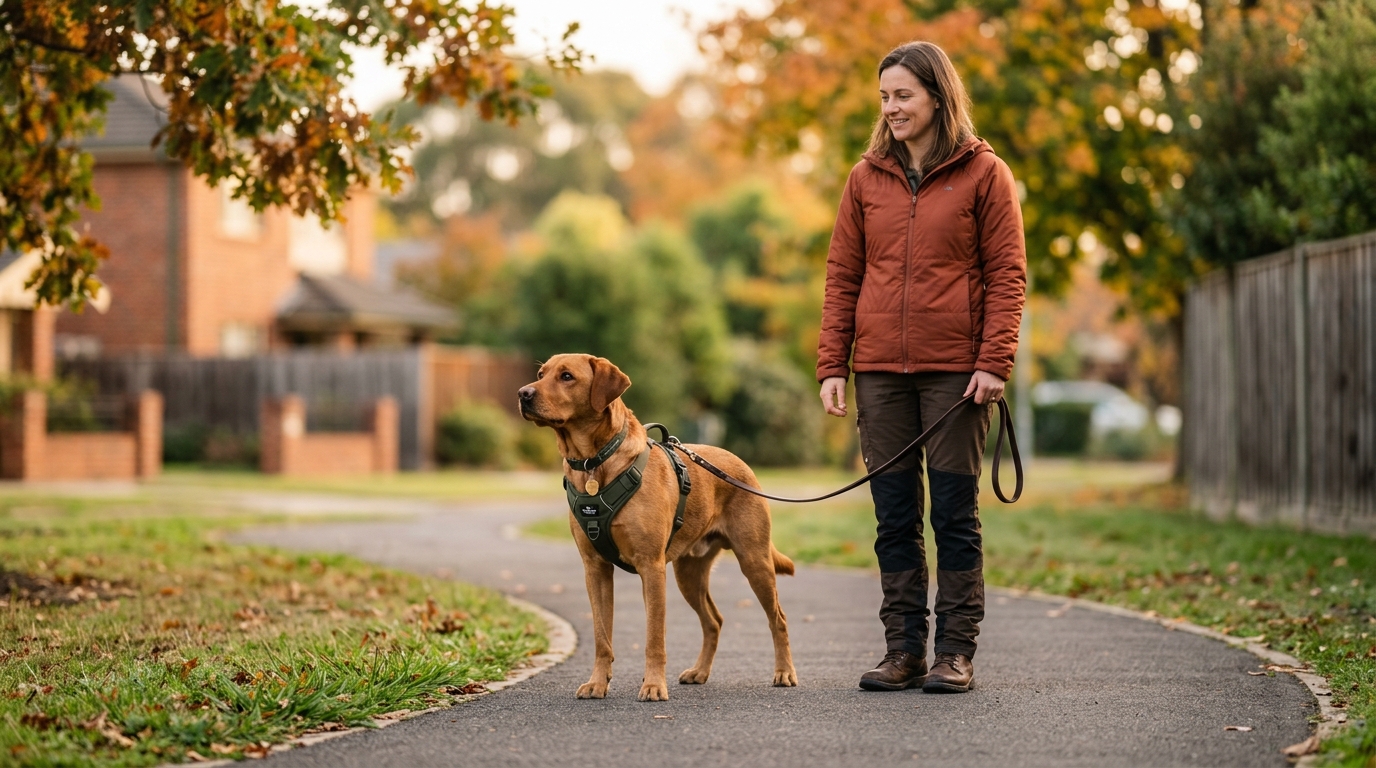
Why Eastern Suburbs walks make it worse
The environment is a multiplier. The Eastern Suburbs of Sydney has specific pressure points that turn a manageable dog into an unmanageable one.
Apartment density. Dogs in apartments have smaller home territories and fewer natural outlets to discharge energy before a walk. They don't get the garden time that lets arousal plateau. They hit the footpath already sitting at a 6 or 7 on the energy meter.
The Bondi to Bronte coastal path and the Coogee tracks. Single-file in places. When another dog appears around a corner, there's no ability to create distance. Your dog has no option to disengage. It's suddenly within two metres of another dog, with the cliff on one side and a wall on the other. This is one of the hardest setups for a reactive dog. There's no exit and no warning, and your own tension is already travelling down the lead before either of you has decided anything.
Centennial Park at peak hours. The weekend 7am to 9am window and the 4pm to 6pm window are the worst. The density of dogs, many off-lead, approaching from multiple directions, is overwhelming for a reactive dog. Off-lead dogs approaching an on-lead reactive dog is a specific problem. The reactive dog can't move away, and the off-lead dog coming in has no idea it's walked into something. The lead itself creates frustration, because for some dogs the lead is the thing taking away their choice to leave.
What most owners try first, and why it backfires
There are three common responses to lead reactivity. All three backfire for the same underlying reason.
Yanking the lead. Other dog approaches, you tense up, shorten the lead, and if your dog lunges, you yank back hard. The problem is that the tension on the lead travels straight down it. Your tight grip is telling your dog "I am stressed, this is real." The yank adds physical discomfort at the exact moment another dog is present, which builds a negative association with other dogs specifically. The dog learns: other dog plus lead equals pain. The reactivity compounds from there.
Stuffing treats in their face during high arousal. A dog at a 7 or 8 on the energy scale can't access the part of the brain that processes food reward. It's flooded with adrenaline and nowhere near a learning state. Treats at this moment don't build a positive association. They either get ignored or, worse, they teach the dog that reacting produces food.
Lead corrections. A sharp check on the lead suppresses the response in the moment but does nothing about the cause. The dog still believes managing other dogs is its job. The correction takes away the outlet and leaves the pressure sitting there. Suppressed behaviour comes back, usually in a different form, or much worse the day the dog gets off lead.
The Relational Leadership protocol for lead reactivity
The walk can't be fixed until the home is fixed. That's the starting point, and it isn't up for negotiation. Our piece on Relational Leadership walks through the five Rules that sit underneath everything below.
Step 1, establish the home foundation first. If your dog is the pack leader indoors, controlling food, leading through doorways, deciding when affection happens, initiating contact with you, then they'll also be the pack leader outdoors. The walk is Rule 5. It can't be reached without the first four Rules in place. Before you spend another session yanking on the footpath, audit the home. Is your dog walking through doorways ahead of you? Initiating all contact? Barking at the gate uncorrected? That last one is its own piece of work, and our guide on how to stop excessive dog barking feeds straight into what happens on the footpath. If you answered yes to any of it, the walk work will have limited effect until the rest gets sorted.
Step 2, win the walk before you leave the house. The energy meter has to be at a 2 or below before the front door opens. A real 2, measured by what your dog is doing rather than by how keen you are to get out. Pick up the lead. If your dog's energy spikes, put it down and wait. Attach the lead. Wait again for calm. Walk around inside on the lead until your dog is settled at your side. Then move to the doorway. You go through first, every time. If your dog is already above a 5 when you hit the footpath, go back inside. A walk done at high arousal reinforces the problem. A cancelled walk is training. The whole pre-walk sequence is laid out properly in the Calm Walk Blueprint, which is worth reading alongside this.
Step 3, SSCD on the walk. Stop, Start, Change Direction. Walk, stop without warning, start again, change direction. Always turn in front of your dog so they have to follow you. Done in silence. Done continuously in the early stages. The point is that your dog can't scan for threats while focused on where you're going next. SSCD replaces outward vigilance with inward attention on you. A dog watching your feet has no capacity left over for guarding the street. Around other dogs, work at the distance where no reaction happens. That might be thirty metres at first. That's fine. Hold there and do SSCD. Don't move closer until your dog is showing zero reaction at the current distance.
Step 4, calm freeze if a dog appears suddenly. If a dog comes around a corner and your dog starts to escalate, take an underhand grip under the collar, say nothing, hold until your dog drops out of the reaction. Then create distance from the trigger. Do not wait for the other dog to pass. Move. The one thing that decides how this goes is whether you react to your dog's reaction. Don't pull back and don't tighten the lead. Skip the "it's okay" as well, because your dog hears the wobble in it. Stay neutral and keep walking. The signal you're sending is that you've looked, there's nothing there, and you're both moving on.
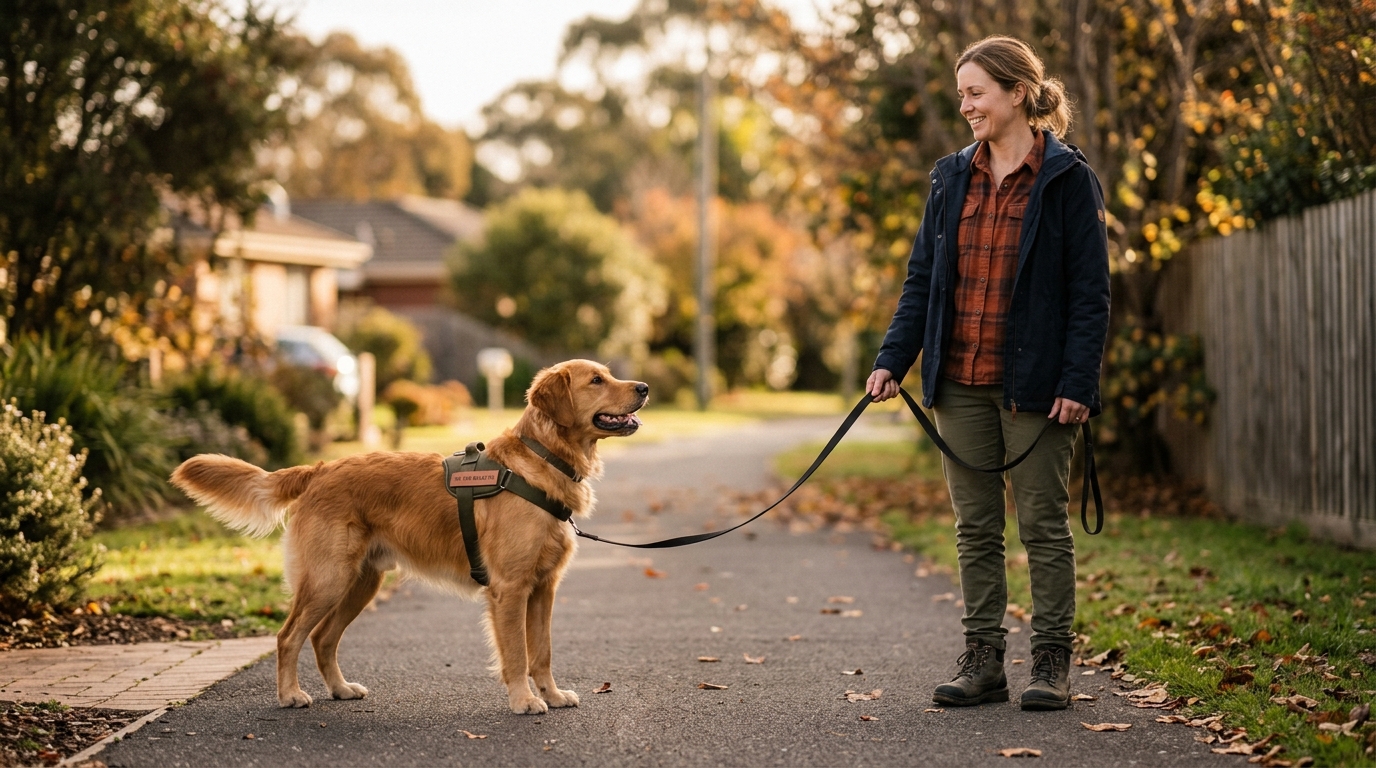
A real example, a German Shepherd in Coogee
Two-year-old male German Shepherd, intact at the start of the work, and one of the dogs we train in Coogee. His owners had been managing the situation by crossing the street every time they saw another dog on Coogee Bay Road or the coastal path. He had never bitten but he had lunged and made contact with leads several times. They described him as "aggressive." I had him as forward-reactive. Calm dog underneath, biddable, and sharper than the household had realised. A classic working-line GSD who was under-stimulated and over-promoted to pack leader.
Session one was an audit. He was leading through every doorway in the house and initiating all physical contact. There was no structure at meal times. He was sleeping on the bed and self-electing to get up. He had unmanaged access to the front windows where he was barking at pedestrians and getting zero consequence. The walk was session five material. We spent session one entirely on the home.
Session two, one week of Rules 1 to 4 in place at home. The household reported he was already calmer. Walk work started in a car park at the end of a quiet street. No other dogs anywhere. SSCD for twenty minutes. He was at my side inside ten minutes, watching my feet. End on that win. No other dogs introduced.
Session three, same car park, but with a neutral dog at twenty-five metres distance. A neighbour I had briefed beforehand. The GSD clocked the other dog and stiffened. I continued SSCD without acknowledging the other dog. Thirty seconds later, the GSD glanced back at me. That was the turn. He chose to look back at me instead of fixating. We stayed at that distance for the rest of the session.
Session four was the Coogee Bay Road footpath, morning, before peak foot traffic. The dog walked on my left, loose lead, past two dogs on the opposite side of the road, about eight metres away. One SSCD turn as a dog appeared fifteen metres ahead on the same side. He looked to me and walked past without a sound. His owners were emotional. What I told them was that they now had a dog who'd started to trust they had it handled, which is the whole game, and that there was still a fair bit of work ahead of them. But the door had opened.
What to do this week
Three things to start today.
One, audit the home before you touch the walk. Write down how many times today your dog leads through a doorway, initiates contact with you, barks at something outside, or controls what happens at a meal. Be honest. If that list is longer than zero, the walk isn't your first priority. Start Rules 1 to 4. Give it a week before going back to walk training.
Two, practise SSCD inside the house on a short lead. You don't need another dog for this. Put a short lead on, walk around your living room, stop, start, change direction, always turning in front. Five minutes, in silence. Your dog should be watching your feet by the end. Do it twice a day. This is walk training.
Three, find your threshold distance and work there. Identify the distance at which your dog first notices another dog but doesn't yet react. Might be thirty metres, might be ten. Whatever it turns out to be, that distance is where your training happens. Do SSCD there with another dog in view. When your dog looks back at you instead of at the other dog, mark that moment, create distance, end the session. That's enough for one day.
Most reactive dog cases we see in the Eastern Suburbs improve inside four sessions. That number assumes the home work is done alongside the walk work. If you want a structured plan for your specific dog, book a 1:1 dog behaviour training session and we'll work it through together. The first thing we'll do is have a proper look at what's happening at home.