Your ten-week-old has drawn blood again. Tiny teeth, surprisingly sharp, clamped down on your hand mid-cuddle. You've tried the yelp. You've tried saying "no" in your firmest voice. You've tried redirecting to a toy every single time, and it works for about three seconds before the teeth are back on your skin.
Here's the thing most people get wrong about puppy biting: it's not aggression, and it's not a training failure. It's completely normal developmental behaviour. Every single puppy does it. The problem isn't that it starts. The problem is what makes it stop, and most of the advice you'll find online actively makes it worse.
Luke Buchanan, Owner of The Toe Beans Co and Sydney's Puppy Trainer, sees this pattern in almost every new puppy client. The yelping, the pushing away, the frustrated corrections repeated for the fortieth time. None of it addresses why the biting is happening, which means none of it can fix it. What does work is a calm, staged approach that changes based on your puppy's age. It's simpler than you'd expect.
Why puppies bite: the real cause
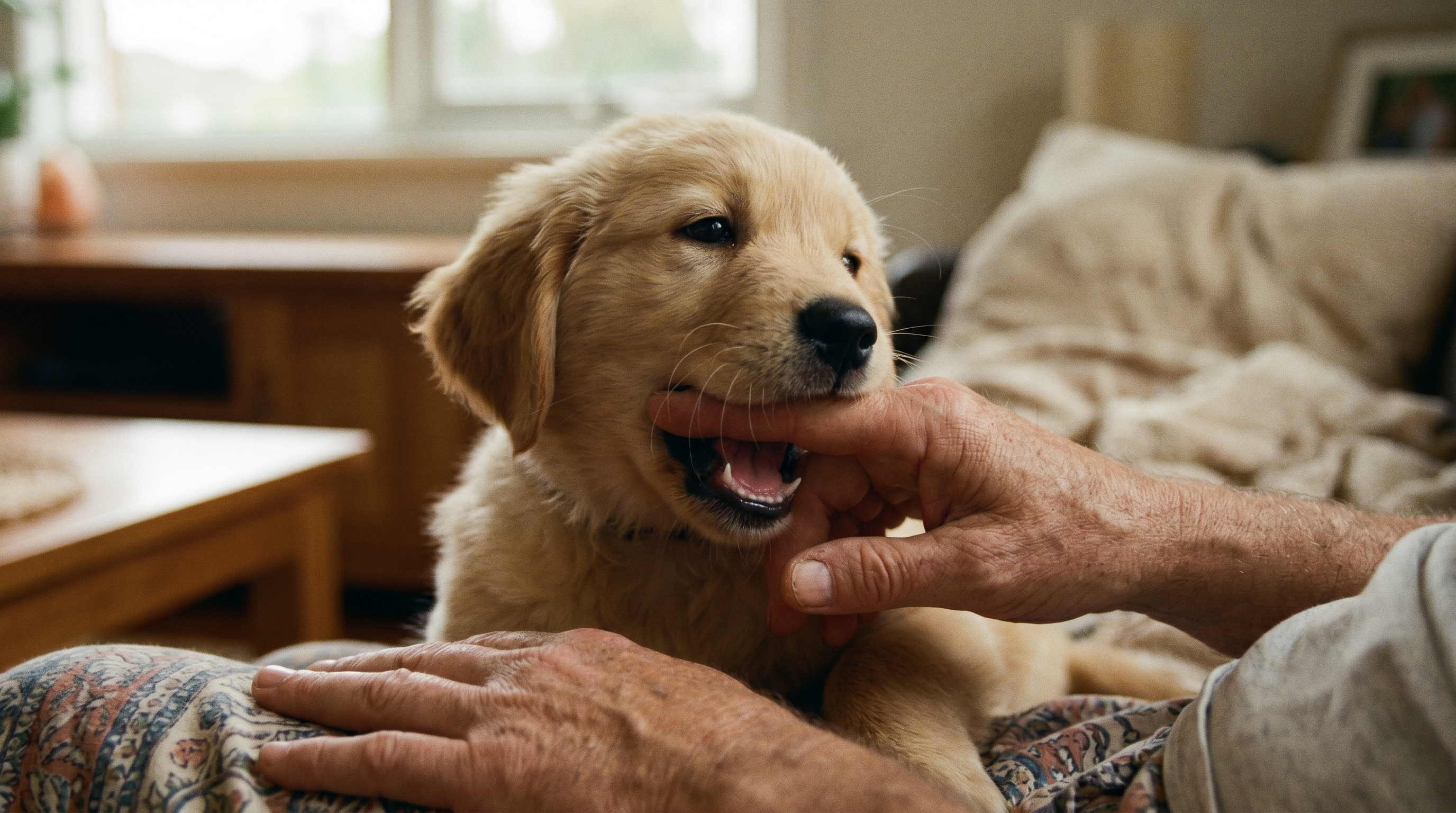
Puppies bite because they're meant to. In the litter, mouthing is how they develop bite inhibition. Siblings yelp, disengage, and the puppy gradually learns how hard is too hard. This is normal behaviour from 8 to 12 weeks. It's not a sign of aggression. It's a puppy doing exactly what its biology is telling it to do.
The problem isn't that biting starts. It's what happens when it doesn't stop.
Most puppies would have mouthing significantly under control before 16 weeks if they were still in the litter. When it persists past that window in a home environment, the cause is almost always the same: the puppy has learned that biting produces a reaction. Any reaction. Yelping, pulling your hand away, laughing, pushing the puppy off. All of these tell the puppy the interaction is continuing. Once the puppy's arousal crosses a certain threshold, the biting becomes reflexive rather than exploratory. The game is on, and the puppy is no longer making a choice about whether to bite.
There's a second dynamic that develops as the weeks pass. A puppy without a clear, calm leader in the household starts testing boundaries. What I see in my sessions is a consistent pattern: mouthing that was tolerated at 9 weeks becomes bolder at 14 weeks. More persistent. Harder. Targeted at hands and clothing. After 16 weeks, mouthing is no longer purely developmental. If it's still happening at that age, it's becoming a behavioural pattern, and the response needs to change.
What most owners try (and why it doesn't work)
The yelp method is the most widely shared advice online. The theory is that mimicking litter-mate communication teaches bite inhibition. In practice, for most puppies in the 8 to 16 week window with a new family, the yelp is exciting rather than aversive. High-pitched sounds increase arousal. They trigger the puppy to bite harder, not softer. Even when it works occasionally, it requires perfect timing and the exact right puppy response every single time.
Saying "no" firmly or pushing the puppy away feels decisive, but it's still a reaction. The puppy has succeeded in getting your attention and a physical interaction. Pushing a puppy away with your hand is, from the puppy's perspective, an invitation to continue. Verbal corrections without a meaningful consequence behind them are noise. After the tenth "no," the puppy has learned that "no" means very little.
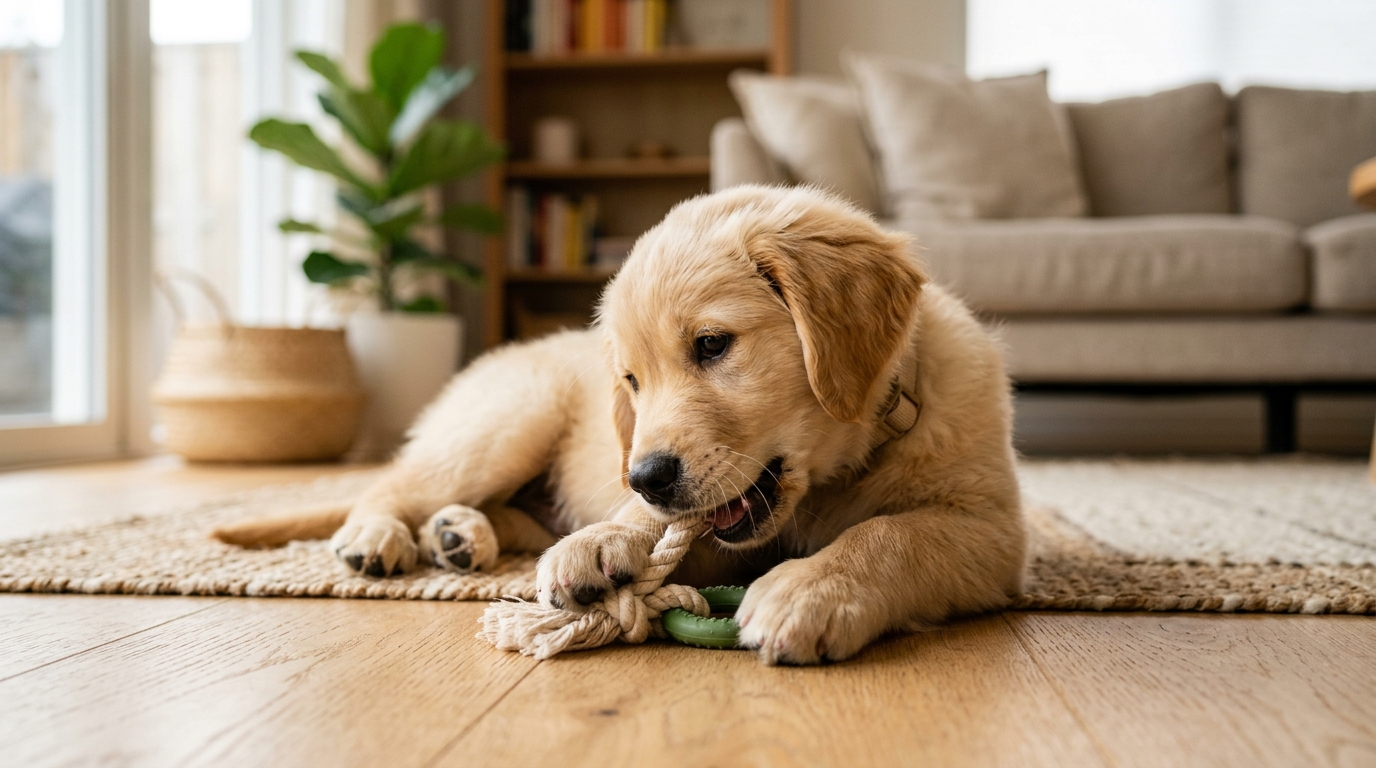
Redirecting to a toy is the correct approach for the early weeks, but most owners keep using it as their only tool well past the point where it should have stepped up. A 15-week-old that gets redirected every time but never experiences a real consequence has learned a pattern: bite, get toy, bite, get toy. Redirection without escalation becomes a game the puppy learns to play.
What actually stops puppy biting
The fix is a staged approach where what you do at 9 weeks is different from what you do at 15 weeks. The age of the puppy determines the tool.
Underneath all of this sits the Relational Leadership framework, specifically the 5 Golden Rules. This isn't about fixing the biting in isolation. The Golden Rules establish the leadership dynamic that reduces the puppy's need to test boundaries in the first place. A puppy with a calm, consistent leader operates at a lower arousal threshold, which means it's less likely to tip into reactive mouthing.
Rule 3 (complete calm after separation) and Rule 4 (everything on your terms) are especially relevant. A puppy that has learned it doesn't control interactions has already removed one of the key drivers of persistent mouthing. You initiate play. You end play. The puppy doesn't demand it by biting or jumping at you.
This breaks down by age. From 8 to 10 weeks: redirect only. Always have a soft toy during any cuddle or play session. The moment teeth make contact with skin or clothing, move the toy into the puppy's mouth calmly and silently. From 12 to 15 weeks: go still, break contact with a gentle push-off, then redirect to the toy. No sound at any point, not even a single word. From 16 weeks onwards: any teeth on skin means immediate timeout. No exceptions. The puppy is calmly taken by the collar and placed in a quiet, boring room for one to three minutes. No speaking. No eye contact. No drama. The absence of all interaction is the consequence.
Silence is the most powerful tool throughout. The puppy responds to energy. Calm says: this behaviour ends the interaction. Every time.
Step by step: the calm redirect and timeout method
- Set up before play, not during it. Before any play or cuddle session, have a soft toy in your hand or within reach. You're not searching for a toy after the biting starts. It's already there.
- The moment you feel teeth on skin, act immediately and say nothing. Don't yelp, don't say "no," don't pull your hand away sharply. If your puppy is under 10 weeks, redirect to the toy in your hand. Move it to their mouth calmly and let them bite that instead.
- From 12 to 15 weeks, go still and break contact with a gentle push-off before redirecting. No sound at any point, not even a quiet word. Freeze, push off gently, then move the toy in. Silence carries the message. A spoken marker doesn't.
- From 16 weeks, redirect is replaced by timeout. Any teeth on skin or clothing: take the puppy's collar with an underhand grip, walk them to a quiet room with nothing interesting in it, close the door for one to three minutes. No words. No eye contact. Walk in front of the puppy when you let them out, and apply complete ignore for several minutes before reintroducing any interaction.
- End play sessions on your terms. If a session is escalating and you can feel the energy climbing toward that over-threshold point, end it before the biting starts. Stop on a calm moment, not a chaotic one. This is Rule 4 in practice.
- Everyone in the household follows the same process. One person playing through the biting while another uses timeout makes the whole system fall apart. The puppy won't generalise if the rules change depending on who's in the room.
Mistakes that make puppy biting worse
Reacting with high energy is the most common accelerator. Pulling your hand away fast, yelping loudly, or laughing triggers more biting. High-pitched, fast-moving responses look like prey and play to a puppy. Energy down, response calm, always.
Inconsistency across the household is the single biggest reason biting persists. In my experience working with hundreds of Sydney puppies, this is the pattern I see most often: one parent does timeout, one parent thinks it's cute and lets the puppy chew on their fingers. The puppy learns that biting works on some people and adjusts its approach accordingly.
Using timeout with too much drama defeats the purpose entirely. A timeout that involves a ten-second chase around the room, raised voices, and a slammed door is not a correction. It's a reaction that escalates arousal rather than helping the puppy settle. The calm, silent collar walk to a boring room is what delivers the message.
Stopping too soon is surprisingly common. Many owners see improvement after a week and ease off the consistency. The approach has to be maintained through the full developmental window, not just until the immediate problem looks better.
When to get professional help
Most puppy biting resolves with consistent application of the staged approach above. But there are specific signs that warrant professional assessment.
If the biting is drawing blood regularly, particularly in a puppy under 16 weeks, that level of bite pressure is abnormal. If the puppy growls during biting episodes or stiffens and holds on rather than releasing, that's a significant flag at any age. If the biting is directed at children and can't be managed safely, the risk needs evaluating by a trainer who can observe the household dynamic in person. And if timeout has been applied consistently by every person for two to three weeks with no reduction, something else is going on that needs a professional eye on it.
Want help putting this into practice?
The Toe Beans Co runs a free SKOOL community where Sydney dog owners get access to training guides, Q&As, and direct support from Luke. It's free to join.
Upcoming Puppy Schools in Sydney
If you're based in Sydney's Eastern Suburbs and want structured, in-person guidance for your puppy, Luke runs regular puppy schools across Bondi, Paddington, Surry Hills, and surrounding areas.
Check upcoming dates and book your spot
Frequently asked questions
Q: Is puppy biting normal?
Yes, all puppies bite during development. It's how they learn bite inhibition from their littermates. The behaviour typically peaks between 8 and 14 weeks. What matters isn't whether it happens, but how you respond to it. A calm, staged approach based on the puppy's age is what moves the behaviour from normal development to resolved.
Q: At what age do puppies stop biting?
With consistent application of the redirect-to-timeout method, most puppies show a real drop in biting by 16 to 20 weeks. The critical shift happens at 16 weeks, when mouthing stops being purely developmental and needs a firmer consequence. If biting hasn't reduced by 20 weeks despite consistent effort from everyone in the household, a professional trainer should assess the dynamic.
Q: Is there a puppy biting trainer near me in Sydney?
The Toe Beans Co offers in-home puppy training across Sydney's Eastern Suburbs, Inner West, and North Shore. The Complete Puppy Program includes a 1:1 at-home session, 4-week group puppy school, and an online course that runs week by week from eight weeks to twenty-four weeks. Puppy schools run at Paddington, Zetland, Marrickville, Alexandria, and Neutral Bay with rolling start dates.