You left the room for thirty seconds to grab a glass of water and came back to a puppy that had scratched the door frame, barked non-stop, and worked itself into a state. Or maybe you watched the camera footage from your first day back at work and saw your puppy pacing, whining, and unable to settle for hours. Either way, you're now googling "puppy separation anxiety" at midnight, wondering if you've already broken your dog.
You haven't. But what you're seeing isn't what most of the internet tells you it is, and the standard advice for fixing it is the reason most owners get stuck.
Luke Buchanan, Owner of The Toe Beans Co and Sydney's Puppy Trainer, works with separation distress in puppies every single week. The pattern is remarkably consistent: the puppy has been treated as an equal rather than being given the structure it needs, and the moment the owner leaves, the puppy panics because it believes it's responsible for the pack. Understanding that dynamic changes everything about how you fix it.
What puppy separation anxiety actually looks like
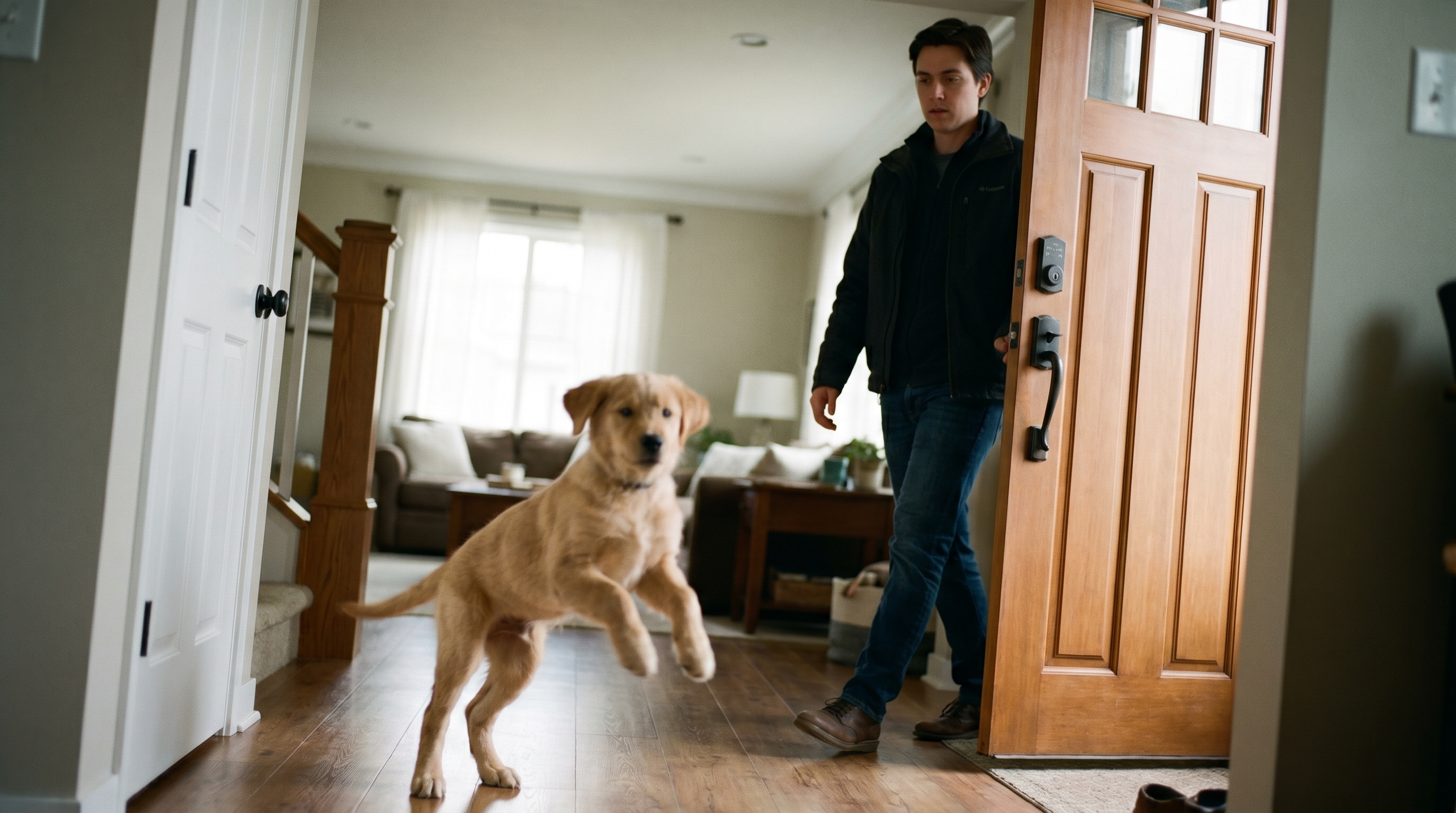
Separation anxiety in puppies presents as distress that begins the moment you leave, or sometimes before you've even gone. The puppy reads your departure cues and starts escalating. Picking up keys, putting on shoes, grabbing a bag. The whining or barking starts before the door closes.
Once you're gone, the behaviour typically includes vocalising (barking, howling, whining that doesn't stop), destructive behaviour focused on exit points (doors, door frames, window sills), pacing and inability to settle, toileting inside despite being house-trained, and in more severe cases, self-harm from scratching or chewing at barriers.
The key distinction is that this isn't boredom. A bored puppy chews a shoe and takes a nap. A puppy with separation distress is in genuine emotional arousal from the moment you leave until you return. There's no settling period. The stress doesn't taper off. If your camera shows a puppy that paces for ten minutes then lies down and sleeps, that's not separation anxiety. If it shows a puppy that's still at the door forty-five minutes later, it is.
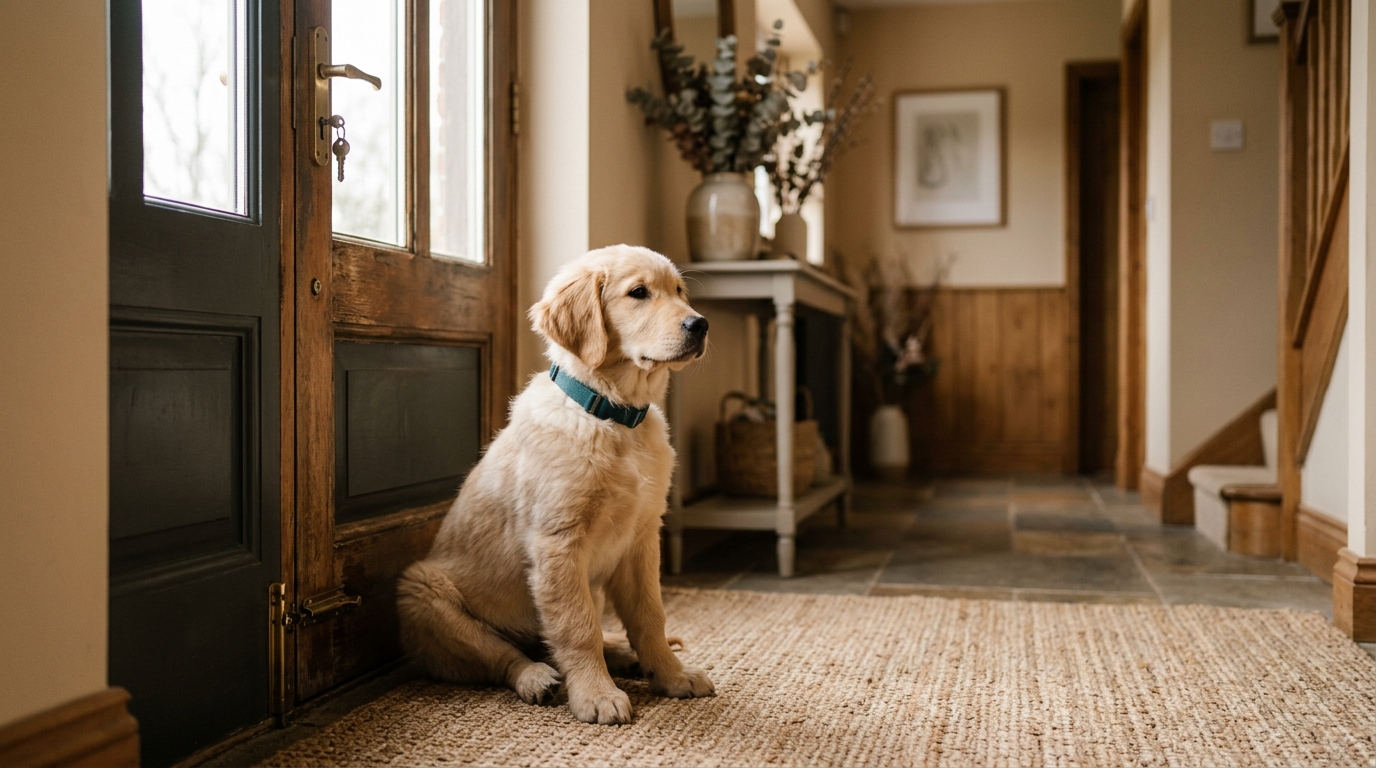
Why it happens: the leadership gap most owners miss
The standard explanation online is that your puppy is "too bonded" or "over-attached." The standard fix is gradual desensitisation: leave for one second, then two, then five, building up painfully slowly over weeks. It works in some mild cases. In most, it doesn't get to the root of the problem.
What I see in my sessions, consistently, is a leadership gap. The puppy hasn't been shown that the owner is the decision-maker. In the absence of clear leadership, the puppy assumes it's responsible for the pack. When the pack leader (the puppy, in its own mind) can't follow the other pack member, it panics. Not because it loves you too much. Because it believes it's supposed to be protecting you, and it can't do its job from behind a closed door.
This is the Relational Leadership framework. The 5 Golden Rules establish you as the calm, consistent leader. When that dynamic is in place, the puppy doesn't need to worry about where you are. It's not its job. It can relax.
Rule 3 is the critical one for separation anxiety: after any period of separation (even leaving the room for a minute), you come back and completely ignore the puppy until it's calm. No eye contact. No touching. No talking. This teaches the puppy that reunions are boring, non-events. It lowers the arousal around departures and arrivals, which is the single biggest lever you can pull.
What most owners try (and why it makes things worse)
Sneaking out is the most common mistake. The logic is that if the puppy doesn't see you leave, it won't get upset. In practice, the puppy suddenly realises you've vanished, which is more distressing than watching you go. It also teaches the puppy that you disappear without warning, making it more vigilant about tracking your movements.
Gradual desensitisation on its own, without addressing the leadership dynamic, is treating the symptom. You can build up to twenty minutes of absence over three weeks of careful conditioning, and then one unexpected disruption resets the whole thing. The puppy's underlying belief that it's responsible for you hasn't changed. You've just temporarily raised its tolerance threshold.
Comfort items, puzzle toys, and background noise are fine as supplementary tools. They're not fixes. A puppy in genuine separation distress won't touch a Kong. It won't be soothed by the radio. These things help a mildly unsettled puppy, not one that's operating at full arousal because it thinks its handler has abandoned the pack.
Coming back when the puppy cries is the fastest way to make separation anxiety permanent. The puppy barks, you return. The puppy has just learned that barking brings you back. Next time, it barks harder and longer.
What actually fixes puppy separation anxiety
The fix starts before you leave the house. It starts with the 5 Golden Rules being applied consistently throughout the day. When the leadership dynamic is established, the puppy's need to monitor you drops significantly. It stops following you room to room. It starts settling on its own. These are the precursors to being able to handle actual departures.
Rule 3 is the engine. Every time you come home, or come back into a room, the puppy gets nothing until it's completely calm. No greeting. No acknowledgement. You walk in, put your things down, make a cup of tea, and only when the puppy has four paws on the floor and a relaxed body do you calmly say hello. This deescalates the emotional charge around comings and goings.
The specific separation training technique is what I call "mini leaves." Once the Golden Rules are being applied and the puppy is starting to show less attachment behaviour during the day, you begin practising short departures with a very specific protocol.
Step by step: the mini leaves method
- Start with room separations, not house departures. Go into another room and close the door. Wait for quiet. Don't open the door while the puppy is vocalising. The moment there's a gap in the noise, open the door, walk past the puppy without acknowledging it, and carry on with what you were doing.
- Apply Rule 3 every single time you reunite. No eye contact, no touching, no talking until the puppy is calm. This is non-negotiable. Every excited greeting you give teaches the puppy that your return is a high-arousal event, which makes your departure a high-arousal event.
- Build duration naturally, not on a stopwatch. The focus isn't on hitting a specific time target. It's on the puppy showing calm behaviour when you're out of sight. If the puppy settles after two minutes today, that's progress.
- Flatten your departure cues. Pick up your keys and sit back down. Put on your shoes and watch TV. Grab your bag and make lunch. Do this repeatedly until the puppy stops reacting to the cues.
- When you do leave the house, keep it boring. No farewell speech. No "be a good boy." Walk out the door the same way you'd walk into the kitchen. Calm, unremarkable, nothing to see here.
- On return, Rule 3 again. Walk in, ignore the puppy completely until it's settled. The message has to be consistent: comings and goings are non-events.
Mistakes that make separation anxiety worse
Making departures emotional is the primary accelerator. Long goodbyes, apologetic tones, treats stuffed into a Kong as a guilt offering on the way out. All of these signal to the puppy that something significant is happening. The goal is the opposite: nothing significant is happening. You're just going to another room that happens to be outside the house.
Inconsistency between household members destroys progress. If one person applies Rule 3 and another scoops the puppy up the moment they walk in the door, the puppy can't learn that reunions are calm. Everyone has to be on the same page, every time.
Punishing the destruction you come home to is pointless and damaging. The puppy doesn't connect your anger with what it did three hours ago. It connects it with your return, which makes your next departure even more stressful. If you come home to a mess, clean it up without comment and apply Rule 3 as normal.
Skipping the foundational leadership work and going straight to absence training is the structural mistake I see most often. The mini leaves technique works because the puppy has already learned, through the Golden Rules, that you're the decision-maker and it doesn't need to worry. Without that foundation, absence training is just exposure therapy applied to a puppy that still believes it's supposed to be in charge.
When to get professional help
If the puppy is injuring itself (raw paws, broken nails, bleeding gums from chewing barriers), that's beyond what home training should attempt alone.
If the distress is extreme from day one and not improving at all after two weeks of consistent Golden Rules application, the intensity suggests something beyond a standard leadership gap.
If you're in a situation where neighbours are complaining or you're at risk of losing your rental because of the noise, get help sooner rather than later. A professional assessment can give you a realistic timeline and a structured plan.
Want help putting this into practice?
The Toe Beans Co runs a free SKOOL community where Sydney dog owners get access to training guides, Q&As, and direct support from Luke. It's free to join.
Check upcoming dates and book your spot
Frequently asked questions
Q: How long does it take to fix puppy separation anxiety?
With consistent application of the Golden Rules and the mini leaves method, most puppies show noticeable improvement within two to four weeks. The leadership foundation is what makes the difference.
Q: Should I crate my puppy when I leave to help with separation anxiety?
Crating can be part of the solution if the puppy has been properly crate-trained and views the crate as a calm, safe space. It should never be used as containment for a puppy in active distress.
Q: Is there a separation anxiety trainer near me in Sydney?
The Toe Beans Co offers in-home puppy training across Sydney's Eastern Suburbs, Inner West, and North Shore. Separation anxiety is one of the most common issues Luke works with in 1:1 sessions.