If your puppy has chewed three of your shoes this week, they're not being naughty. They're teething, bored, or stressed. The fix is different for each one, and most owners apply the wrong fix because they haven't stopped to ask which it is.
Destructive chewing in puppies under fourteen weeks is almost always developmental and entirely normal. Your job is to redirect, not suppress, and to manage the environment so your puppy can't practise on the wrong things. Here's what's actually going on and what to do about it.
In my sessions with Sydney puppies, I see the same pattern week after week: an owner who's tried everything except working out why the chewing is happening in the first place. Luke Buchanan, Owner of The Toe Beans Co and Sydney's Puppy Trainer, breaks down the three real causes below, and the protocol that actually works for each.
Why puppies chew in the first place
There are three causes of destructive chewing and the protocol for each is different. Getting the diagnosis right is most of the work.
Teething (8 to 16 weeks)
Between eight and sixteen weeks, your puppy is cutting their first teeth and their gums are uncomfortable. Chewing relieves that pressure. This isn't bad behaviour. It's biology. At this stage almost anything is fair game. Skirting boards, table legs, shoe laces, the kids' toys. The texture is often the attraction rather than the item itself.
Boredom and under-stimulation
A puppy with nothing to do will create something to do. Chewing is one of the most satisfying self-rewarding behaviours available to a dog. It releases endorphins. It passes time. The item often gets more interesting the more you chew it. A puppy left in a room with shoes, rugs, and chair legs and no outlet will chew them. This isn't defiance. It's what bored dogs do.
Stress and over-arousal
A puppy who is anxious, whether from separation, a new environment, or arousal with nowhere to go, will often chew as a displacement behaviour. The chewing isn't opportunistic. It has a driven quality. Your puppy may return to the same item repeatedly, or chew when you leave the room even briefly.
What most owners do wrong
Telling the puppy off. Shouting "no" after the fact does nothing. Your puppy can't connect a verbal correction to something they did twenty seconds ago. Even catching them in the act and shouting is largely ineffective, because you're now bringing excited, high-energy interaction to the exact moment they're doing something wrong. That's not how dogs learn. The response to unwanted behaviour in a puppy is calm redirection, not noise.
Removing everything chewable and leaving it at that. The pattern I see most often in Sydney living rooms: everything chewable gets removed, and the puppy is just as destructive within a week, because nothing replaced the outlet. Clearing the floor is excellent prevention and should be the first step. But owners who only do this have taught the puppy nothing. The puppy now has a different problem to chew. When an item inevitably gets left out, a child's shoe, a phone charger, a bag strap, your puppy chews it, you're furious, and the cycle starts again. Prevention plus active redirection. Not prevention alone.
Bitter sprays as the whole strategy. Bitter apple and similar deterrents work for some puppies on some surfaces some of the time. They're not a training tool. A puppy who is bored or teething will often chew through deterrents anyway. They're useful as a temporary barrier on one specific item while you work on the behaviour. Not a substitute for engagement.
The redirect, do not punish protocol
The moment you catch your puppy chewing something they shouldn't, the sequence is this.
Step 1, no speaking. Don't say your puppy's name. Don't say "no." Don't say anything. The moment you speak you create engagement. Stay completely silent.
Step 2, calm collar walk. Move calmly to your puppy. Take the collar with an underhand grip, palm facing up, under the chin. Don't pull or yank. Walk your puppy two to three steps away from the item. This is the physical redirect. It separates them from the behaviour without drama.
Step 3, give the replacement immediately. Have an acceptable chew ready before you start training for this. The moment your puppy is away from the forbidden item, offer it. This is the critical step most owners miss. They redirect without giving the puppy somewhere to put the chewing energy. It goes straight back to the skirting board.
Step 4, walk away. Don't hover. Don't watch the puppy chewing the toy like you're waiting for them to do something wrong. Walk away. Your puppy's interaction with the correct item is its own reward.
Step 5, if they return to the forbidden item, isolate. No drama. No lecture. Calm collar walk to a boring room. One to three minutes. Release without interaction. This is a timeout as a reset, not a punishment. Your puppy learns: chewing that thing ends the fun.
What to actually buy, and what is a waste of money
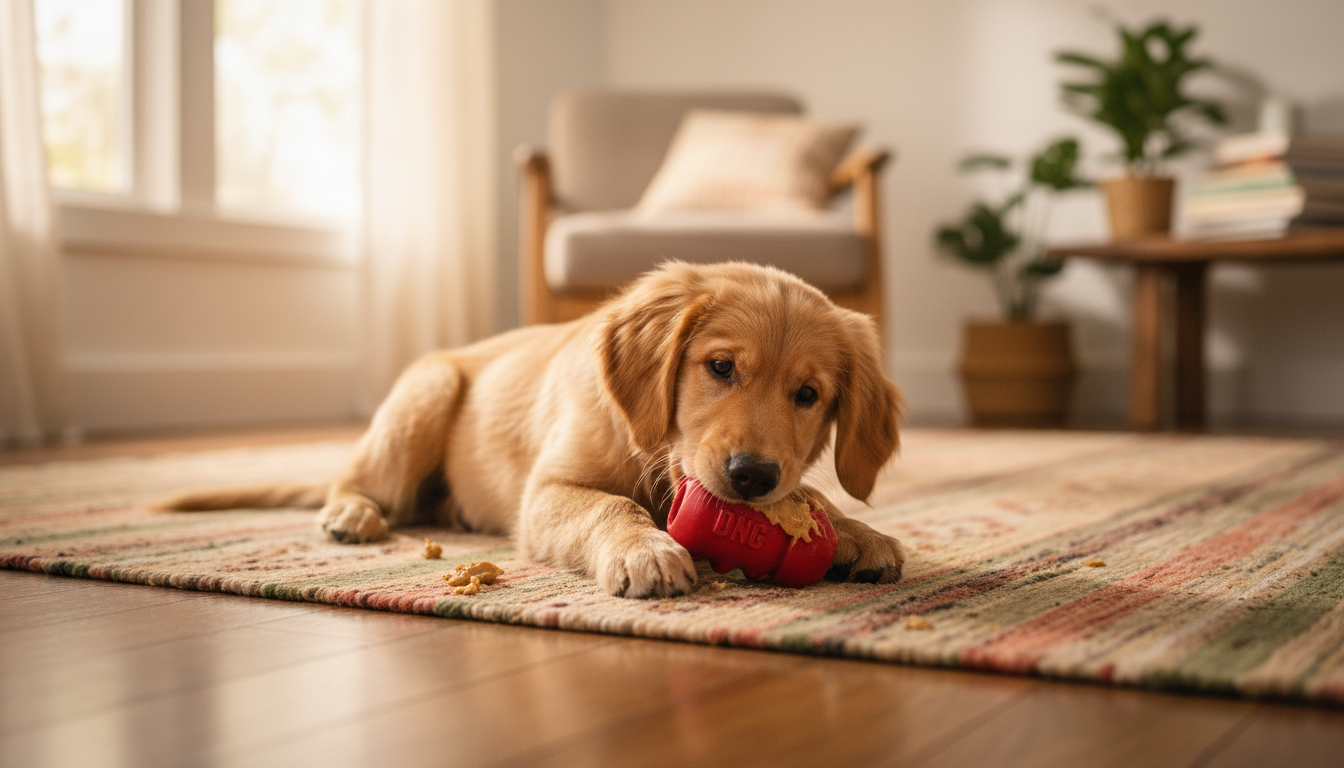
Worth the money. Frozen Kongs and similar stuffed rubber toys. Fill with puppy-safe food. Mashed sweet potato, plain yoghurt, their own wet food. Freeze. A frozen Kong takes twenty to forty minutes to work through and keeps a teething puppy's gums cold while satisfying the urge to gnaw.
Rubber chew toys, medium hardness. Look for toys that have some give but can't be torn apart in five minutes. Your puppy needs something that fights back slightly. Avoid anything marketed as "indestructible" for serious chewers at this age. Often too hard for puppy gums.
Snufflemats and lick mats. Engagement tools, not purely chew tools. A snuffle mat hides kibble in rubber strands and your puppy has to sniff it out. A lick mat with peanut butter (xylitol-free) or soft food scratches the same itch as chewing.
Wet cloth toy, frozen. A knotted tea towel soaked in water and frozen. Costs nothing. Excellent for peak teething discomfort.
When chewing crosses into destructive behaviour
Most puppy chewing resolves by fourteen to sixteen weeks as teething eases and you get on top of management. The cases worth taking seriously are those where the chewing is clearly anxiety-driven and separation-related.
The signs that point to something bigger: your puppy destroys things specifically when you leave, even for a few minutes. The chewing focuses on exits, door frames, the area around the front door, window ledges. It comes with other separation signs. Pacing, whining, loss of toilet training when alone, following you obsessively before departure. Your puppy can't settle when you're home. Always "on," always seeking contact.
In a recent session, I worked with a Cavoodle in Paddington whose owner had already tried three different chew toys and a bitter spray before calling me. The chewing wasn't about taste. It was separation distress dressed up as destruction.
Inside the Relational Leadership framework, a puppy showing this kind of separation distress believes they're the leader of the household. The drive to chew, escape, and vocalise when alone comes from leadership stress, not from missing you in a sentimental way. This isn't something a lick mat will fix. It needs the underlying dynamic addressed, the five Golden Rules in place, alongside a structured plan of short, deliberate separations built up gradually. The piece on Relational Leadership covers the framework.
If a new owner describes all of the above two weeks in with a puppy, they need a trainer, not more chew toys.
A two-week plan for an 8 to 14-week-old puppy
Before anything else, do a prevention audit. Walk through every room your puppy has access to. Anything at floor level that shouldn't be chewed, move it. Buy a baby gate if needed.
Days 1 to 3. Set up the environment and the rotation. Have three to five acceptable chew options ready. Frozen Kongs are non-negotiable for this age. Rotate what your puppy has access to each day so nothing loses novelty. Start the collar walk redirect every single time you catch them on a forbidden item. No exceptions.
Days 4 to 7. The redirect becomes a reflex. Begin very short separations. Leave the room for twenty to thirty seconds, return, don't greet your puppy. Apply Rule 3, complete ignore on return, from day one.
Days 8 to 10. Introduce a crate or pen as the settled space. A puppy with a safe, defined area associated with rest and appropriate chewing is far less likely to roam and destroy.
Days 11 to 14. Audit and adjust. By the end of two weeks you should see a clear reduction in chewing on forbidden items. If you're not, the honest answer is usually one of three things: the environment isn't managed well enough, the redirect isn't happening consistently by every person in the household, or there are anxiety signals that need addressing separately.
If you want a structured framework for the first six months that covers chewing, biting, toilet training, separation, and the whole puppy curriculum, the Complete Puppy Program is built for it.
Frequently asked questions
How long does destructive puppy chewing last?
Destructive chewing driven by teething normally eases by fourteen to sixteen weeks, once the adult teeth are through and the gums stop being sore. Chewing driven by boredom or stress doesn't resolve on a timeline. It resolves when the environment and the trigger are addressed, which can take anywhere from a fortnight to a few months depending on consistency.
Does bitter spray stop puppies chewing?
Bitter spray slows some puppies on some surfaces, but it isn't a fix on its own. A bored or teething puppy will often chew through it anyway. It works best as a temporary barrier on one specific item while you run the redirect protocol, not as a stand-alone strategy.
How fast can a Sydney puppy trainer resolve destructive chewing?
Most Sydney puppies I work with show a clear drop in forbidden-item chewing within the first two weeks of consistent redirection and management. Cases with a separation-anxiety component take longer, because the underlying leadership dynamic needs addressing before the chewing itself settles.