
Why Your Dog Is Overprotective of You (and How to Help)

Overprotective behaviour is one of the most misread problems in dog training. Owners describe it as devotion. They say their dog is "protective" of them, and there's often pride mixed into that description. But overprotective behaviour isn't loyalty, it's anxiety, and it comes with a clear escalation ladder that gets harder to address the longer you wait.
Luke Buchanan, Owner of The Toe Beans Co and Sydney's Puppy Trainer, works with overprotective dogs regularly through the adult dog training programme. In his experience, the dogs that are hardest to help are the ones where the behaviour became background noise years before the owner decided to address it. Early is always easier. Here's what's actually happening, and what you can do about it.
The myth that your dog is "protecting" you
The word "protecting" is doing a lot of damage. It reframes an anxiety response as a virtue, and once an owner sees it that way, they stop trying to fix it.
In the Relational Leadership framework, your dog positioning itself between you and a stranger, growling when someone approaches, or body-blocking access to you is not loyalty. It's a failure of the leadership dynamic. Your dog has assumed the role of threat assessor because no one in the household has clearly occupied the calm leader role. Dogs that live under genuine, grounded pack leadership don't feel responsible for threat assessment. The leader handles that. Your dog has taken on that job because it hasn't been shown that the humans in the house have this handled, so it fills the gap itself. It's the same root logic behind resource guarding: a dog stepping into a job it thinks nobody else is doing.
When owners call this behaviour protective and respond to it with affection, that response, however well-intentioned, lands in your dog's world as confirmation. The threat response was correct, and the pack leader validated it. The behaviour intensifies. What started as tension at a stranger's approach escalates because every instance where the owner soothed or allowed the behaviour was logged as a success.
What's actually happening is that your dog is anxious. It's operating in a state of chronic low-level stress because it believes it carries responsibility for outcomes it has no real ability to control. That's not love, that's a dog in a difficult situation with no clear way out.
What overprotective behaviour actually looks like
The behaviour has a clear escalation ladder, and it overlaps with the pattern behind general reactivity. Most owners only recognise it near the top of that ladder, by which point it's considerably harder to work with.
It starts with positioning and blocking, your dog places its body between you and another person. This often looks like affection. But watch the body. Weight forward, scanning outward. That's not your dog leaning in for a pat. That's your dog in surveillance mode.
From there, the signals get clearer. A stiff, rigid body where your dog has gone from loose and fluid to physically braced. A hard, sustained stare directed at the perceived threat. Low whale eye, the whites visible at the lower edge of the eye as your dog tracks movement without fully turning its head. Hovering and pacing when someone approaches you.
Then the sound signals begin. A low growl at approach, this is still the warning phase, still manageable, still your dog communicating rather than acting. And then, if the warnings have been repeatedly ignored or soothed away, the lunge or snap.
Every dog signals before it escalates. The problem is that owners who have normalised the lower-rung behaviours remove their dog's ability to warn and force it to skip steps.
The difference between protective and territorial aggression
These are commonly confused and the distinction matters because the entry point for the work is different.
Territorial aggression is place-anchored. Your dog defends a specific location or resource, the house, the car, the yard, the crate. Remove your dog from the space and the trigger largely disappears.
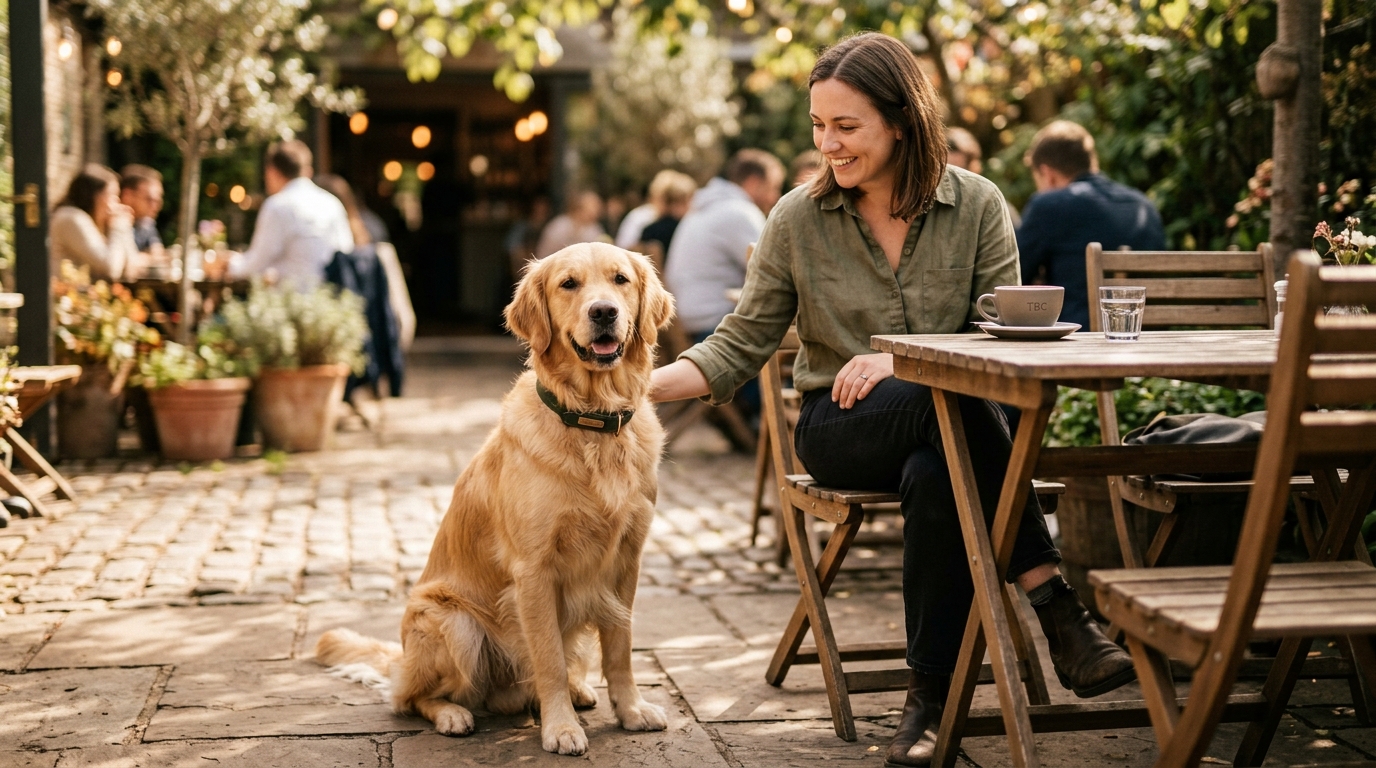
Overprotective behaviour travels with you. The trigger is mobile. Your dog doesn't need to be at home to show the behaviour. It will display on a walk, at a cafe, in a park. The location is irrelevant, your dog is monitoring access to a specific person, not a specific space.
You can test for this: take your dog to a neutral location and have a stranger approach you. If the same behaviour appears away from home, it's person-directed. If it doesn't, the territory is likely doing most of the work.
Why the behaviour gets worse if you do nothing
There's no neutral in this pattern. Either you address it or your dog practises it, gets more efficient at it, and the threshold drops.
Every time your dog displays the behaviour and the perceived threat retreats, a stranger walks past, the postman leaves, your dog records a win. From its perspective, the aggression worked. This is the most powerful reinforcement there is: direct evidence that the behaviour produced the desired outcome. The behaviour becomes self-reinforcing regardless of what the owner does.
But owner behaviour makes it worse. Three responses accelerate the pattern faster than anything else.
Tensing the lead. When you see your dog stiffening and tighten the lead, you communicate tension down that line. A tight, rigid lead tells your dog: something is wrong here. Arousal rises before anything has happened.
Physical reassurance, reaching down and stroking your dog while it growls, saying "it's okay." From your dog's perspective, calm tactile contact is a reward. Your dog has just received confirmation that its threat assessment was correct.
Verbal reassurance with a soothing tone. Your dog doesn't process language. It processes emotional register. A gentle, reassuring voice while your dog is in an alert state confirms the alert instead of calming it.
What positive reinforcement looks like with this issue
The work has two levels: what the owner does in the moment, and the underlying leadership dynamic at home. Neither alone is sufficient.
The goal is not suppression. Punishing the bark or the growl without addressing the anxiety underneath leaves your dog skipping the warning steps entirely.
In the moment, the handler's job is to be calm and grounded, not tense, not apologetic. The calm freeze from the Relational Leadership framework applies here: stop moving, breathe out, soften your body. The lead goes slack. No words. The owner communicates through physical state rather than instruction.
Working below threshold is the most important principle in this work. Once your dog crosses threshold, the point where it can no longer process calm signals, recovery takes time and the learning window closes. Everything useful happens before that point.
Early intervention follows the same sequence every time, and it's entirely silent. On the first alert, the stiffening, the hard stare, the first low sound, stay completely still and say nothing. If your dog escalates to a second alert, stand between your dog and whatever it's reacting to, then walk away without looking back. Any further reaction after that gets immediate, silent isolation, no words, no eye contact. Don't pet or praise your dog at any point during this. Calm contact mid-reaction reads as reward, not comfort.
When to bring in a trainer
Most overprotective behaviour should be worked with professional support from the start, not after other approaches have failed.
Specific signs that you need an assessment rather than a blog post: your dog has snapped at someone approaching you, regardless of whether contact was made. Your dog is growling at familiar people or family members who come near you. The behaviour has intensified over the past three to six months. It's appearing in contexts where it didn't before. You're organising your daily routine around your dog's reactions.
Growling directed at children near you is a safety matter. Don't try to manage that at home. Get a professional in.
The adult dog training sessions at The Toe Beans Co are structured specifically for these cases. An in-home session gives Luke a complete picture of the actual environment, the actual triggers, and the household dynamic.
Want help putting this into practice?
The Toe Beans Co runs a free SKOOL community where Sydney dog owners get access to training guides, Q&As, and direct support from Luke. It's free to join.
Frequently asked questions
Is my small dog being overprotective or just yappy?
Small dogs show the same escalation ladder as large dogs, they're less physically threatening, so owners tend to tolerate the behaviour for longer. If your small dog positions itself between you and visitors, stiffens when strangers approach, or growls consistently in the same contexts, it's showing overprotective behaviour. Your dog's size doesn't change what's driving it or what fixes it.
My dog only does this when my partner is around. Why?
Person-directed overprotection often targets the person your dog has the strongest attachment to, and the behaviour intensifies when a third party (like a partner) is perceived as competing for access to that person. What your dog is doing is monitoring and controlling access. The fix is the same, addressing the leadership dynamic and the anxiety underneath, but the specific trigger tells you which relationship the work needs to prioritise.
Will neutering or spaying fix it?
Desexing can reduce hormonally-driven behaviours in some dogs, but overprotective behaviour in the form described here is primarily anxiety-based rather than hormone-driven. It won't reliably fix it on its own, and in some cases can temporarily increase anxiety if done at the wrong developmental stage. A behavioural assessment will tell you far more about what's driving the specific pattern than a general procedure will address.
