
How to Stop Your Dog Counter Surfing (Without Punishment)

Counter surfing is a self-rewarding habit. Every time your dog reaches the bench and finds food, that moment becomes a training session, one with better timing and higher value than anything you'd deliberately arrange. By the time most owners come to Luke Buchanan, Owner of The Toe Beans Co and Sydney's Puppy Trainer, the habit has been running for months. The dog has a PhD in bench raiding. The owner has tried scolding, shouting, and telling the dog to get down. None of it's worked.
It hasn't worked because the approach misunderstands what's driving the behaviour. This guide covers the real cause, why telling your dog off is the wrong lever, and the two-part system that actually fixes it.
What counter surfing actually is, and why your dog does it
Counter surfing is a scavenging instinct meeting an unmanaged environment. It isn't defiance, and it isn't your dog disrespecting you or testing boundaries.
Dogs are opportunistic. Their nose tells them the bench is where food lives. The first time they steal something, a piece of bread, a chicken thigh cooling before dinner, the wrapper from last night's takeaway, that moment becomes a lesson the dog won't forget. The bench produced food. The bench will produce food again. The sequence is complete and it's been logged.
This is a self-reinforcing behaviour loop. Every successful theft is its own training session, delivered with better timing and higher value than anything an owner would deliberately arrange. There's no unlearning it without intervention. You let the habit compound, or you stop it at the source.
The kitchen context concentrates all the triggers at once: strong food smells, owner distraction, surfaces at nose height. For most medium to large dogs, a kitchen bench is literally at nose level. Calling it bad behaviour misses what's happening. The dog is doing exactly what its instincts were built to do. The problem is that the environment has been allowing it.
In my sessions, counter surfing is almost always a management problem masquerading as a training problem. The dog isn't the issue, the unattended roast on the bench is.
Why telling your dog off doesn't work
The timing problem is fundamental. By the time you react, the dog has already eaten the reward. The sequence has completed: surface check, food found, food consumed. The behaviour produced exactly what the dog was after. Now you're adding noise and upset to the aftermath, but from the dog's perspective those two things are completely unconnected.
Dogs can't link cause and effect across more than a few seconds. Scolding a dog who stole something two minutes ago teaches them nothing about stealing. What it does teach them is that you sometimes become upset for reasons they can't identify. Over time, that erodes trust without changing the behaviour at all.
The "guilty look" owners often see isn't guilt. It's the dog reading your body language and producing appeasement signals: lowered head, tucked tail, avoiding eye contact. These are social behaviours designed to de-escalate tension. The dog has learned your tone signals something bad is coming, and it's responding to that signal. It has no idea the sandwich is involved.
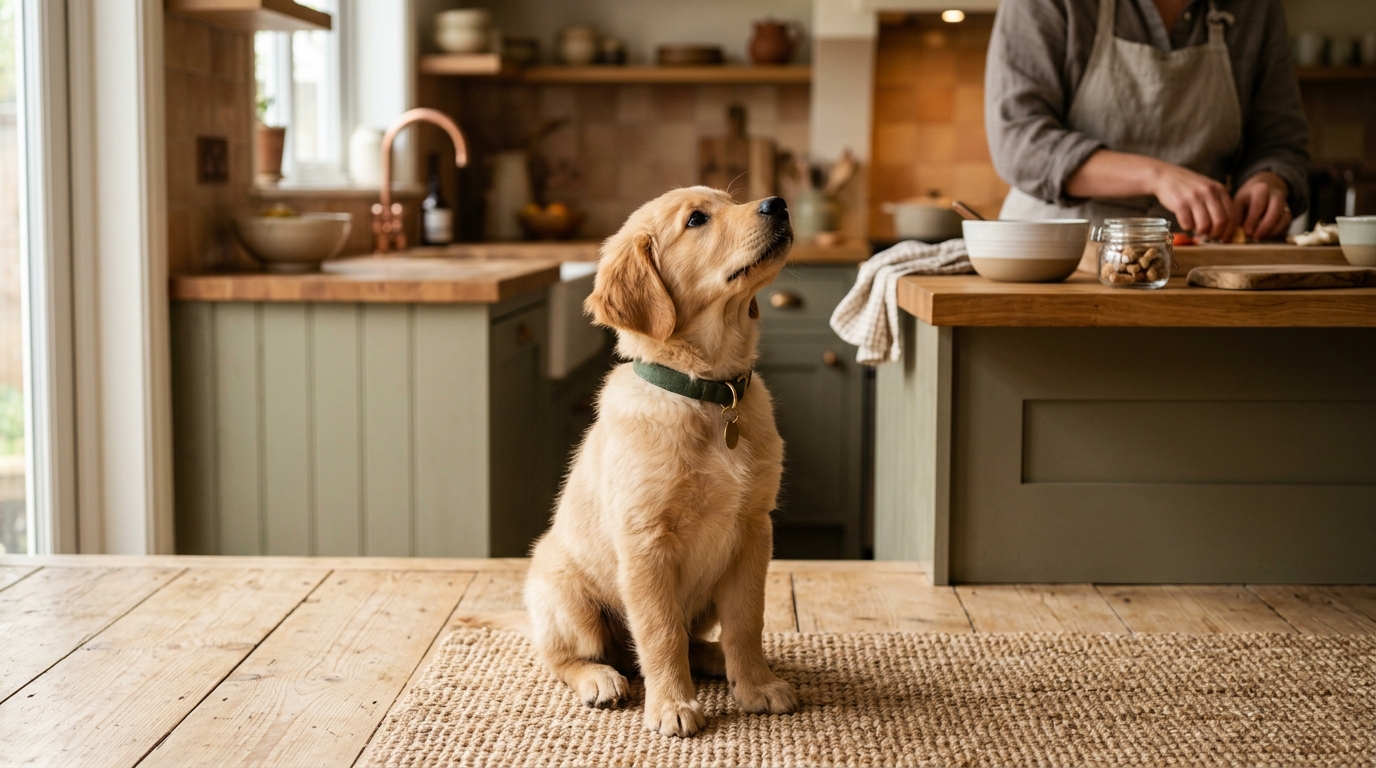
The management-first rule (the part most owners skip)
Management has to come before training here because counter surfing is self-reinforcing. Every theft that happens during the training period resets progress. You can't out-train a behaviour that's actively rewarding itself faster than your sessions can counter it.
Three things make up solid kitchen management.
Clear the bench as a non-negotiable habit. Nothing of value left at nose height or reachable by jumping. This removes the variable that makes the behaviour rewarding. The bench needs to be boring. A dog who checks a surface and finds nothing interesting will eventually stop checking.
Physical barriers when you can't supervise. A baby gate or closed kitchen door when cooking is happening or when you're not watching. It interrupts the habit loop before the reward occurs, stopping the behaviour from practising itself while you build the replacement.
Teaching the alternative behaviour
The replacement behaviour is a solid settle on a mat, a specific spot in or near the kitchen that your dog defaults to when you're cooking. The reason mat work is the right tool here is that it's physically incompatible with counter surfing. A dog lying on their mat cannot simultaneously have their paws on the bench.
You're occupying the dog with something that makes the problem behaviour impossible.
Building the behaviour happens in stages. Start by introducing the mat outside the kitchen with no distractions. Guide or lure the dog onto it, mark the moment all four paws are on it, reward. Repeat until they're offering the mat voluntarily when it appears. Then add duration, reward them for holding position before releasing with a word like "free."
Once the mat is solid in a low-stakes environment, introduce it into the kitchen. Then proof it against cooking activity. A frozen Kong at that point earns its place, it gives the dog something to do on the mat that has genuine value, and it keeps them there through real kitchen action.
The mat should never be framed as "go away." It should be a good place to be. High-value rewards happen there. Over time, the dog gravitates toward it because the mat has learned to produce more reliable rewards than the bench does. This mat and settle approach is one of the foundations of the Complete Puppy Program, where we build it from eight weeks before the habit has a chance to form.
What to do in the moment you catch them
The principle is redirect, not react.
When you catch your dog mid-attempt, paws on the bench, nose heading toward the surface, the goal is to interrupt the sequence calmly and redirect to the mat, without escalating the situation. There's no need to say anything, the interrupt is entirely physical. Move in calmly and steadily, no calling out, no rushing, closing the gap between the dog and the bench with your body until they back off or turn away on their own. If they've already got hold of something, take the collar with a calm, unhurried grip and guide them away, the same wordless approach used to redirect chewing.
From there, lead the dog to their mat and settle them. Mark and reward once they arrive, that reinforces the redirect itself, not the interrupt. You're reinforcing the whole chain, left the bench, moved with you, went to the mat. That full sequence, delivered silently from start to finish, is what you want the dog to default to. Once they're settled, disengage calmly, no praise voice, no eye contact, just calm withdrawal.
Avoid shouting, chasing the dog away, or making the interaction dramatic. High drama creates arousal at exactly the moment you're trying to establish a calm default behaviour.
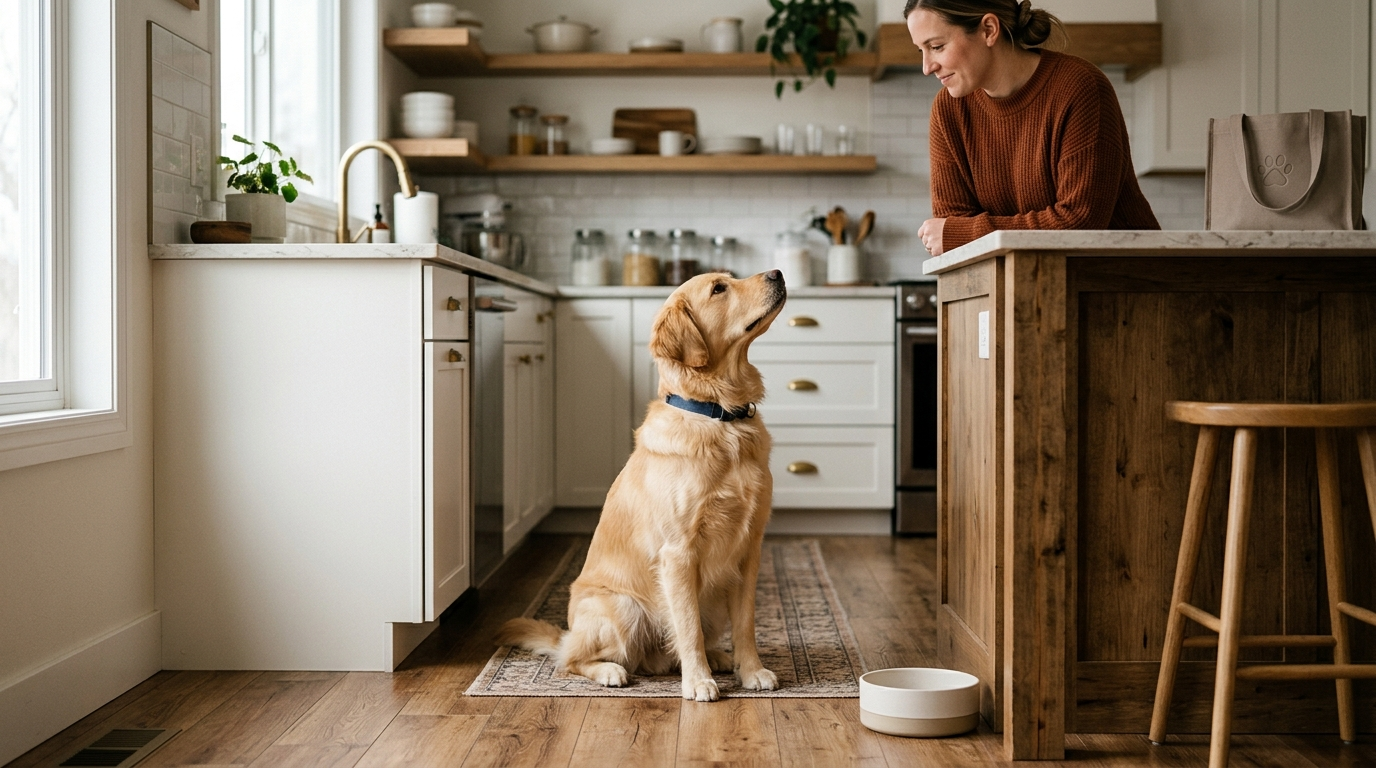
When counter surfing becomes a bigger problem
Counter surfing on its own is a management and training issue. It becomes something else when the behaviour around food escalates beyond the act of stealing.
Watch for guarding of the bench or kitchen area: stiffening when you approach during cooking, blocking behaviour, a hard stare or low growl. This is the dog not just taking food of opportunity but starting to claim the space as a resource. That's a different problem with a different protocol, see our guide to resource guarding in puppies for the early signs and fix.
Any growling or snapping if you interrupt mid-steal is a signal to get professional support before continuing the training work. A dog that shows teeth or makes contact when you remove food has moved into resource guarding, and that warrants an assessment.
The same applies if the behaviour involves children. If a dog is guarding food in any form with children nearby, treat it as a safety issue and book a session. The adult dog training sessions at The Toe Beans Co are structured specifically for these cases, an in-home session means the trainer sees the actual environment, the actual triggers, and the real household dynamic.
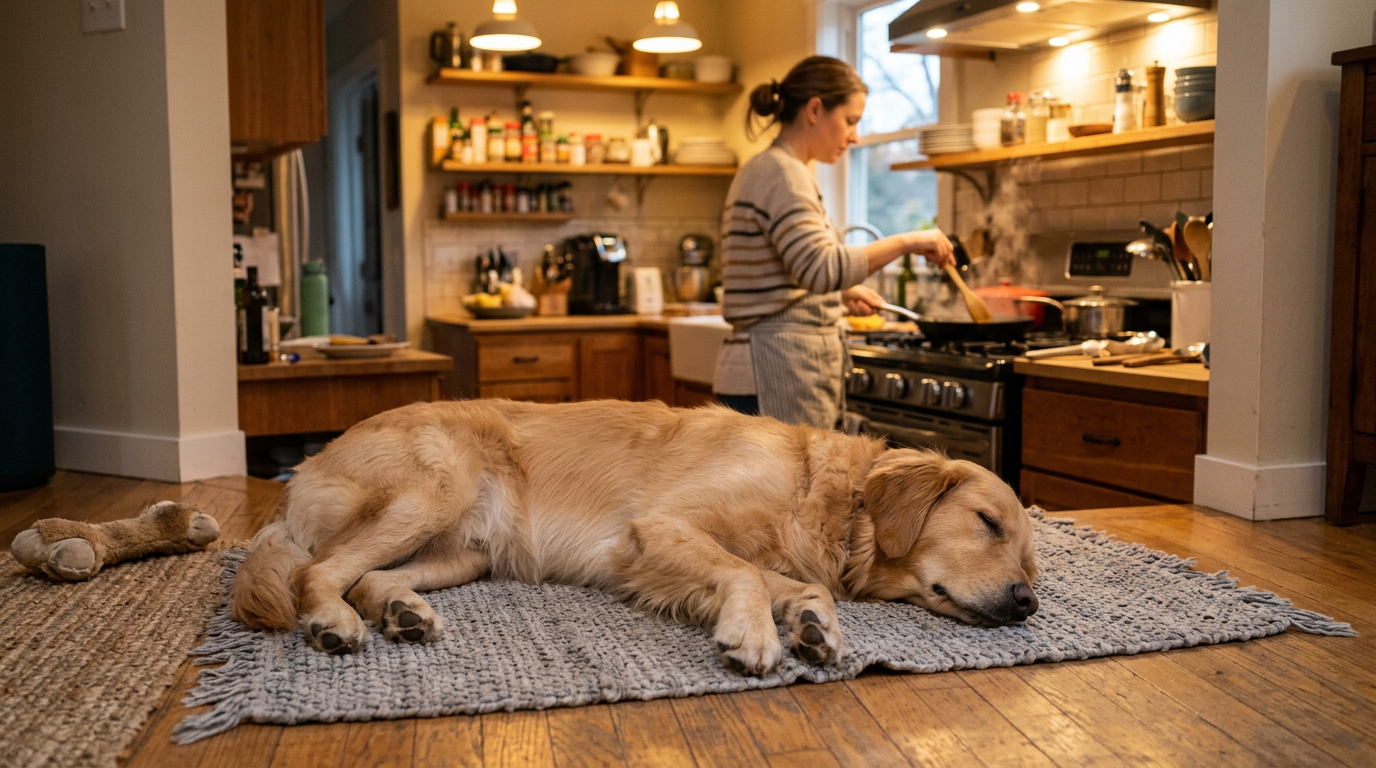
Want help putting this into practice?
The Toe Beans Co runs a free SKOOL community where Sydney dog owners get access to training guides, Q&As, and direct support from Luke. It's free to join.
Frequently asked questions
How long does it take to stop counter surfing?
With consistent management and daily mat work, most dogs show clear improvement within two to three weeks. The key is that management and training have to run at the same time. Every theft that happens during the training period resets progress, so clearing benches and using barriers when unsupervised isn't optional, it's the foundation the training sits on.
Will a citronella collar or scat mat fix it?
These are aversive tools and they don't address the root cause. A scat mat deters access to a specific surface but doesn't teach the dog what to do instead, the behaviour often migrates to another surface, or reappears when the mat is removed. At The Toe Beans Co, we don't use pain, fear, or discomfort in our training. There are more effective approaches available that don't carry the risk of creating anxiety around kitchen spaces or your dog around you.
My dog only does it when I'm not in the room. What now?
That's actually the most common pattern. The dog has learned that counter surfing is safe when you're absent. The fix isn't trying to catch them, it's removing the opportunity when you're not there (barriers, cleared benches), and conditioning a default mat behaviour so strongly that it happens whether you're watching or not. Consistency in the routine matters more than surveillance.
