September is when most Sydney puppies come home. A spring puppy in Sydney also gets the most disrupted fifteen weeks of the year, and almost nobody accounts for that when they choose a litter. Collect a puppy in the first week of September and it's roughly twenty-four weeks old on Christmas Day, which means its socialisation window shuts over the holidays. Luke Buchanan, Owner of The Toe Beans Co and Sydney's Puppy Trainer, sees the result every February: puppies that were fine in October come back wary of the front door, unsure about men in hats, and unwilling to walk past the neighbour's bins. That isn't bad luck. It's a calendar problem, and it's the one thing about spring puppies nobody mentions.
What actually changes outdoors in a Sydney spring
Spring adds three things to a Sydney puppy's environment that weren't there in winter: seeding grass, paralysis ticks, and ground heat that arrives earlier in the day than you'd expect.
Grass seeds are the one owners underestimate. Through October and November the long stuff at the edge of every oval goes to seed, and those seeds are shaped to travel one way only, which is inward. They lodge between toes, in ears, under eyelids. A puppy's whole world sits at ankle height, so it doesn't walk past the long grass. It walks through it.
Paralysis ticks are active along the east coast from spring into summer. Prevention is your vet's call. The nightly check is yours, and that's where it stops being admin and becomes training. Run your hands over the whole puppy every evening, ears, armpits, between the pads, while it's tired and settled. Ten weeks of that and you've conditioned a dog that tolerates being handled by a vet or a groomer, which is worth more than the tick check itself.
Heat is the third, and it's underfoot before it's in the air. If you can't hold the back of your hand on the footpath for seven seconds, walk on grass or walk at dawn. All of it is habituation material if you use it deliberately, which is what a structured socialisation checklist is for.
Daylight saving moves the evening walk, so move the routine first
Daylight saving starts on the first Sunday in October, the 4th this year, and a puppy's routine should shift in the week before it rather than the week after.
Every year I get the same messages in the second week of October. An hour is nothing to an adult and quite a lot to a twelve-week-old that eats, sleeps and toilets on a rhythm. Shift feeding, naps and the last toilet break by ten or fifteen minutes every second day from around the 28th of September. Do nothing and you get 5am starts and toilet accidents that look like a training regression and aren't one.
The bigger change is what the evening walk turns into. Suddenly it's light until eight, and every park in Sydney fills between six and seven thirty. Skateboards, joggers, kids on scooters, bats going over at dusk. That's a different world from a three o'clock winter walk, and it arrives all at once. Keep the length honest while it does: five minutes of on-lead exercise per month of age, twice a day, and rough play counts towards the total. A puppy over its threshold learns nothing except that the park is too much. The puppy daily routine post lays the blocks out properly.
The socialisation maths: count forward from your pickup date
The socialisation window closes at six months, so add sixteen weeks to the day you collect your puppy at eight weeks old and you have the date it shuts. Do that arithmetic first, because spring pickups land very differently depending on the fortnight.
| Puppy home at 8 weeks | Age on Christmas Day | Socialisation window remaining |
|---|---|---|
| Early September | About 24 weeks | Almost none. It closes over the holidays. |
| Early October | About 20 weeks | Around 4 weeks, all of it in the Christmas period |
| Early November | About 16 weeks | Around 8 weeks, most of it in January |
| Late November | About 11 weeks | Around 13 weeks, but the busiest ones come first |
The late-November puppy still has most of its window intact, but the opening month of it runs through the most crowded weeks of the year. The early-September puppy has the reverse problem: by the time the family is off work, the window has gone.
Group classes have their own gate. The Toe Beans Co requires the second vaccination to be completed, or proof that it's imminent, and that usually falls in the 12 to 14 week range. In our experience it's commonly 12. Your vet sets that schedule, not us. So a puppy home in early September can be in a class by mid-October, while one home in mid-November probably won't start until January. Work at home carries no such constraint, because no other dogs are involved. There's a fuller breakdown in the post on what vaccinations a puppy needs before puppy school.
The Christmas problem: a full house at the wrong moment
A house full of unfamiliar visitors is the most concentrated socialisation opportunity of the year, and it's the one most owners get wrong, because volume isn't the same thing as exposure.
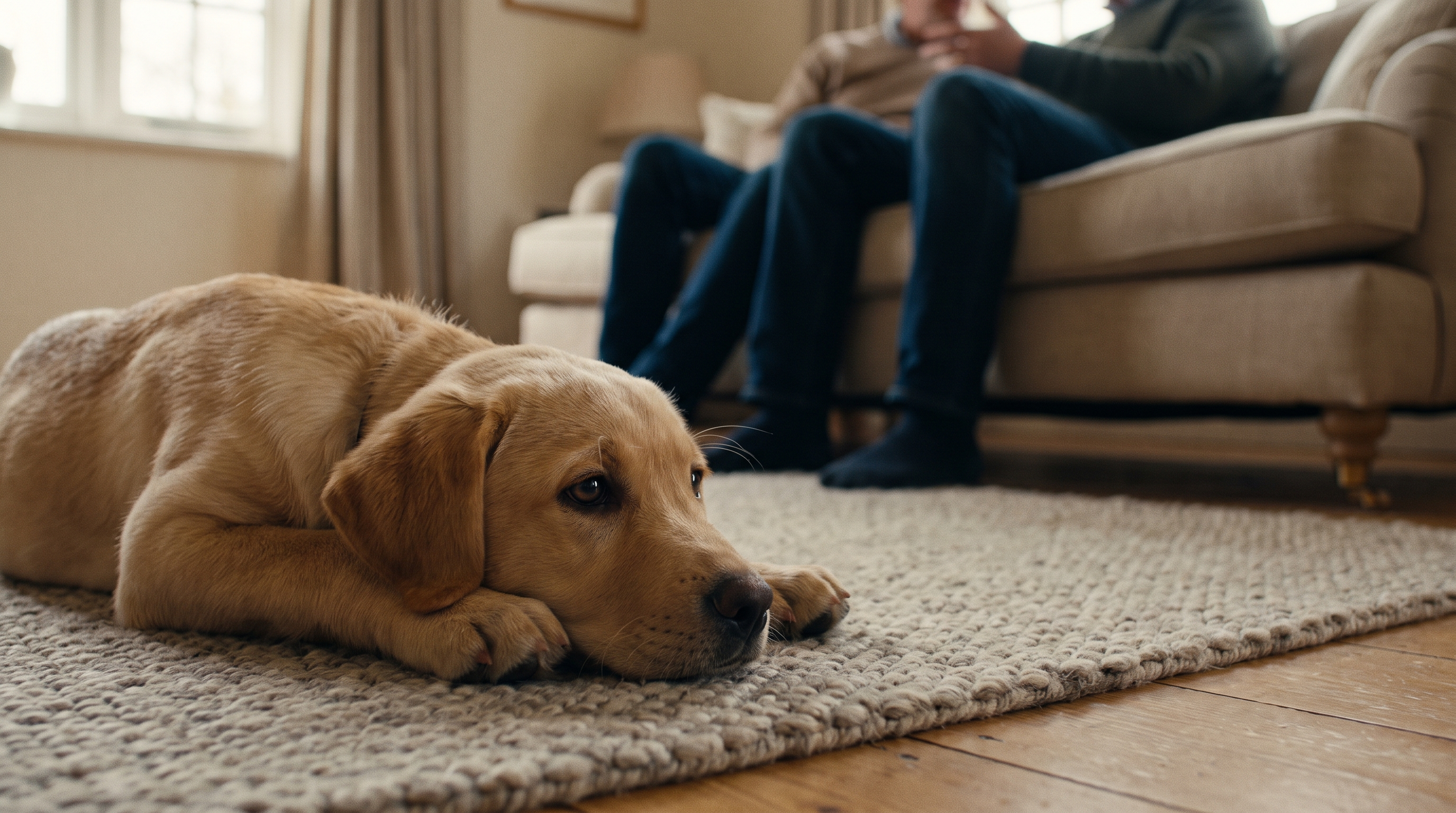
Puppies move through sensitive developmental stretches where something they walked past happily in October can genuinely worry them in December. You get no warning, just a puppy hesitating at something it had already accepted, and your response decides which way it settles.
Christmas Day stacks the odds against you. Twelve people, most of them strangers. Children at eye level, a doorbell going all afternoon, everyone wanting a turn holding the puppy. In a sixteen-week-old that produces an aroused, over-threshold animal, and over threshold just means past the point where calm behaviour is available to it. My January intake is reliably full of dogs that were fine in November and are now suspicious of the front door. Almost every one of them had a big Christmas.
The signs are specific. The puppy stops taking food it would normally take, the mouthing turns frantic rather than playful, or it goes quiet and flat, which owners read as settled and usually isn't. Handling that is the handler's job. Deciding whether something is a threat is a job you take off the puppy, not one you leave sitting with it. So:
- Brief people at the door before they're through it. Nobody approaches the puppy, reaches for it, or picks it up. If they want to say hello, they call it over and let it choose.
- Gate the puppy away while everyone arrives, then bring it through on a short line once people are seated and the noise has dropped. Book naps in like appointments through the day.
- When something worries it, stay neutral. Don't soothe and don't crouch to reassure. Turn your back on whatever set it off. Your reaction is the puppy's evidence about whether the thing mattered. Affection afterwards, once it's calm.
What to do about all of it
Nearly all of this gets solved in October, not on the 24th of December.
- Work out your two dates: the day the window closes, and the first day a group class is open to you.
- Book the class before the puppy is home. Spring is the busiest enrolment stretch of the year.
- Front-load the people. Get the unfamiliar humans done across October and November, in ones and twos, on your terms. Then December is revision rather than first exposure, and that difference is the whole thing.
- Move the routine in the last week of September, before the clocks do.
- Build the settle spot in November, while the house is still quiet, and do the grass seed and tick check nightly as handling practice.
- Tell the family the rules before they arrive, not while they're bending over your puppy.
If you're collecting a puppy this month, the intake you want is almost certainly an October or November one. You can check current puppy school dates and enrol against your own pickup date.
Want help putting this into practice?
The Toe Beans Co runs a free SKOOL community where Sydney dog owners get access to training guides, Q&As, and direct support from Luke. It's free to join.
Upcoming puppy schools in Sydney
Luke runs regular puppy schools across Sydney, with venues in Paddington, Edgecliff, Zetland, Alexandria, Marrickville and Neutral Bay. All six are taking bookings, and anyone in Sydney can attend any location.
Check upcoming dates and book your spot →
Frequently asked questions
Is spring a good time to get a puppy in Sydney?
Spring is a good time to get a puppy in Sydney provided you plan around Christmas, because a spring puppy spends its socialisation window in the busiest stretch of the year. October and November make outdoor exposure easy. December is the risk, when the house is fullest and the family least available to train.
When can a spring puppy start puppy school in Sydney?
A puppy can join a group puppy school in Sydney once its second vaccination is complete, or there's proof it's imminent, usually in the 12 to 14 week range. A September puppy is generally in class by mid-October. Training at home can start the week the puppy arrives, because no other dogs are involved.
What should I do with my puppy on Christmas Day?
Keep your spring puppy out of the arrivals, then bring it in on a short line once visitors are seated. Brief everyone not to approach, reach for or pick up the puppy, and let it choose whether to come. Schedule naps through the day, and stay neutral rather than soothing if something worries it.